
The proposal to ‘buy’ Greenland was not merely a diplomatic faux pas; it was a symptom of a worldview that imagined international relations as a real estate deal. In this imagination, land was undervalued, leaders were negotiable, and history itself could be reset with a sufficiently aggressive offer
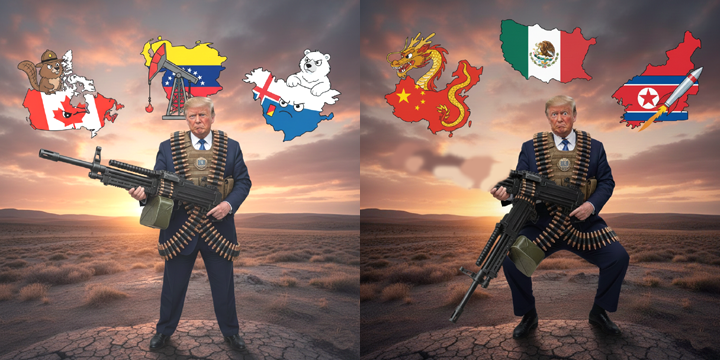
History has a way of compressing loud moments into small footnotes. What feels seismic while it is happening often settles, with the passage of time, into a mere contour on a long landscape. Venezuela, Greenland, Canada—these names, strung together with the theatrics of the Trump era, sound today like fragments of an unfinished boast. They evoke a period when American power was spoken of in the language of acquisition and leverage, when geography itself was treated as a negotiable asset, and when headlines flirted with ideas that once belonged to nineteenth-century imperialism. Yet when history finally writes its calmer account, Donald Trump is unlikely to appear as a great territorial re-engineer of the world. He will register, instead, as a bump—noisy, disruptive, unmistakable, but ultimately incapable of altering the deeper tectonic plates of global order.
The Trump years revived an old fantasy: that power could once again be exercised through blunt transactions, territorial bargains, and coercive bravado. The suggestion to “buy” Greenland was not merely a diplomatic faux pas; it was a symptom of a worldview that imagined international relations as a real estate deal. In this imagination, land was undervalued, leaders were negotiable, and history itself could be reset with a sufficiently aggressive offer. That Greenland belongs to Denmark, that its people possess agency, that sovereignty in the twenty-first century is not a for-sale sign—these were inconveniences brushed aside in favor of spectacle. The idea collapsed under its own absurdity, but it revealed something deeper: a nostalgia for a world where power could be demonstrated by annexation rather than influence.
Venezuela occupied a different place in this imagination. It was not a property to be bought, but a problem to be solved, a regime to be toppled, an oil-rich state whose collapse seemed to invite intervention. The rhetoric was muscular, sanctions were sharp, and recognition was bestowed on an alternative leadership with theatrical confidence. Yet the outcome was familiar. The regime endured, the people suffered, and the United States discovered once again that overthrowing governments is easier in speeches than in reality. Venezuela did not become an American protectorate, nor did it become a democratic showcase. It became, instead, another reminder that power constrained by global opinion, regional politics, and internal resistance does not translate easily into decisive outcomes.
Canada’s inclusion in this triad is perhaps the most revealing. Canada was never a target for annexation in any literal sense, but it became a rhetorical foil. Trade wars, tariff threats, and casual insults replaced the quiet diplomacy that had defined one of the world’s most stable bilateral relationships. The message was clear: no ally was too close to be pressured, no agreement too sacred to be reopened. Yet even here, the limits were evident. Canada did not bend into subservience, nor did it fracture. The renegotiation of trade agreements produced incremental changes, not imperial submission. The border remained where it always was, invisible and mundane, a testament to the resilience of institutions over personality.
These episodes share a common thread: the gap between ambition and capacity. Trump’s rhetoric suggested a willingness to redraw maps, to coerce nations, to revive a raw version of American dominance. But rhetoric is not reality. The modern world is dense with constraints—legal, economic, diplomatic, and moral. Annexation is no longer a simple act of marching armies or signing decrees. It invites sanctions, resistance, insurgency, and long-term instability. Even superpowers must calculate costs that far outweigh symbolic gains. Trump, for all his bravado, operated within a system that limited him far more than he acknowledged.
This is where the comparison with Mexico, China, and North Korea becomes instructive. These are not marginal states, nor are they vulnerable in the ways Trump’s rhetoric seemed to prefer. Mexico is deeply entwined with the United States economically, demographically, and culturally. Any serious attempt to “annex” or fundamentally coerce Mexico would detonate the American economy, fracture society, and ignite a conflict with consequences measured in generations. China, meanwhile, represents not just a nation but a civilizational power with economic, technological, and military depth. North Korea, isolated and belligerent, possesses nuclear weapons precisely to deter the kind of coercion Trump’s language flirted with. Against these realities, bravado dissolves. The guts required are not merely personal courage but a willingness to absorb catastrophic costs. No American president, Trump included, possesses that mandate.
Trump’s posture toward these states exposed a paradox. He spoke loudly about strength, yet avoided the arenas where strength would be truly tested. Trade wars substituted for military confrontation with China. Personal diplomacy substituted for strategic resolution with North Korea. Threats substituted for policy with Mexico. This was not cowardice in a personal sense, but prudence forced by structure. The system would not allow reckless escalation without consequence, and Trump, despite his rhetoric, consistently stepped back from the edge when consequences loomed too large.
History, therefore, will likely see Trump not as a transformative imperial figure but as a stress test. He tested the elasticity of alliances, the patience of institutions, and the tolerance of norms. Some frayed, some bent, but few broke. Greenland was not bought. Venezuela was not captured. Canada was not subdued. Mexico was not annexed. China was not contained. North Korea was not neutralized. The maps remained unchanged, even as the noise was deafening.
This does not mean the period was inconsequential. Bumps can bruise. Trump’s era normalized a language of contempt toward diplomacy, elevated transactionalism over trust, and encouraged other leaders to test boundaries. It weakened the moral authority of the United States even as it amplified its volume. It signaled to the world that America’s commitment to rules could be conditional, that its alliances could be leveraged, and that its rhetoric could outpace its resolve. These are not trivial effects. They shape perceptions, embolden rivals, and unsettle partners.
Yet perception is not permanence. Institutions, both domestic and international, absorbed the shock. Courts constrained executive impulses. Bureaucracies slowed radical departures. Allies adapted, hedged, and waited. Adversaries probed but did not overturn the order. When the noise receded, the structures remained. That endurance is precisely why history will compress the moment. Trump will appear as an anomaly, a deviation from trend rather than its author.
The irony is that true annexation today is rarely territorial. Influence is exercised through supply chains, standards, technology, finance, and culture. China understands this far better than Trump ever did, expanding its reach not by planting flags but by building dependencies. The European Union exerts power through regulation rather than conquest. Even the United States, at its most effective, has shaped the world through institutions, markets, and ideas. Trump’s fixation on the visible symbols of power—land, borders, deals—missed the quieter mechanisms that actually move history.
In that sense, the bravado about guts is misplaced. The absence was not courage but comprehension. Understanding the world as it is requires accepting limits, trade-offs, and complexity. It requires patience rather than spectacle. Trump preferred the drama of threat to the discipline of strategy. That preference ensured that his ambitions would remain theatrical rather than transformative.
When future historians write of Venezuela, Greenland, and Canada in the context of the Trump years, they will likely do so with a tone of bemused disbelief. They will note the headlines, quote the statements, and then move quickly to the outcomes—or lack thereof. The real story will not be about annexation but about the resilience of a world order that, for all its flaws, resisted regression to a cruder age.
In the end, Trump’s place in history will resemble a pothole on a long road. Drivers remember the jolt, curse the moment, and then continue on their journey. The road itself remains. Venezuela continues its tragic struggle, independent of American fantasies. Greenland remains Greenland, its future tied to its people and the Arctic’s changing climate, not to a property ledger. Canada remains Canada, quietly confident in its sovereignty. Mexico, China, and North Korea remain formidable precisely because they sit beyond the reach of theatrical power.
History is unsentimental. It measures not volume but effect. And measured by effect, the Trump era’s flirtations with annexation and domination shrink rapidly. What remains is the lesson: that in a tightly interconnected world, the loudest claims often leave the smallest marks.