
Why a country like India with abundant human capital, strategic geography, and rising export ambitions still struggles to make its free trade and special economic zones truly competitive
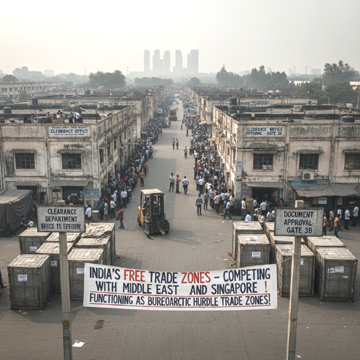
In economic theory, Free Trade Zones (FTZs) and Special Economic Zones (SEZs) represent powerful policy instruments to catalyze exports, attract foreign direct investment (FDI), and create jobs. They are conceived as regulatory sanctuaries ‒ places where duties, tariffs, and red tape are minimized, and where logistics and customs processes operate with maximum speed and efficiency. In several global examples, particularly in the Middle East and Singapore, such zones have become thriving hubs of global commerce, attracting multinational corporations with world-class infrastructure, seamless regulatory frameworks, and integrated supply-chain connectivity. Yet in India, despite high expectations and repeated policy revisions, the reality has been underwhelming. More often than not, India’s FTZs operate less like liberalized economic enclaves and more like “bureaucratic hurdle trade zones” — full of regulatory friction, infrastructure gaps, and persistent governance challenges.
This article examines why that disconnect exists — why a country with abundant human capital, strategic geography, and rising export ambitions still struggles to make its free trade and special economic zones truly competitive.
1. The Promise vs. The Reality: What Free Trade Zones Should Be
In their ideal form, Free Trade Zones help businesses:
- defer or eliminate customs duties on imported goods stored for re-export;
- perform value-added activities (sorting, packaging, repackaging, light assembly) in a duty-free environment;
- operate with minimal bureaucratic intervention in customs clearances and logistics;
- integrate seamlessly with global manufacturing and distribution networks;
- attract FDI by offering stable regulatory frameworks, tax incentives, and efficient logistics.
Singapore and Middle Eastern zones like Jebel Ali Free Zone (JAFZA) exemplify many of these features. Singapore’s FTZs — spanning ports, airports, and designated warehousing districts — offer duty and GST deferment, faster customs clearance, and the ability to perform value-added processes, all under streamlined digital systems. These advantages directly improve cash flow for companies and reduce operational costs.
Similarly, Middle Eastern free zones, particularly in the United Arab Emirates (UAE), offer 100% foreign ownership, zero corporate tax for decades, fully repatriable profits, and direct connectivity to major global shipping corridors. JAFZA, for example, hosts thousands of companies from scores of countries, leveraging infrastructure directly integrated with one of the world’s busiest ports.
These are the benchmarks — zones built not just on fiscal incentives but on efficient execution, predictable regulation, and logistical excellence.
2. India’s Free Trade Zone Framework: Structure and Intent
India’s attempt to harness the benefits of free trade environments is rooted in two main policy instruments:
- Free Trade Warehousing Zones (FTWZs) — created to combine warehousing and bonded facilities to facilitate import-export businesses without immediate customs duties, and
- Special Economic Zones (SEZs) — broader economic enclaves with tax incentives aiming to boost exports and manufacturing.
Both are governed under the SEZ Act (2005) and Rules (2006) and aim to enable duty-free import/storage of goods, processing, and eventual export. FTWZs were envisioned to leverage India’s strategic location and logistics potential to become global distribution hubs.
On paper, this resembles the free zone model in Singapore or the Gulf. Yet the similarities largely end at the conceptual level.
3. Bureaucracy and Regulatory Complexity: A Defining Constraint
Multi-Agency Red Tape
Far too often, instead of simplification, India’s FTZ and SEZ regime places businesses at the mercy of multiple overlapping authorities — customs, commerce, state departments, and varied ministries. Despite “single-window clearance” promises, businesses report delays, conflicting requirements, and repeated audits across agencies.
FTWZ operators, for example, cite specific procedural bottlenecks such as:
- lack of a consolidated, clear-cut policy framework governing how FTWZ transactions interact with customs systems;
- limited knowledge among regulatory officials about the FTWZ policy;
- absence of integration between the SEZ portal and ICEGATE customs platform, causing avoidable delays.
This is not just inefficiency — it deters investors. Where Singapore’s customs systems are standardized and highly automated, reducing paper trails and processing time, India’s remain fragmented and manual in many places.
Approval Timelines that Stretch and Stretch
Foreign investors and exporters looking at India’s zones often find themselves grappling with unpredictable timelines for approvals. While foreign zones may offer company setup in days or weeks, Indian FTZ and SEZ clearances — including land use, environmental permissions, and labor clearances — can drag on for months due to inter-departmental coordination issues.
These delays echo broader challenges in doing business in India’s trade ecosystem — hurdles that global competitors have deliberately streamlined through digital transformation and clear statutory timelines. The weight of bureaucracy thus turns India’s FTZs into paper-driven regulatory mazes, not bridges to global markets.
4. Infrastructure Deficit: A Hidden Cost of Trade
One of the most glaring weaknesses of India’s FTZ landscape is infrastructure gaps — especially in logistics connectivity.
Singapore’s FTZ infrastructure is world-class: its ports, airports, warehousing, and customs processes are designed for speed and efficiency, minimizing dwell time for cargo and facilitating quick re-exports.
Indian zones, by comparison, face persistent issues:
- Inadequate road/rail linkage to ports — goods must sit in transit yards for longer, increasing costs.
- Port congestion and customs bottlenecks — container clearance times are longer than benchmarks in ASEAN and GCC countries.
- Fragmented warehousing outside major metros — and uneven cold chain or value-added processing facilities.
The result: Indian exporters often incur higher logistics costs and slower throughput than competitors in China, Vietnam, Singapore, or UAE. These hidden costs compound bureaucratic delays, making India’s FTZs less attractive for global companies that could otherwise benefit from faster turnaround and lower inventory costs.
5. Limited Integration with domestic markets
Ideally, economic zones not only boost exports but also integrate with the domestic economy — through backward linkage with local suppliers, technology transfers, and jobs outside the zone.
In India, however, many zones operate as isolated enclaves with restricted domestic market access. SEZ rules often require high duties on goods destined for the Domestic Tariff Area, making it uncompetitive for units to sell into the Indian market without additional paperwork and costs.
By contrast, Middle Eastern zones often serve as regional gateways, allowing companies to bridge markets in Africa, Europe, and Asia with ease. Similarly, Singapore’s FTZ ecosystem, though oriented outward, thrives because businesses use it as a hub for both transshipment and regional distribution, not as an isolationist export enclave.
India’s zones, in contrast, are handicapped by this duality — not fully integrated domestically, nor seamlessly connected to broader global value chains.
6. Underutilization and Policy Inconsistency
India’s SEZ story is also marked by vast underutilization and slow gestation. A significant number of approved SEZs remain non-operational or partially developed, indicating mismatches between planning and demand.
Moreover, policy changes — such as the withdrawal of certain tax incentives or modifications in SEZ regulations — introduce policy uncertainty that dampens investor confidence. Investors often value predictability over marginal fiscal perks; what matters most is a stable regime with clear long-term rules, something that many free zones abroad prioritize.
7. Competitive Comparisons: India vs. Middle East and Singapore
Middle East: Connected, Competitive, and Pro-Business
Free zones in the Middle East, such as Jebel Ali, exemplify strategic infrastructure + efficient regulation. JAFZA’s integrated positioning with one of the region’s largest ports and its multimodal logistics network enables companies to reduce transit times and costs significantly — a critical factor for trade-oriented businesses.
Additionally, free zones in the UAE offer features like 100% foreign ownership, long-term tax exemptions, repatriability of profits, and streamlined business setup procedures.
These structural features are complemented by investor-oriented policies and aggressive investment promotion — an ecosystem approach rather than a fragmented policy.
Singapore: Efficiency and Global Connectivity
Singapore’s FTZs are globally respected not because they are tax-free alone, but because they eliminate friction in trade flows — customs procedures are predictable, documentation minimal, infrastructure top-tier, and logistics optimized for global distribution.
Crucially, Singapore has turned its entire city-state into a free trade environment — all import/export points operate under a coherent, standardized framework that avoids jurisdictional patchwork.
8. What’s Holding India Back? A Synthesis
The underperformance of India’s free trade zones stems from several structural issues:
- Excessive Bureaucratic Layers — Even in zones designed to reduce red tape, outdated manual processes and multiple regulatory bodies still hinder speed and efficiency.
- Infrastructure Deficiencies — Inefficient logistics — roads, ports, rail, customs — increase cost and time, eroding the competitive advantage zones are supposed to offer.
- Policy Uncertainty — Frequent changes in incentive regimes and unclear long-term frameworks create investor hesitation.
- Poor Integration with Economy — Zones are often isolated from domestic markets and suppliers, reducing spillovers into broader industrial growth.
- Low Utilization and Execution Gaps — Many zones remain underdeveloped or fail to attract early-stage investment due to planning versus actual demand disconnects.
Thus, instead of acting as catalysts for efficient trade and investment, India’s FTZs and SEZs often replicate the bureaucratic hurdles that plague the wider economy — long waits, complex compliance, and uncertain outcomes.
9. The Path Forward: Reforms and Strategies
Addressing these challenges will require systemic reform:
Streamline and Digitize Processes
India needs to accelerate digital integration between SEZ/FTWZ portals and customs/ICEGATE systems, reduce paperwork, and enforce strict timelines for approvals and clearances.
Infrastructure Prioritization
Investment in logistics corridors, cold chains, and direct port connectivity must become a priority, with targeted upgrades around FTZ and SEZ clusters.
Policy Stability and Clarity
Stable, long-term policy frameworks with predictable tax and regulatory regimes would encourage long-term investment decisions.
Domestic Linkage Incentives
Allowing smoother access to the domestic market (easing duties, facilitating job work) could make zones more viable and better linked to India’s broader economic goals.
Enhanced Promotion and Global Positioning
India must better market its zones globally, not just as low-cost enclaves but as strategically connected, business-friendly hubs with reduced friction and clear governance.
10. Just on paper
On paper, India has the potential to establish FTZs and SEZs that rival Singapore or Middle Eastern hubs. Its strategic location, market size, and rising industrial capacity suggest enormous latent potential. But potential alone is not enough.
Where competitors have moved decisively toward efficiency, connectivity, and investor-oriented governance, India has often remained mired in the very bureaucratic hurdles it sought to eliminate. Without concerted reform — in regulation, infrastructure, and execution — India’s free trade zones risk remaining what critics call bureaucratic hurdle trade zones rather than engines of global commerce. To unlock their true value, India must shift from a compliance-centric mindset to a performance-centric trade strategy — one that embraces speed, integration, and simplicity not just in theory but in day-to-day execution.