Drones point toward a world in which wars are fought faster, deeper, and more ambiguously, with escalation risks shifted from human casualties to algorithmic miscalculation
For over a century, air power was inseparable from the human body. The limits of flesh—fear, fatigue, training time, political risk—defined how wars were fought in the skies. That era is ending. The battlefield of tomorrow is no longer dominated by manned fighters alone but by Unmanned Combat Aerial Vehicles (UCAVs), machines designed to penetrate airspace that would be politically, morally, or tactically unacceptable for human pilots. These aircraft do not replace humans so much as they displace them from danger, from decision loops, and increasingly from visibility itself.
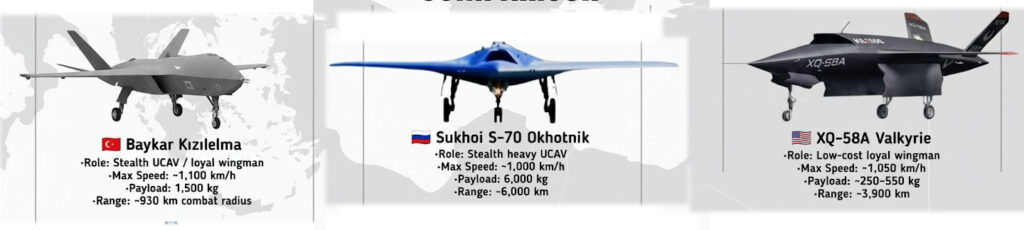
The rise of “Loyal Wingmen” and heavy stealth UCAVs marks a structural change in warfare comparable to the introduction of tanks or submarines. These systems are not merely drones in the counterterrorism sense; they are autonomous or semi-autonomous strike platforms intended for peer and near-peer conflict. Turkey’s Baykar Kızılelma, Russia’s Sukhoi S-70 Okhotnik, and the United States’ XQ-58A Valkyrie represent three distinct philosophies of future war—speed and nationalism, brute stealth and payload, and scalable mass and attrition economics.
Together, they point toward a world in which wars are fought faster, deeper, and more ambiguously, with escalation risks shifted from human casualties to algorithmic miscalculation.
From remote-controlled drones to autonomous combat systems
The early drone wars of the 2000s and 2010s were asymmetric. Predator and Reaper drones hunted insurgents who had no air defenses, no electronic warfare, and no political leverage. Those systems were extensions of surveillance capitalism and counterinsurgency, not true instruments of high-end war. The new generation of UCAVs is different. They are built from the ground up to survive in contested airspace filled with surface-to-air missiles, electronic jamming, cyber intrusion, and enemy fighters.
This shift mirrors a broader reality: major powers now expect future wars to be short, intense, and technologically saturated. Human pilots are expensive, politically sensitive, and increasingly vulnerable. Training a fifth-generation fighter pilot can take a decade and cost tens of millions of dollars. Losing one risks not only life but escalation, propaganda defeat, and domestic backlash. Losing a drone risks embarrassment, not funerals.
As a result, air forces are reorganising around mixed formations in which manned fighters act as command nodes while UCAVs perform the most dangerous tasks—penetration, decoy, electronic attack, and first-wave strike.
Turkey’s Baykar Kızılelma and the rise of middle-power air power
Turkey’s Baykar Kızılelma is not merely a weapons platform; it is a statement of strategic independence. Designed as a stealth UCAV capable of operating from short runways and potentially aircraft carriers, Kızılelma reflects Ankara’s ambition to be a regional military power unconstrained by Western export controls.
With a top speed approaching 1,100 km/h, a payload of roughly 1,500 kg, and a combat radius of around 930 km, Kızılelma occupies a unique niche between traditional drones and manned fighters. It is fast enough to survive modern air defenses, stealthy enough to penetrate them, and autonomous enough to fly alongside Turkey’s F-16s and future indigenous fighters.
In a hypothetical Eastern Mediterranean conflict—over Cyprus, gas fields, or contested airspace—Kızılelma would likely fly ahead of manned aircraft, probing Greek or allied radar coverage, triggering air defenses, and striking high-value targets such as radar stations and command nodes. In Syria or Iraq, it allows Turkey to conduct deep strikes without risking pilots or diplomatic escalation tied to casualties.
More broadly, Kızılelma signals a future in which middle powers no longer accept technological inferiority. By mastering UCAVs, states like Turkey, Iran, and South Korea can punch far above their traditional weight, reshaping regional balances without matching the full-spectrum air forces of the United States or China.
Russia’s S-70 Okhotnik and the logic of brutal penetration
If Kızılelma represents agility, Russia’s Sukhoi S-70 Okhotnik represents mass and menace. Weighing as much as a fighter aircraft and capable of carrying up to 6,000 kg of weapons, the Okhotnik is less a “wingman” than an unmanned bomber designed to fly deep into enemy territory under the umbrella of stealth.
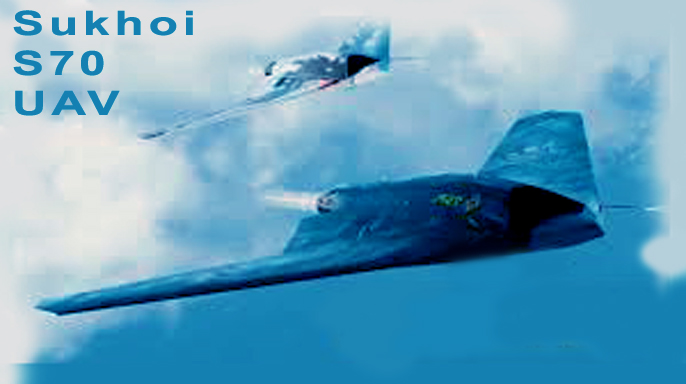
With a reported range of around 6,000 km, the S-70 can threaten targets across continents. Paired with Russia’s Su-57 fighters, it is intended to operate as part of a manned-unmanned team in which the pilot directs multiple drones, each acting as a weapons truck, sensor platform, or decoy. In a European war scenario, Okhotniks would likely be used to saturate NATO air defenses in the opening hours of conflict. Flying low-observable profiles, they could deliver cruise missiles, glide bombs, or electronic warfare payloads against airbases, logistics hubs, and energy infrastructure. Their loss would be acceptable if it opened corridors for manned aircraft and ballistic missiles.
The Ukraine war has already demonstrated Russia’s willingness to absorb equipment losses in pursuit of strategic objectives. The Okhotnik extends that logic into the air domain. It is built not to survive indefinitely but to survive long enough to change the battlespace.
America’s XQ-58A Valkyrie and the economics of attrition
The United States approaches UCAVs from a different angle: cost and scale. The XQ-58A Valkyrie is explicitly designed to be expendable. With a payload of 250–550 kg and a range of approximately 3,900 km, it lacks the raw power of the Okhotnik or the speed glamour of Kızılelma. Its strength lies in numbers.
The Valkyrie can be launched from austere locations, flown autonomously or semi-autonomously, and integrated with America’s fifth-generation fighters like the F-35 and F-22. Its purpose is not to replace manned aircraft but to overwhelm enemy defenses through mass. A single pilot might command multiple Valkyries, sending them ahead to scout, jam, or strike.
In a Pacific war scenario involving China, this philosophy becomes critical. The tyranny of distance, the vulnerability of forward airbases, and the sheer scale of the theater make attrition inevitable. Valkyries could be deployed in large numbers from dispersed locations, complicating Chinese targeting and forcing expensive interceptors to be wasted on relatively cheap drones.
This reflects a deeper American insight: future wars may be decided less by exquisite platforms than by who can sustain losses longest. In that sense, the Valkyrie is as much an industrial weapon as a military one.
War scenarios: Ukraine, Gaza, and the normalisation of drone combat
Although none of these advanced UCAVs have yet been deployed in full-scale peer conflict, the future they represent is already visible. Ukraine has become the world’s first large-scale drone war. Both sides use unmanned systems not just for surveillance but for strike, electronic warfare, and psychological pressure. The sky is no longer a sanctuary; it is a contested mesh of sensors, jammers, and autonomous kill chains.
In Gaza and Israel’s northern front, drones have collapsed the distinction between battlefield and rear area. Persistent surveillance and precision strike have made concealment nearly impossible. The lesson absorbed by major powers is clear: whoever controls the unmanned layer controls escalation.
In a future NATO–Russia confrontation, UCAVs would almost certainly dominate the first phase of combat. Before tanks roll or soldiers cross borders, drones would blind radars, destroy satellites’ ground links, and paralyse logistics. The war would begin invisibly, with machines fighting machines, while political leaders debate whether a “real” war has started at all.
The moral and strategic vacuum of autonomous violence
One of the most dangerous aspects of UCAV proliferation is not their lethality but their deniability. When no pilot is at risk, the threshold for use drops. When decisions are partially delegated to algorithms, accountability blurs. Was a strike intentional, a software error, or an emergent behaviour of a learning system?
This ambiguity favours revisionist powers and grey-zone strategies. A drone incursion can be dismissed as a test, a malfunction, or a provocation without fingerprints. Retaliation becomes politically complex. Escalation ladders become foggy.
Moreover, as UCAVs proliferate, so will countermeasures. Electronic warfare, cyber attacks, and AI spoofing will target not just hardware but decision-making itself. Future air battles may be fought less with missiles than with corrupted data streams and false targets.
The end of air superiority as a singular concept
Traditionally, air superiority meant controlling the skies through better pilots and aircraft. UCAVs fracture that concept. Control becomes temporary, localised, and transactional. A state may dominate the air over a region for hours, not days, before losing it again.
This fluidity favours adaptability over dominance. Systems like the Valkyrie are designed to be replaced quickly. Systems like Okhotnik are designed to strike decisively before being hunted down. Systems like Kızılelma are designed to give regional powers autonomy and bargaining power.
Air forces of the future will look less like elite clubs and more like ecosystems—layers of manned aircraft, unmanned strike platforms, sensors, and electronic warfare nodes, all coordinated by software.
War after the human body
The emergence of advanced UCAVs marks a turning point not just in military technology but in the philosophy of war. Baykar Kızılelma, Sukhoi S-70 Okhotnik, and XQ-58A Valkyrie embody different national answers to the same question: how do you fight when human vulnerability is no longer the central constraint?
The answer, increasingly, is to move humans out of harm’s way while accelerating the pace and reach of violence. This does not make war safer; it makes it easier. It compresses decision times, expands battlefields, and erodes the moral friction that once restrained escalation. In the coming decades, wars may begin without a single pilot taking off, without a single declaration being made, and without a clear moment when peace ends. The drones will already be in the air, waiting for permission—or perhaps merely probability—to strike.