The parallel begins, as it must, with state violence against its own people. In 1971, Pakistan’s military regime, having lost the general election to Sheikh Mujibur Rahman’s Awami League, chose repression over democracy. East Pakistan was treated as a colony rather than an equal partner in the state
History is often narrated by the victors, but its deeper lessons lie in the asymmetries between victory and consequence. The comparison between Venezuela in 2026 and Bangladesh in 1971 is compelling not merely because both involve state collapse, humanitarian catastrophe, and foreign military intervention, but because of what followed those interventions. The crucial difference lies not in the suffering of the people or the moral bankruptcy of the regimes involved, but in the strategic outcomes for the intervening powers. In 1971, India responded to Pakistan’s aggression, won a decisive military victory, helped create Bangladesh, and yet failed to convert that victory into lasting geopolitical, economic, or narrative gains. In 2026, the United States did not merely respond; it initiated, shaped, and concluded the Venezuelan conflict on its own terms—and in doing so, gained nearly everything it sought.
The parallel begins, as it must, with state violence against its own people. In 1971, Pakistan’s military regime, having lost the general election to Sheikh Mujibur Rahman’s Awami League, chose repression over democracy. East Pakistan was treated as a colony rather than an equal partner in the state. Economic extraction, cultural contempt, and political exclusion culminated in Operation Searchlight, a campaign of mass violence that included systematic killings, rape, and the targeting of intellectuals. Bangladesh was not born out of separatist ambition alone; it was forged in the certainty that coexistence under such a state had become impossible.
Venezuela’s collapse followed a different ideological path but reached a similar destination. The Maduro regime hollowed out democratic institutions, weaponized the judiciary, criminalized opposition, and transformed the military into a rent-seeking partner in governance. Oil wealth, instead of building resilience, entrenched corruption and dependence. As living standards collapsed, repression intensified. Arbitrary arrests, torture, extrajudicial killings, and enforced disappearances became tools of governance. Like Pakistan in 1971, the Venezuelan state ceased to function as a representative authority and instead behaved as an occupying force ruling over a hostile population.
The humanitarian dimension seals the analogy. In 1971, nearly ten million refugees poured into India from East Pakistan, creating an economic and political emergency that New Delhi could not ignore. In Venezuela’s case, millions fled across Latin America, producing the largest refugee crisis in the region’s modern history. Colombia, Peru, Brazil, and others absorbed the shock, while international agencies struggled to cope. In both cases, mass displacement transformed a domestic crisis into an international one, forcing external powers to choose between intervention and prolonged instability.
Yet it is at the point of intervention that the differences become decisive. India in 1971 did not seek war. It absorbed refugees for months, attempted diplomatic pressure, and endured Pakistani air strikes before launching a full-scale military response. When war came, it was swift and decisive. In thirteen days, the Indian armed forces defeated Pakistan’s military in the east, leading to the surrender of 93,000 prisoners of war and the creation of Bangladesh. Militarily, it was one of the most complete victories in modern history.
But India’s victory was framed as defensive, moral, and limited. It did not extract economic concessions, permanent strategic leverage, or enforceable political alignment from the new state. Bangladesh emerged grateful but sovereign, quickly asserting its own interests and identity. India bore the long-term costs: managing a fragile neighbor, absorbing waves of migrants over decades, enduring regional instability, and facing a Pakistan that learned not humility but grievance. India won the war, but failed to dominate the peace.
The United States, by contrast, approached Venezuela with a fundamentally different logic. Washington did not stumble into war as a reluctant responder; it structured the conflict from the outset. Diplomatic isolation, economic sanctions, intelligence operations, and coalition-building preceded direct action. When military force was finally applied, it was framed not as a regional necessity but as a global enforcement of norms: democracy, human rights, and stability. Unlike India in 1971, the United States did not limit itself to removing an oppressive regime; it redesigned the post-conflict environment.
This is where the analogy sharpens into critique. The United States emerged from the Venezuelan intervention with strategic gains across multiple dimensions. First, it reasserted dominance over the Western Hemisphere, signaling to rivals that Latin America remained a red line. Second, it secured preferential access to Venezuela’s vast oil reserves, reshaping global energy markets at a time of geopolitical volatility. Third, it weakened the influence of adversarial powers that had embedded themselves in Venezuela, from Russia to Iran, without paying a comparable price. Fourth, it demonstrated that regime change, when tightly controlled and economically integrated, could still deliver returns.
India’s 1971 experience offers a mirror image. Despite holding overwhelming leverage—93,000 Pakistani prisoners of war, a defeated adversary, and global sympathy—India chose restraint without strategy. The Simla Agreement normalized relations without extracting accountability. War crimes went largely unpunished. Pakistan’s military narrative of victimhood went unchallenged internationally. Bangladesh, meanwhile, was left to navigate reconstruction with limited long-term economic integration with India. The moral high ground was preserved, but the strategic ground was ceded.
The difference lies not in ethics but in statecraft. India fought as a civilization-state burdened by moral responsibility and postcolonial insecurity. It sought legitimacy, not leverage. The United States fought as an empire comfortable with power projection and transactional outcomes. It sought not just regime change, but structural advantage. Where India feared being seen as expansionist, the United States was untroubled by accusations of imperialism, confident in its ability to shape the narrative and absorb criticism.
Another key difference is narrative control. Pakistan successfully reframed 1971 domestically as a story of Indian aggression rather than internal collapse. This allowed its military to retain political dominance and avoid institutional reform. India, paradoxically, failed to impose its own narrative internationally or regionally. The genocide in Bangladesh never received the sustained global reckoning it deserved. In Venezuela’s case, the United States ensured narrative saturation: human rights abuses documented, media access embedded, opposition leaders legitimized internationally, and the fallen regime delegitimized beyond recovery. History, this time, was written quickly and decisively.
The aftermath further underlines the contrast. Bangladesh struggled with coups, assassinations, and economic hardship, while India faced decades of regional instability and migration pressure. The costs of victory were diffuse and long-term. In Venezuela, the post-conflict order was tightly managed. Reconstruction contracts, energy policy, and security architecture were aligned with U.S. interests. The burden of stabilization was shared, outsourced, or monetized. Victory was not merely military; it was systemic.
This is not an argument that India should have behaved like the United States, nor that morality is a strategic weakness. It is an observation about how power operates in the real world. India’s 1971 war was just, necessary, and historically vindicated, but it exposed a persistent Indian dilemma: winning battles without shaping outcomes. Venezuela 2026 exposes the opposite logic: shaping outcomes by defining the battlefield, the narrative, and the peace.
The deeper lesson of comparing Venezuela 2026 with Bangladesh 1971 is not about who was right or wrong, but about the costs of restraint and the rewards of control. India acted when forced, stopped when satisfied, and trusted history to remember correctly. The United States acted when ready, stopped when its objectives were secured, and ensured history had little room to forget.
For Venezuela, as for Bangladesh, liberation came at immense human cost. But the destinies of those liberations were shaped not only by the courage of the people, but by the ambitions of those who intervened. In 1971, India gave birth to a nation and walked away. In 2026, the United States reshaped a nation and stayed—economically, strategically, and narratively.
That is the uncomfortable difference. One power won a war and lost the peace. The other designed the war to win the peace before the first shot was fired.
The comparison highlights two main points:
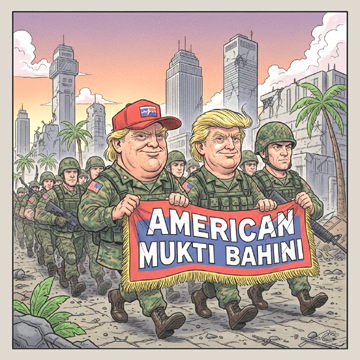
External Intervention: In 1971, India intervened to support the Bengali independence movement (Mukti Bahini) against West Pakistan, despite the US sending its 7th fleet in an attempt to intimidate India. The analogy suggests that the recent US actions in Venezuela—including the capture of President Nicolás Maduro after a US strike and subsequent US announcements about running the country until a transition—represent a modern form of foreign intervention in a sovereign state’s affairs.
Geopolitical Crisis and Instability: Both events involve significant political upheaval, violence, and international involvement. The 1971 war was a bloody nine-month conflict resulting in a major humanitarian crisis and a mass exodus of refugees to India. The situation in Venezuela in early 2026 involves intense unrest, economic collapse, allegations of human rights abuses, and a power vacuum following Maduro’s capture, with the international community divided on the legitimacy of the actions taken.
Internal Political Unrest: The 1971 war stemmed from a political and ethnic conflict in East Pakistan after the Awami League won the 1970 elections but was denied power. Similarly, the current crisis in Bangladesh (in late 2025/early 2026) is characterized by significant domestic turmoil, protests, violence against minorities, and a controversial political transition after the ousting of former PM Sheikh Hasina.
Essentially, the phrase serves as a shorthand to describe a major, potentially world-reshaping conflict involving a superpower, regional dynamics, and internal liberation struggles.