
The familiar American media argument — that foreign intervention is inherently wrong — sounds hollow to Venezuelan ears who have been suffering for long. From the inside, Venezuela had long ceased to be sovereign in any meaningful sense
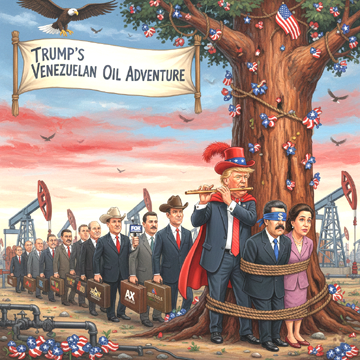
The dramatic removal of Nicolás Maduro from power by U.S. military action on January 3, 2026, instantly split the world into camps that spoke past each other. For some governments, particularly a handful aligned closely with Washington, the operation was framed as an overdue reckoning with a criminalized regime that had hollowed out a once-prosperous state. For many more, especially across Latin America and among major powers such as China and Russia, the strikes were condemned as a flagrant violation of sovereignty and international law, an unvarnished act of regime change that risked destabilizing an already fragile region. Europe, characteristically cautious, tried to balance its language, emphasizing restraint, legality, and de-escalation while avoiding outright endorsement or condemnation. Yet none of these diplomatic reactions, supportive or hostile, fully captured the emotional and political reality that mattered most: how Venezuelans themselves experienced the fall of Maduro.
From the outside, particularly from the United States, the question was often framed in abstract moral terms. Is foreign intervention ever justified? Is Trump acting out of democratic principle or crude oil interests? Does this mark a dangerous return to twentieth-century gunboat diplomacy? These questions are not illegitimate, but they are incomplete. They treat Venezuela as a chessboard rather than a lived society. For Venezuelans, especially those who left and those who stayed without power or protection, the meaning of January 3 cannot be understood without grasping the depth and duration of collapse that preceded it.
To understand why relief, rather than outrage, became the dominant emotional response among many Venezuelans, one must begin in 2013. When Hugo Chávez died and Nicolás Maduro inherited power, the country was already structurally fragile, but still functional. Over the next decade, Venezuela experienced something closer to civilizational breakdown than ordinary recession. Roughly eighty percent of the economy evaporated. Hyperinflation did not merely erode purchasing power; it destroyed the very concept of money. Prices rose daily, sometimes hourly. Salaries became symbolic gestures, pensions historical jokes. Professions disappeared because they no longer corresponded to a viable economic reality. Engineers drove taxis, doctors emigrated, teachers abandoned classrooms. Time itself seemed to fracture, as planning for the future became an act of self-deception.
The political system disintegrated alongside the economy. Elections continued, but they ceased to matter. In 2015, the opposition won parliament decisively; the result was ignored. In 2024, Venezuelans voted again, this time delivering a landslide rejection of Maduro by margins comparable to a hypothetical U.S. election in which every swing state flipped decisively. The result was again dismissed. At that point, the distinction between authoritarianism and totalitarian stagnation became academic. This was no longer a flawed democracy; it was a closed system.
Importantly, this collapse was not met with immediate armed rebellion. Venezuelans protested, marched, organized, and voted. Thousands were killed; tens of thousands were imprisoned as political detainees. Yet the opposition clung stubbornly to constitutionalism and legality, even as those concepts were hollowed out by the regime. This insistence on peaceful change, often misunderstood abroad as passivity, was in fact an expression of civic exhaustion rather than acquiescence. When no institutional channel works, restraint becomes a form of despair.
One of the most misunderstood aspects of Venezuelan society during this period was the visible minority that appeared to support the regime. From afar, this group was often cited as evidence that Maduro retained a genuine social base. In reality, this “support” came from three distinct and morally unequal categories. Some benefited directly from corruption and state patronage. Others were insulated from collapse by access to dollars, foreign connections, or regime proximity. The third group, however, was the most tragic: millions reduced to survival dependency. Government-issued food boxes, irregular, often expired, and insufficient, became instruments of political control. People were told, sometimes explicitly, that regime change would mean hunger. This was not ideological loyalty; it was hostage psychology. When survival depends on obedience, consent loses its meaning.
Against this background, mass emigration became the final safety valve. Roughly one-third of the population left. Families fragmented across continents. Entire cities aged prematurely as the young disappeared. Death in exile became common. Grandparents never met grandchildren. This diaspora experience shaped the Venezuelan reaction to Maduro’s fall as much as those who remained inside the country. For many, the capture of Maduro was not a geopolitical spectacle but the symbolic end of a personal sentence.
This is why the familiar American argument — that foreign intervention is inherently wrong — sounds hollow to Venezuelan ears. From the inside, Venezuela had long ceased to be sovereign in any meaningful sense. Iranian, Cuban, Russian, and Chinese involvement permeated security, intelligence, and infrastructure. The country functioned as a logistical node for illicit trafficking and geopolitical signaling. The idea that January 2026 marked the first violation of Venezuelan sovereignty ignores years of informal occupation and extraction by non-Western powers.
None of this implies naïveté about U.S. motives. Venezuelans are acutely aware of oil, minerals, and strategic interests. Trump’s own rhetoric, boasting of American involvement in Venezuela’s oil industry and sending senior defense officials and energy executives to assess assets, removed any remaining ambiguity. Yet the moral arithmetic of collapse alters how such interests are weighed. When a lock has rusted shut for a decade, people care less about who turns the key than whether the door finally opens.
This tension between lived desperation and international principle is not new. Venezuela’s 2026 crisis sits squarely within a long and deeply contested history of U.S. intervention in Latin America. From the Banana Wars of the early twentieth century to Cold War coups and post-Cold War “humanitarian” interventions, Washington has repeatedly combined ideological justification with economic self-interest. Guatemala in 1954, Chile in 1973, Brazil in 1964, and numerous interventions in Central America and the Caribbean established a pattern: left-leaning or reformist governments perceived as threatening U.S. interests were destabilized, often violently, in the name of anti-communism or regional stability.
These interventions produced mixed outcomes at best and enduring trauma at worst. Military dictatorships, torture, disappearances, and decades of delayed democratic development followed many U.S.-backed regime changes. The memory of this history fuels contemporary condemnation of the Venezuela strikes. Critics see January 2026 not as an exception but as a return to form: unilateral force, moralized rhetoric, and resource extraction dressed up as liberation.
Yet history also complicates easy analogies. Venezuela under Maduro was not Chile in 1970 or Guatemala in 1954. It was not a reformist democracy experimenting with redistribution, but a collapsed petro-state where elections had become performative rituals and basic governance had disintegrated. Even within the U.S. policy establishment, earlier attempts at regime change through sanctions and proxy leadership, particularly the Juan Guaidó episode, were widely acknowledged as failures. Sanctions worsened civilian suffering without dislodging Maduro. Guaidó never controlled institutions and ultimately lost legitimacy even within the opposition. By 2022, the strategy was openly described by U.S. officials as counterproductive.
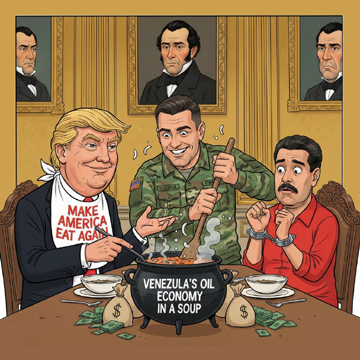
The January 2026 intervention therefore marked a qualitative shift from pressure to force. Airstrikes on Caracas, the capture of Maduro and his wife, and Trump’s declaration that the U.S. would “run the country” during a transition shattered the pretense of indirect involvement. This explicitness is precisely what alarms critics and reassures supporters. For opponents, it confirms fears of imperial overreach. For exhausted Venezuelans, it ends a decade of ambiguity and paralysis.
The international response reflects this moral split. Governments condemning the action speak the language of law and precedent, fearing a world where unilateral force becomes normalized. Those welcoming it emphasize outcomes over process, arguing that legality divorced from human reality becomes complicity. Europe’s caution reflects its own historical burden: knowing both the dangers of power politics and the costs of inaction.
Ultimately, the Venezuelan reaction cannot be reduced to pro-American sentiment or ideological alignment. It is better understood as a collective exhale after years of suffocation. People are not celebrating bombs or humiliation; they are responding to the sudden possibility that history might start moving again. Hope, after prolonged deprivation, becomes worth the risk.
Whether that hope will be justified remains uncertain. U.S. administration of a transition, particularly one tied openly to energy interests, carries enormous risks. Venezuela’s social fabric is fragile, its institutions eroded, its trust depleted. The legacy of past interventions looms large, reminding observers that removing a dictator is easier than rebuilding a country. Yet for many Venezuelans, the moral ledger is already settled. The old order offered only managed decay. Against that certainty, even an uncertain future feels like progress.
If Americans wish to understand why Venezuelans reacted with relief rather than outrage, they should ask not whether intervention fits abstract doctrines, but what level of suffering makes people willing to accept risk in exchange for the chance to rebuild. This was not an ideological endorsement of U.S. power. It was an exhausted society responding to the sound of a lock finally turning.
Viva Venezuela libre.
#venezuela #caracas #maduro #madurodictador #trump #maga #donaldtrump #usa

