
Glyphosate, the most widely used herbicides in modern agriculture, has contributed to rising autism rates. A 3,200 percent increase in autism rates must be further investigated and interpreted. Changes in diagnostic criteria, particularly the expansion of the autism spectrum, have allowed more individuals to be identified who might previously have gone undiagnosed or been classified under different conditions. Still, it is a big number
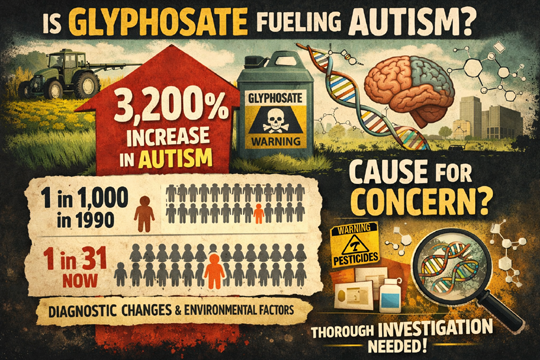
In recent years, a powerful narrative has emerged claiming that modern society, particularly in the United States, has engineered a silent public health crisis. At the center of this argument lies a striking statistic: autism diagnoses have reportedly risen from 1 in 1,000 children in 1990 to approximately 1 in 31 today. In certain regions, such as California, figures as high as 1 in 12.5 are often cited. These numbers are presented as evidence of a dramatic and alarming increase, one that some interpret as the result of systemic environmental and cultural changes rather than natural variation or improved detection.
The condition in question, Autism Spectrum Disorder, is a complex neurodevelopmental disorder characterized by differences in social communication, behavior, and sensory processing. Over the past 30 years, awareness, diagnostic criteria, and screening practices have evolved significantly. This evolution has contributed to higher reported prevalence rates, but it has also fueled debates about whether the increase reflects a true rise in incidence or simply better recognition.
The claim of a 3,200 percent increase in autism rates is often used to suggest a large-scale, systemic cause. However, such figures must be interpreted with caution. Changes in diagnostic criteria, particularly the expansion of the autism spectrum, have allowed more individuals to be identified who might previously have gone undiagnosed or been classified under different conditions.
Nevertheless, the concern remains: could environmental and lifestyle factors be contributing to this rise? The hypothesis is not without scientific interest. Researchers have long explored the role of environmental exposures, genetic predisposition, and their interaction in shaping neurodevelopmental outcomes.
The argument presented in the source text goes further, suggesting intentionality, that modern systems have “engineered” these outcomes and labeled them as progress. While this framing is provocative, it is important to distinguish between deliberate design and unintended consequences of industrial, agricultural, and social evolution.
To evaluate these claims, one must examine the evidence surrounding environmental chemicals, food systems, water quality, and societal trends. Each of these domains has undergone profound transformation since the late 20th century. Understanding their potential impact requires a careful, evidence-based approach rather than reliance on sweeping generalizations.
Autism trends and the challenge of interpretation
The reported increase in autism diagnoses is one of the most discussed public health trends of the past few decades. However, interpreting this increase is far from straightforward. In 1990, diagnostic criteria for autism were narrower and less inclusive. Many individuals who would today be diagnosed with autism were previously categorized under other developmental or behavioral conditions.
The introduction of broader diagnostic frameworks, particularly in the 1990s and early 2000s, significantly expanded the definition of autism. This shift allowed clinicians to identify a wider range of presentations, including milder forms that might previously have gone unnoticed. Increased awareness among parents, educators, and healthcare providers has also contributed to higher diagnosis rates.
Screening practices have improved dramatically. Pediatricians now routinely assess developmental milestones, and early intervention programs have become more accessible. These changes have led to earlier and more frequent identification of autism, which in turn raises prevalence statistics.
At the same time, researchers continue to investigate potential environmental contributors. Studies have explored factors such as air pollution, maternal health, and exposure to certain chemicals during pregnancy. While some associations have been identified, causation remains difficult to establish. Autism is widely understood to result from a combination of genetic and environmental influences rather than a single cause.
The claim that “no virus did this; a system did this” simplifies a complex issue. Biological systems rarely respond to a single factor in isolation. Instead, they are shaped by a web of interacting influences, including genetics, environment, and social context.
It is also important to recognize regional variations in reported prevalence. Differences in healthcare infrastructure, diagnostic practices, and cultural attitudes toward developmental disorders can all influence reported rates. For example, higher rates in certain areas may reflect better access to diagnostic services rather than a true increase in incidence.
In summary, while the rise in autism diagnoses is real, its interpretation requires nuance. It cannot be attributed solely to environmental toxins or societal changes without robust evidence. Instead, it reflects a combination of improved detection, evolving definitions, and ongoing scientific investigation.
Chemical exposure and public concern
One of the central claims in the narrative is that widespread chemical exposure, particularly to substances like Glyphosate, has contributed to rising autism rates. Glyphosate is one of the most widely used herbicides in modern agriculture, and its presence in the environment has been extensively studied.
Since the mid-1990s, the use of glyphosate has increased significantly, particularly with the adoption of genetically modified crops designed to tolerate it. As a result, trace amounts can be detected in soil, water, and even human biological samples. This has raised concerns about its potential health effects.
Some researchers have hypothesized that glyphosate may destroy the gut microbiome, the community of microorganisms that inhabit the digestive tract. The gut microbiome plays a role in digestion, immune function, and, potentially, brain development. However, the extent to which glyphosate exposure affects human health at typical environmental levels remains a subject of debate.
Regulatory agencies such as the Environmental Protection Agency in the United States have evaluated glyphosate and concluded that it is unlikely to pose a significant risk to human health when used as directed. Nevertheless, controversy persists, and ongoing research continues to explore its long-term effects.
Another group of chemicals frequently mentioned in this context is PFAS, often referred to as “forever chemicals.” These substances are used in a wide range of products, including non-stick cookware, water-resistant fabrics, and food packaging. They are called “forever chemicals” because they do not break down easily in the environment or the human body.
PFAS exposure has been linked to various health concerns, including hormonal disruption and immune system effects. Their presence in drinking water and food has prompted increased regulatory scrutiny and efforts to limit exposure. However, establishing a direct link between PFAS and autism remains challenging due to the complexity of both the condition and the exposure pathways.
The presence of chemical residues in water supplies is another area of concern. Studies have detected trace amounts of pharmaceuticals, including antidepressants and antibiotics, in some water sources. These findings highlight the need for improved water treatment and environmental management, but the health implications of such low-level exposure are still being studied.
While it is important to investigate potential risks, it is equally important to avoid drawing conclusions that are not supported by evidence. The relationship between environmental chemicals and neurodevelopment is an active area of research, but definitive answers are still emerging.
The role of diet and ultra-processed foods
The transformation of the global food system over the past 50 years has been profound. The rise of ultra-processed foods, products that contain artificial additives, preservatives, and flavor enhancers, has changed dietary patterns in many countries.
These foods are often convenient and affordable, but they have also been associated with various health concerns, including obesity, metabolic disorders, and cardiovascular disease. Some researchers have begun to explore their potential impact on the gut microbiome and, by extension, brain health.
Additives such as artificial dyes and emulsifiers have been studied for their effects on behavior and gut health. While some evidence suggests that certain additives may influence behavior in sensitive individuals, the overall impact on neurodevelopment remains unclear.
The gut-brain axis, the connection between the digestive system and the central nervous system, is an area of growing scientific interest. Changes in the gut microbiome have been linked to various conditions, including mood disorders and neurodevelopmental differences. However, the mechanisms involved are complex and not fully understood.
It is important to note that diet is only one of many factors that influence health. Genetics, environment, and lifestyle all play significant roles. While improving dietary quality is beneficial for overall health, it is unlikely to serve as a single solution to complex conditions like autism.
The narrative that modern food systems are “poisoning” populations is an oversimplification. While there are legitimate concerns about certain aspects of food production and consumption, these issues must be addressed through evidence-based policies and public health initiatives rather than alarmist rhetoric.
Social change and delayed parenthood
The text also highlights societal changes, particularly the trend toward delayed parenthood. It claims that every 10-year delay in having children increases autism risk by 21 percent. This assertion is based on studies that have found associations between parental age and autism risk.
Advanced parental age, both maternal and paternal, has been linked to a slightly increased risk of autism. Possible explanations include genetic mutations that accumulate over time and changes in reproductive biology. However, the increase in risk is relatively modest and must be considered in context.
For example, while the relative risk may increase, the absolute risk remains low. Most children born to older parents do not develop autism. Therefore, framing delayed parenthood as a major driver of autism prevalence can be misleading.
Social changes such as increased educational attainment, career opportunities, and shifting cultural norms have influenced family planning decisions. These changes have brought many benefits, including improved economic stability and greater gender equality.
It is important to approach this topic with nuance. While biological factors associated with age may influence risk, they are only one piece of a larger puzzle. Simplifying the issue to a single variable overlooks the complexity of human development and social dynamics.
India, globalisation, and the path forward
The final part of the narrative draws a comparison between the United States and India, suggesting that India is following the same path of industrialisation, chemical exposure, and lifestyle change. It warns that similar health outcomes may emerge as a result.
India currently reports lower autism prevalence rates, such as 1 in 65 children, though data collection methods and diagnostic practices vary. As awareness and diagnostic capacity improve, reported rates may increase, reflecting better detection rather than a sudden rise in incidence.
Globalisation has indeed led to the spread of similar food systems, consumer products, and cultural trends across countries. This presents both opportunities and challenges. On one hand, access to technology and healthcare has improved. On the other, new environmental and lifestyle risks have emerged.
The key question is not whether modernisation should occur, but how it can be managed responsibly. This includes regulating chemical use, improving food quality, ensuring clean water, and promoting public health education.
The idea that “policy follows power” highlights the importance of governance and accountability. Effective policies require collaboration between scientists, policymakers, and the public. They must be based on evidence and designed to protect health without hindering progress.
Ultimately, the debate over autism, environmental exposure, and societal change reflects broader concerns about the direction of modern civilisation. While it is important to question and investigate potential risks, it is equally important to rely on rigorous science and avoid conclusions that outpace the evidence.
Progress is not inherently harmful, but it must be guided by knowledge, responsibility, and a commitment to human well-being.

