
Gross Domestic Product measures the total value of goods and services produced in an economy. It captures size, not distribution. It measures flow, not security. It counts output, not dignity
One of the most repeated and celebrated economic headlines of the past year is that India has become the world’s fourth-largest economy. The statement is delivered with pride, often framed as a civilisational vindication and proof that the country is finally reclaiming its historical place in the global order. On television debates, in political speeches, and across social media, the ranking is presented as self-evident evidence of national success. But beneath this headline lies a far more uncomfortable question: what does being the fourth-largest economy actually mean for ordinary Indians?
Does it mean that most Indians are getting richer? Does it mean that their standard of living is improving in a durable and meaningful way? Does it mean secure jobs, better health care, affordable education, cleaner air, or genuine social mobility? When the headline is interrogated through data rather than rhetoric, the answer is sobering. For the majority of Indians, the lived economic reality remains stubbornly disconnected from the triumphalism of GDP rankings.
Gross Domestic Product measures the total value of goods and services produced in an economy. It captures size, not distribution. It measures flow, not security. It counts output, not dignity. In a country as large and unequal as India, GDP can grow rapidly even while vast sections of the population remain trapped in precarity. This is not a theoretical possibility; it is precisely what is happening.
According to the World Inequality Report, nearly 40 percent of India’s total wealth is held by the top 1 percent of the population. The bottom 50 percent together own barely three percent of national wealth. Such concentration is not a side detail; it fundamentally distorts how aggregate numbers should be interpreted. GDP per capita, often cited as a shorthand for prosperity, becomes deeply misleading in this context. Averages hide extremes. When wealth and income are so heavily skewed, the “average Indian” described by per capita figures does not actually exist.
If one removes just the top 1 percent of earners from the calculation, India’s per capita income drops sharply. Remove the top 5 percent, who together control close to 62 percent of national wealth, and the average income falls to around $1,100 a year, less than ₹1 lakh annually. This figure is far closer to the economic reality experienced by the majority of Indians than the glossy averages cited in official presentations. It is also the reason why the state continues to provide free food rations to nearly 80 crore people. In a genuinely prosperous society, such a vast dependence on food subsidies would be unthinkable.
The coexistence of a massive GDP ranking and widespread material vulnerability should alarm policymakers and citizens alike. Yet, it rarely does. The celebration of size has crowded out serious discussion about structure. India’s growth in recent years has increasingly been characterised by what economists describe as “jobless growth.” Output expands, corporate profits rise, asset prices soar, but employment generation remains weak, especially in the formal sector. For a country with one of the youngest populations in the world, this is a structural failure with long-term consequences.
Each year, millions of young Indians enter the labour market with aspirations shaped by education, media, and the promise of a rising economy. What they encounter instead is a labour market dominated by informality, low wages, contractual insecurity, and limited upward mobility. Formal employment, with social security and stability, grows far more slowly than the working-age population. As a result, many are forced into self-employment not out of entrepreneurship, but out of compulsion. Street vending, gig work, delivery platforms, and casual services absorb labour, but rarely provide pathways to skill development or income security.
At the same time, inflation quietly erodes whatever income gains do occur. Food, housing, healthcare, education, and transport costs rise faster than wages for large sections of the population. When growth is combined with inflation and weak job creation, its benefits increasingly accrue to those who already own assets rather than those who depend on wages. Money piles up not in productive employment-generating activities, but in real estate, gold, financial speculation, and government-linked contracts. Asset inflation enriches the few while pushing essential goods further out of reach for the many.
Real estate is perhaps the clearest example of this dynamic. Urban property prices have soared far beyond the purchasing power of average salaried households. Housing increasingly functions less as shelter and more as a store of value for surplus capital. For those who already own property, rising prices generate paper wealth. For those who do not, home ownership becomes a distant dream, and rent consumes an ever-larger share of income. This deepens intergenerational inequality, as wealth is transmitted through inheritance rather than earned through work.
Gold, traditionally seen as a hedge against uncertainty, absorbs household savings that might otherwise flow into productive investment. Government contracts, infrastructure projects, and public procurement increasingly concentrate wealth among a narrow circle of firms with the scale and political access to compete. While such projects do contribute to GDP, their employment intensity is often limited, and their benefits rarely trickle down in proportion to their headline value.
The result is an economy where inequality does not merely widen; it hardens. Social mobility slows as the distance between classes grows and the ladders connecting them weaken. When decent jobs are scarce, education loses its power as a leveller. Degrees proliferate, but returns diminish. Young people invest time and money in qualifications only to find themselves underemployed or unemployed. This breeds frustration, cynicism, and a sense that the system is rigged.
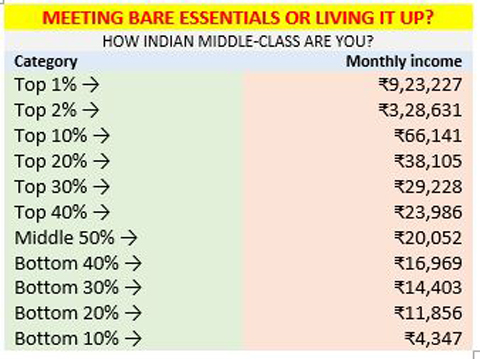
The distribution of monthly incomes across India starkly illustrates how narrow the so-called middle class actually is. A monthly income of around ₹20,000 places an individual roughly at the middle 50 percent of the population. This figure is often assumed to represent a comfortable lower-middle-class life, yet in most urban centres it barely covers rent, food, and basic utilities, leaving little room for savings, healthcare emergencies, or education expenses. A household earning ₹38,000 a month is already in the top 20 percent. The top 10 percent begin at just over ₹66,000 monthly. These numbers reveal how compressed incomes are for the vast majority, and how quickly one moves into elite categories in a generally poor society.
At the very top, the contrast is staggering. The top one percent earns over ₹9 lakh a month. This is not merely a difference of degree; it is a difference of economic universe. Such disparities shape access to healthcare, education, housing, networks, and political influence. They determine whose voices are heard and whose struggles remain invisible.
Yet, public discourse often treats inequality as an abstract moral concern rather than a concrete economic risk. Extreme inequality undermines aggregate demand because the rich cannot consume enough to compensate for the suppressed purchasing power of the masses. It distorts investment decisions towards luxury consumption and speculative assets rather than mass employment. It fuels social resentment and erodes trust in institutions. Over time, it weakens democracy itself, as economic power translates into disproportionate political influence.
India’s fourth-largest economy ranking also obscures other structural weaknesses. GDP per capita remains low compared to most major economies. Public spending on health and education lags far behind what is required for a population of India’s size and aspirations. Air pollution imposes enormous hidden costs through lost productivity, healthcare expenditure, and reduced life expectancy. Environmental stress threatens agriculture, water security, and urban liveability. None of these realities are captured by GDP rankings, yet they profoundly shape the quality and sustainability of growth.
An economy can grow fast while leaving large sections of its population vulnerable. Size alone does not guarantee resilience. What matters is how growth is generated and how its benefits are distributed. A strong economy is not one that merely produces more, but one that enables its people to live securely, breathe clean air, access quality public services, and find dignity in work.
This does not mean dismissing India’s growth achievements. Expanding output, infrastructure, and technological capacity are real and necessary accomplishments. But celebration without introspection risks complacency. The question is not whether India should aspire to be a large economy, but whether it can become a fair and inclusive one.
For that, policy priorities must shift from headline management to structural reform. Job creation, especially in labour-intensive manufacturing and services, must be central rather than incidental. Small and medium enterprises, which employ the majority of workers, need genuine support rather than rhetorical praise. Public investment in health and education must be seen not as welfare, but as productive economic strategy. Progressive taxation and better enforcement can create fiscal space to fund such investments while addressing extreme concentration at the top.
Most importantly, the national conversation must mature beyond rankings. Being fourth-largest tells us how much India produces. It does not tell us how securely Indians live, how evenly opportunity is distributed, or how hopeful the next generation feels about its future. Until growth translates into broad-based employment, rising real incomes, and genuine social mobility, the ranking will remain a statistic celebrated at the top and largely irrelevant at the bottom. Perhaps the real measure of success is not how loudly we celebrate our place in global tables, but how honestly, we confront the gap between economic size and lived reality. That conversation is harder, less flattering, and far more necessary.


Brilliant analysis that deconstructs the myth of the so called 4th largest economy!
Thank you. Forward looking people should get together under DRONEPAGES and drive change.