Iran’s Persian identity is thousands of years old. The Persian landmass and the Indian peninsula along with the south East Asian cultures grew up together. The Persian culture is unique from the Arabian culture. In this war between Iran and the USA, the Persian end of Iran needs to be preserved and the orthodox Islamic end of Iran needs to be squelched
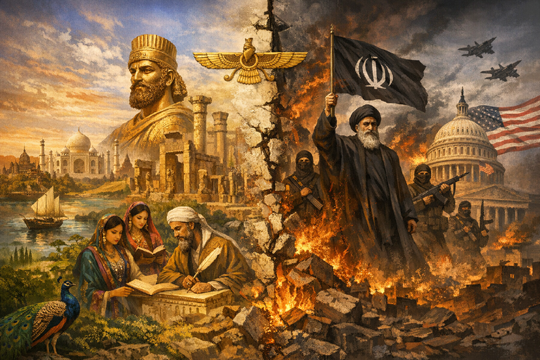
The civilization that today occupies the territory of Iran is one of the oldest continuous cultural traditions in human history. Long before the modern nation-state emerged in the twentieth century, the land known historically as Persia had already developed a distinctive language, artistic tradition, political system, and philosophical outlook that shaped much of Asia and the Middle East. The Persian identity stretches back several millennia, rooted in empires, literature, science, and cultural exchange that influenced neighboring civilizations from the Mediterranean to the Indian Ocean.
When historians speak of Persia, they refer not only to a geographic region but also to a civilizational idea. Persian culture evolved through successive empires, dynasties, religious transformations, and intellectual movements. Through all these changes, however, certain cultural threads remained consistent: a strong literary tradition, a refined court culture, philosophical inquiry, and a cosmopolitan outlook that absorbed and reshaped influences from other civilizations.
The historical memory of Persia includes some of the most significant political entities in ancient history. The Achaemenid Empire, founded by Cyrus the Great in the sixth century BCE, stretched from the Indus Valley to the Mediterranean. It became one of the largest empires the ancient world had ever seen. This empire introduced administrative innovations, road systems, and a model of governance that allowed diverse cultures and religions to coexist within a vast imperial structure.
Later dynasties such as the Sassanian Empire continued to shape Persian identity through art, architecture, and intellectual life. Even after the Islamic conquest of Persia in the seventh century, Persian culture did not disappear. Instead, it adapted and transformed the incoming religious framework, blending Islamic traditions with older Persian cultural patterns.
Thus the Persian identity cannot be reduced simply to religion or political ideology. It is a layered civilization shaped by thousands of years of cultural development.
Persia and the Indian civilization corridor
One of the most important aspects of Persian history is its long relationship with the civilizations of the Indian subcontinent. For millennia, trade routes, cultural exchanges, and political interactions connected the Persian plateau with the lands of the Indian subcontinent.
Geographically, Persia occupies a strategic position between the Mediterranean world, Central Asia, and South Asia. Caravans carrying goods, ideas, and people moved across this region long before the emergence of modern borders. These interactions created what historians sometimes describe as a civilizational corridor linking Persia and India.
Language itself reflects this shared heritage. Persian and many languages of northern India belong to the Indo-Iranian branch of the Indo-European language family. This linguistic relationship reveals ancient connections that predate modern political boundaries.
Cultural influences flowed in both directions. Persian administrative practices influenced several Indian kingdoms, while Indian philosophical and artistic traditions reached Persian courts through scholars and merchants.
The relationship became particularly strong during the medieval and early modern periods. Persian served as the language of administration and high culture in several Indian empires, including the Mughal Empire. Persian poets, scholars, and architects played crucial roles in shaping the cultural landscape of South Asia during that era.
At the same time, Indian mathematics, astronomy, medicine, and philosophy were studied by Persian intellectuals. The exchange enriched both civilizations and created a shared intellectual space that extended across thousands of kilometres.
Thus Persian culture did not develop in isolation. It grew through constant dialogue with neighboring civilizations, particularly those of the Indian subcontinent.
Cultural exchange with Southeast Asia
Beyond India, Persian influences also reached parts of Southeast Asia through trade networks that connected the Indian Ocean world. Merchants sailing across the Arabian Sea and the Bay of Bengal carried not only goods but also languages, religious ideas, and artistic traditions.
Persian traders and scholars contributed to the spread of Islamic learning across maritime Asia, but they also interacted with local cultures in ways that produced hybrid traditions. Architectural styles, textiles, literature, and culinary practices reveal subtle Persian influences in several Southeast Asian societies.
These connections demonstrate how Persian civilization historically functioned as a bridge between different cultural regions. Its intellectual and artistic traditions traveled widely across Asia, leaving traces that can still be seen in literature, architecture, and language.
The Persian world was therefore not confined to modern Iranian borders. It was part of a broader cultural network stretching across the Indian Ocean and Central Asia.
Distinction between Persian and Arab cultures
A key element in understanding Iranian identity is recognizing the difference between Persian and Arab cultures. Although both regions share aspects of Islamic history, their cultural foundations are distinct.
The Arabs of the Arabian Peninsula developed their own linguistic, tribal, and cultural traditions long before the rise of Islam. Arabic language, poetry, and social structures formed the backbone of Arab civilization.
Persian culture, by contrast, was shaped by a different historical trajectory involving ancient empires, Zoroastrian religious traditions, and a long tradition of imperial administration.
When Islam spread across the Persian plateau in the seventh century, it introduced new religious frameworks but did not erase the older Persian cultural identity. Instead, Persians integrated Islamic ideas into their own cultural system. Persian scholars played a major role in shaping Islamic philosophy, theology, and literature.
Indeed, some of the most influential thinkers in Islamic intellectual history wrote in Persian or were deeply influenced by Persian culture. Over time, Persian became one of the major languages of Islamic scholarship alongside Arabic.
This blending of traditions created a distinctive Persian-Islamic civilization that differed from the Arab-Islamic traditions of the Arabian Peninsula.
Understanding this distinction is important because it reveals how Iran’s identity includes multiple layers: ancient Persian heritage, Islamic religious traditions, and modern national identity.
Persian literature and intellectual heritage
One of the most enduring expressions of Persian identity lies in its literary tradition. Persian poetry, in particular, occupies a central place in cultural life.
Poets such as Rumi, Hafez, and Ferdowsi produced works that remain widely read centuries after they were written. Their poetry explores themes of love, spirituality, philosophy, and the human condition.
The epic poem Shahnameh by Ferdowsi is particularly significant because it preserves the mythological and historical memory of ancient Persia. Written around the year 1000 CE, the work recounts the stories of Persian kings and heroes from mythical times to the Arab conquest.
By celebrating the ancient past of Persia, the Shahnameh helped maintain a sense of cultural continuity even after major political transformations.
Persian literature also influenced neighboring cultures. Persian poetic styles were adopted in languages such as Urdu and Turkish, and many literary traditions across Asia drew inspiration from Persian forms.
Thus literature became one of the key vehicles through which Persian identity survived and evolved over centuries.
The tension between cultural identity and political ideology
Modern Iran contains multiple layers of identity that sometimes coexist peacefully and sometimes come into tension. On one hand there is the ancient Persian cultural heritage, which emphasizes language, literature, history, and artistic expression. On the other hand there are political and religious ideologies that emerged during more recent historical periods.
The Islamic Revolution of 1979 transformed Iran into a theocratic republic guided by religious authorities. The revolution sought to reshape the political system around Islamic principles, particularly those of Shiite theology.
However, the deeper Persian cultural identity did not disappear. Many Iranians continue to celebrate pre-Islamic festivals, literature, and historical traditions that date back thousands of years.
This coexistence of identities sometimes produces debates about the direction of the country. Some emphasize Iran’s Islamic political framework, while others highlight the broader Persian cultural heritage that predates the modern political system.
Such debates reflect the complexity of Iranian society rather than a simple division. Iran’s identity is not defined solely by religion or politics but by a combination of historical layers.
The geopolitical tensions involving Iran
Iran’s position in global politics has been shaped by its strategic location, energy resources, and historical experiences with foreign intervention. Over the past several decades, tensions between Iran and the United States have become a defining feature of Middle Eastern geopolitics.
These tensions stem from a combination of factors including regional conflicts, nuclear policy disputes, and ideological differences. At times the rivalry has raised fears of direct military confrontation.
Within Iran itself, such geopolitical pressures can intensify internal debates about national identity and political direction. Some voices emphasize resistance to foreign influence, while others advocate engagement with the international community.
External conflicts therefore often intersect with internal discussions about the balance between cultural heritage, political ideology, and national interests.
Preserving cultural heritage during geopolitical conflict
Whenever nations face conflict or international pressure, there is a risk that cultural heritage becomes overshadowed by political narratives. Yet history demonstrates that civilizations survive precisely because their cultural foundations endure beyond political crises.
The Persian cultural tradition represents a vast legacy of literature, art, philosophy, and scholarship that extends far beyond the boundaries of modern political systems. Preserving this heritage is important not only for Iran but for the broader history of human civilization.
Cultural heritage includes historical monuments, manuscripts, architectural sites, and intangible traditions such as music and poetry. Protecting these elements ensures that future generations can understand the intellectual and artistic achievements of the past.
International organizations and scholars often emphasize that cultural heritage belongs to humanity as a whole. The preservation of Persian history therefore holds significance far beyond national borders.
The complexity of identity in modern Iran
Modern Iranian society is diverse and dynamic. It includes different ethnic groups, languages, religious interpretations, and political perspectives.
Persian identity forms a major component of the national narrative, but it exists alongside other cultural influences that have developed over centuries. The country’s history includes interactions with Central Asian, Turkic, Arab, and South Asian cultures.
This diversity reflects Iran’s historical role as a crossroads of civilizations. Trade routes, migrations, and intellectual exchanges brought multiple influences into the region, creating a rich cultural mosaic.
Debates about identity and governance therefore occur within a complex social landscape rather than a simple binary division. Many Iranians view their heritage as a combination of Persian history and Islamic traditions rather than choosing between them.
Understanding this complexity is essential when discussing Iran’s future or its role in global affairs.
The enduring legacy of Persian civilization
The story of Persia is ultimately a story of cultural resilience. Over thousands of years the region has experienced invasions, dynastic changes, religious transformations, and political revolutions. Yet the underlying cultural identity has survived.
Persian language continues to be spoken by millions of people. Persian poetry continues to be recited and studied. Persian art and architecture continue to inspire admiration around the world.
This enduring legacy demonstrates the power of culture to outlast political systems and geopolitical conflicts. Civilizations are not defined solely by governments or military power but by the ideas, stories, and artistic expressions they leave behind.
The Persian cultural tradition remains one of the great intellectual and artistic achievements of human history. Its influence extends from literature and philosophy to architecture and science.
As global politics continues to evolve, the preservation and appreciation of this heritage will remain important for scholars, historians, and cultural communities around the world.
Understanding the depth of Persian identity helps place modern geopolitical events within a broader historical perspective. It reminds us that nations are not merely political entities but living civilizations shaped by centuries of cultural development.
The future of Iran will undoubtedly continue to involve debates about governance, ideology, and international relations. Yet beneath those debates lies a deeper cultural foundation that has endured for millennia. That foundation—the civilization of Persia—remains one of the enduring pillars of human history.