
Ladakh has a lot of land for real estate and mining. If Ladakh gets the tribal land and forest notification, the filthy property dealers / builders who want to grab the land with the nexus with politicians can’t get that land. Phunsukh Wangdu (you know who) opposed this grab. He was arrested under an anti-terrorist law so that he would be afraid of torture. He did not break. So, he was released
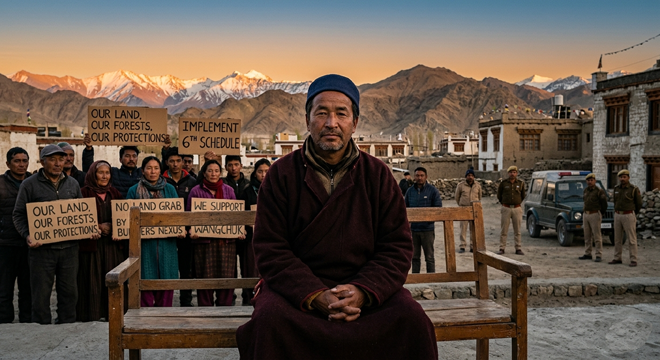
Ladakh possesses something that many other parts of India no longer have in abundance: vast stretches of relatively untouched land. Beneath this land lie potential mineral resources, and above it stand landscapes capable of supporting tourism, infrastructure, and strategic installations. To some, this represents opportunity. To others, it represents danger, particularly the danger that outside economic interests might overwhelm the small local population.
In recent years, the debate has increasingly focused on whether Ladakh should receive special legal protections that restrict who can buy land and how natural resources can be exploited. These protections are often framed in terms of tribal land rights and forest protections, which would ensure that the land remains primarily in the hands of local communities.
At the heart of this debate stands a group of activists and public figures who argue that without such safeguards Ladakh could experience the same land speculation and environmental degradation seen in many other parts of India. Among them is a figure who became widely known through cinema: the real-life inspiration behind the fictional character Phunsukh Wangdu in the celebrated Bollywood film 3 Idiots. The character was inspired by the engineer and education reformer Sonam Wangchuk, whose activism has increasingly focused on protecting Ladakh’s land, culture, and ecological balance.
For centuries this cold desert remained isolated from the rush of modern economic forces. Its villages, monasteries, and fragile ecosystems evolved slowly, shaped by harsh winters, limited water, and a deeply rooted cultural heritage influenced by Tibetan Buddhism. Today, after the abrogation of Article 370 in Kashmir, Ladakh finds itself at the center of a complex debate involving development, land ownership, ecological preservation, and political power.
The story of land in Ladakh is therefore not merely about property or mining rights. It is about identity, survival, and the tension between economic development and the preservation of a fragile Himalayan society.
The unique geography and culture of Ladakh
Understanding the land question in Ladakh requires first understanding the region itself. Situated between the great mountain ranges of the Karakoram and the Himalayas, Ladakh is one of the highest inhabited regions on Earth. Much of its terrain lies above 10,000 feet, where oxygen levels are low and agriculture is possible only during short summer months.
Historically Ladakh functioned as a crossroads of trade between Central Asia, Tibet, and the Indian subcontinent. Caravans moved through its mountain passes carrying salt, wool, tea, and spices. Over centuries this trade produced a unique cultural blend influenced by Tibetan Buddhism, Central Asian commerce, and Indian administration.
Today Ladakh is administratively separate from the former state of Jammu and Kashmir, having been reorganized in 2019 into its own union territory by the Government of India. The decision was part of a larger political restructuring associated with the abrogation of Article 370 of the Indian Constitution.
While the change brought Ladakh directly under the administration of New Delhi, it also triggered new concerns among locals about land ownership. Previously, certain protections under the old state laws limited land purchases by outsiders. With the new administrative structure, residents feared that those safeguards might weaken.
This concern is particularly acute because Ladakh’s population is small. The entire region has fewer than 300,000 residents spread across vast mountainous terrain. In such circumstances, even a modest influx of outside investment in land could dramatically change ownership patterns.
The attraction of Ladakh’s land and mineral wealth
In recent decades Ladakh has drawn increasing attention from investors, infrastructure developers, and mining companies. The reasons are not difficult to understand.
First, Ladakh possesses enormous tracts of land suitable for tourism infrastructure. As India’s domestic tourism market expands, the demand for hotels, resorts, and adventure tourism facilities has increased dramatically. The dramatic landscapes of Ladakh, including places like Pangong Lake and Nubra Valley, attract thousands of visitors each year.
Second, the region may contain valuable mineral deposits. Geological surveys have long suggested the presence of resources such as lithium, rare earth elements, and other strategic minerals in the broader Himalayan belt. In a world transitioning toward electric vehicles and renewable energy, such minerals have become highly valuable.
Third, Ladakh’s strategic location near the border with China has made it a focal point for military infrastructure. Roads, airfields, and logistical facilities require land and construction activity, which in turn stimulates economic interest in surrounding areas.
For property developers and speculative investors, these factors combine to create a powerful incentive: buy land early and wait for development to raise its value.
But for many Ladakhis, this scenario raises a disturbing possibility. They fear that wealthy outsiders could purchase large amounts of land, driving up prices and pushing local communities to the margins of their own homeland.
The demand for tribal land protection
To prevent such outcomes, many Ladakh residents have called for the extension of legal protections similar to those granted to tribal areas elsewhere in India.
In particular, activists have demanded inclusion under provisions like the Sixth Schedule of the Indian Constitution or comparable frameworks that protect indigenous land ownership. Such provisions restrict the transfer of land to non-local buyers and give local councils greater authority over development decisions.
Supporters of these protections argue that Ladakh’s environment is extremely fragile. The region’s water resources depend heavily on glaciers, many of which are shrinking due to climate change. Overdevelopment could quickly overwhelm the delicate balance that sustains agriculture and traditional livelihoods.
Moreover, Ladakh’s cultural heritage is deeply tied to its land. Monasteries, village commons, and traditional grazing areas form part of a social system that has survived for centuries in an extremely harsh climate.
Activists argue that once land speculation begins, it becomes almost impossible to reverse. What begins with small purchases eventually leads to large real estate projects, which then attract more migrants, investors, and infrastructure demands.
In their view, tribal land protections are therefore not an obstacle to development but a safeguard ensuring that development occurs in a controlled and sustainable manner.
The rise of activism in Ladakh
In this debate, the voice of local activism has grown stronger in recent years. Among the most prominent figures advocating environmental and land protections is Sonam Wangchuk.
An engineer, innovator, and educator, Wangchuk gained national recognition through his work on sustainable technologies suited for Himalayan conditions. He pioneered the concept of artificial glaciers known as “ice stupas,” designed to store winter water for use during the dry spring season.
Beyond technological innovation, Wangchuk has increasingly emerged as a public advocate for Ladakh’s future. He has spoken extensively about the risks posed by uncontrolled tourism, climate change, and large-scale land acquisition.
His activism often emphasizes that Ladakh’s environment cannot support the same development model used in the plains of India. Water scarcity, fragile soils, and high altitude place strict limits on infrastructure expansion.
Through public campaigns, speeches, and social media outreach, he has argued that Ladakh must chart its own path, one that prioritizes ecological sustainability and community ownership.
When activism meets political power
However, activism in politically sensitive regions often intersects with broader national debates about security, development, and governance.
Ladakh lies in one of the most strategically important parts of India’s northern frontier. Its borders touch areas of long-standing geopolitical tension involving both China and Pakistan.
In such a context, authorities are often cautious about protests or movements that could disrupt administrative stability. Laws originally designed to address terrorism and national security sometimes come into play when dealing with large-scale protests or political agitation.
Critics argue that this dynamic can blur the line between legitimate civic activism and perceived threats to public order. Supporters of the government, on the other hand, maintain that maintaining stability in border regions is essential for national security.
Within this complicated environment, episodes have occasionally arisen where activists claim they were subjected to legal pressure or intimidation.
The symbolism of resistance
Stories of individuals standing firm under pressure often become powerful symbols within social movements. In Ladakh, narratives of resistance to land speculation and environmental degradation have helped mobilize public support.
For many activists, the issue is framed not merely as a legal dispute but as a moral struggle. They argue that Ladakh’s land is not simply a commodity to be traded but a shared inheritance belonging to future generations.
Such framing resonates strongly in a region where cultural traditions emphasize community cooperation and respect for nature. Monastic teachings often stress the interconnectedness of human life and the environment.
When an activist refuses to back down from their demands despite legal challenges, it reinforces the perception that the cause itself is just and deeply rooted in the region’s cultural values.
Development versus preservation
The conflict over land in Ladakh ultimately reflects a broader dilemma faced by many regions across the world: how to balance economic development with environmental preservation.
On one side are those who argue that Ladakh needs greater investment, infrastructure, and job opportunities. Tourism, mining, and construction could potentially generate employment for young people who might otherwise migrate to cities.
On the other side are those who fear that rapid development would permanently damage the region’s fragile ecosystems. Once glaciers shrink, water sources disappear, or traditional grazing lands are lost, the consequences could be irreversible.
This tension is particularly acute in high-altitude regions where environmental changes occur slowly but are difficult to reverse.
Many Ladakhis therefore advocate a middle path: development that is carefully regulated, locally controlled, and environmentally sustainable.
The influence of national politics
Land policy in Ladakh is ultimately shaped by decisions made in New Delhi. The central government must balance local aspirations with national priorities, including strategic infrastructure and economic growth.
Political leaders often emphasize that Ladakh’s development is essential for strengthening India’s presence in the Himalayan frontier. Roads, telecommunications networks, and renewable energy projects are frequently highlighted as key priorities.
At the same time, the government has acknowledged the importance of protecting Ladakh’s cultural identity and environmental heritage.
Negotiations between local leaders, activists, and national authorities continue as both sides attempt to find a workable framework for land governance.
The future of Ladakh’s land
The outcome of this debate will shape Ladakh’s future for decades to come. If strong land protections are implemented, the region may retain its traditional community-based land ownership structures while allowing carefully managed development.
If such protections are weakened or absent, market forces could rapidly transform the region’s land ownership patterns.
Either path carries risks and opportunities.
What makes Ladakh’s situation unique is the combination of ecological fragility, strategic importance, cultural heritage, and economic potential. Few regions face such a complex intersection of factors.
A landscape that demands caution
Ultimately the story of Ladakh’s land is a reminder that geography shapes politics as much as ideology does. In a high-altitude desert where water is scarce and winter temperatures plunge far below freezing, the margin for environmental error is extremely small.
Development decisions made today could determine whether Ladakh remains a largely intact Himalayan ecosystem or becomes another example of uncontrolled mountain tourism and speculative real estate expansion.
The voices calling for protection argue that once land passes into the hands of powerful economic interests, it becomes extremely difficult for local communities to reclaim control.
Yet the forces of development are powerful and persistent, driven by national growth, global demand for minerals, and the allure of Ladakh’s dramatic landscapes.
Between these competing visions lies a narrow path, one that requires careful policy, transparent governance, and a deep respect for the land itself. Whether Ladakh succeeds in navigating this path may ultimately depend on how strongly its people continue to assert their rights, their identity, and their responsibility toward one of the world’s most remarkable high-altitude regions.