
Modi represents a political reality the West has not fully come to terms with: a leader from an erstwhile “third world” country who is not seeking approval, does not crave proximity, and is perfectly comfortable saying no—repeatedly, publicly, and without apology
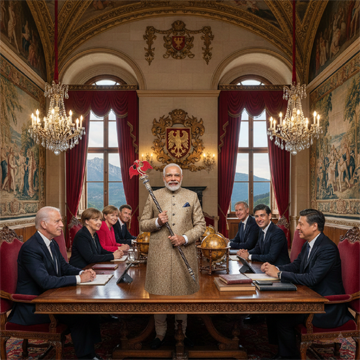
Power is often misunderstood when it comes from outside the traditional centres of global authority. For decades, the West has been accustomed to leaders from developing or formerly colonised nations arriving hat in hand—eager for validation, desperate for optics, willing to trade autonomy for access. Prime Minister Narendra Modi does not fit this mould. He neither bends nor breaks. And that, more than anything else, unsettles a certain political temperament in Washington.
Modi represents a political reality the West has not fully come to terms with: a leader from an erstwhile “third world” country who is not seeking approval, does not crave proximity, and is perfectly comfortable saying no—repeatedly, publicly, and without apology. This is not belligerence. It is sovereignty exercised with confidence.
Donald Trump’s recent irritation, and his attempts to spin or dilute a sequence of clear diplomatic rejections, must be understood in this context. What rankles is not the refusal itself, but the audacity of refusing.
Forgotten rejections and the selective memory of power
It appears that Donald Trump has conveniently forgotten—or chosen to forget—that Prime Minister Modi declined his invitations not once, but three times within a short span. Each rejection was deliberate, unambiguous, and rooted in India’s priorities rather than American optics.
The first instance came around the G7 Summit in Canada in June 2025. Trump extended an invitation for a Washington stopover immediately after the summit, clearly intended to create headlines and reinforce a narrative of proximity. Modi declined publicly, citing a prior commitment to visit Odisha and pay respects at the Jagannath temple. This was not a casual scheduling conflict. It was a conscious decision to prioritise domestic commitments and cultural continuity over an international photo-op.
The second instance followed soon after, when Trump hosted Pakistan’s General Asim Munir for a White House lunch. Around the same time, Modi was invited for a stopover. Once again, he declined. The symbolism was impossible to miss. India was not interested in being slotted into a diplomatic tableau where its security concerns and red lines were being diluted for transactional convenience.
The third rejection came in October 2025, when Trump invited Modi to attend Gaza peace talks in Sharm el-Sheikh. India chose to be represented at a lower level, and Modi himself stayed away. This was a clear signal that India would not lend its highest political authority to forums framed primarily around others’ strategic narratives, especially where outcomes were predetermined and optics outweighed substance.
These were not accidents. They were decisions.
Five calls, no answer: The trust deficit that speaks volumes
What makes the episode even more revealing is what followed these refusals. It is on record that Trump attempted to reach Modi by phone five times. Modi did not take those calls, citing a trust deficit.
In diplomatic terms, this is extraordinary. World leaders usually go out of their way to maintain at least a façade of constant communication. To allow calls to go unanswered is not discourtesy; it is a message. It signals that the issue is not timing but trust.
Trust, once eroded, cannot be repaired through theatrics or flattery. Modi’s refusal to engage telephonically suggests a deeper assessment of intent—an understanding that dialogue without sincerity becomes noise, and engagement without respect becomes imbalance.
For Trump to later deny, distort, or minimise this sequence only deepens the perception of political petulance. Heads of state are expected to speak with dignity and gravitas, not with the tone of a novice grasping at relevance.
India’s independent foreign policy: Not a slogan, but a practice
These rejections underscore something fundamental about India’s contemporary foreign policy: it is independent not in rhetoric, but in execution.
India under Modi does not align automatically, does not attend reflexively, and does not validate agendas it did not help shape. Invitations from Washington no longer carry an implicit premium. They are evaluated on merit, timing, and alignment with India’s national interest.
This is a profound shift from earlier decades, when proximity to the United States was often treated as an end in itself. Modi has inverted that equation. Engagement is conditional. Respect is non-negotiable. Optics are secondary.
The West often mistakes this posture for arrogance or aloofness. In reality, it is the natural behaviour of a civilisation-state rediscovering its equilibrium after centuries of external dominance.
Sovereignty over spectacle: The Odisha and Jagannath signal
Modi’s decision to prioritise a visit to Odisha and the Jagannath temple over a Washington stopover deserves particular attention. This was not merely a personal or religious choice. It was a political signal layered with meaning.
By choosing Jagannath over Washington, Modi reminded both domestic and international audiences that India’s civilisational anchors matter more than elite validation. He reinforced the idea that India’s legitimacy flows from its people, its traditions, and its internal cohesion—not from the approval of foreign capitals.
For a Western political culture steeped in optics and summitry, this is difficult to digest. But for India, it is a declaration of self-confidence.
Disengagement as strategy, not sulk
Critics may argue that repeated refusals amount to disengagement. That interpretation misses the point. This is not withdrawal; it is calibration.
Modi has shown that India will engage deeply where interests converge—on technology, defence manufacturing, energy transition, and multipolar governance. But India will disengage, or downgrade engagement, where conversations are framed around pressure, symbolism, or imbalance.
The pattern of refusals suggests not petulance but prudence. It reflects a leadership unwilling to be drawn into performative diplomacy that offers little strategic value.
Trump’s spin and the erosion of credibility
For Trump to deny or distort these facts is not merely misleading; it undermines the credibility expected of a U.S. President. When the leader of the world’s most powerful nation appears unable to accept rejection with grace, it exposes a fragility beneath the bravado.
Diplomacy is not a popularity contest. It is an exercise in mutual respect. Attempting to rewrite the narrative after the fact only amplifies the original slight.
Worse, it signals to other global leaders that Washington struggles to accept a world where its invitations are no longer irresistible.
The West’s discomfort with a non-compliant India
At the heart of this episode lies a deeper discomfort. The West is still adjusting to an India that is assertive, selective, and unapologetic. Modi is not the problem; the problem is an outdated mental model of India.
This is an India that does not seek to be “managed,” “mentored,” or “integrated” on someone else’s terms. It participates as an equal, not as a junior partner. It listens, but it also declines.
For leaders accustomed to deference, this feels like defiance.
Modi as a product of civilisational memory
Modi’s political instincts are rooted in a long civilisational memory. India has seen empires rise and fall. It has endured conquest, colonisation, and condescension. It has learned that sovereignty, once compromised, is difficult to reclaim.
This historical consciousness informs Modi’s choices. It explains his reluctance to be drawn into episodic engagements that do not respect India’s autonomy. It explains his insistence on dignity over display.
A tough cookie the world must learn to digest
Modi is, indeed, a tough cookie. Not because he postures, but because he is anchored. He does not bend because he does not need to. He does not break because he is not stretched beyond his principles.
The West will eventually learn to digest this reality. The alternative is continued frustration, misreading, and diplomatic self-inflicted wounds.
India is no longer auditioning for a role in a Western-written script. It is writing its own.
The new normal in global power relations
The episode of repeated invitations and repeated refusals is not an aberration. It is the new normal. As power diffuses and the world moves towards multipolarity, leaders like Modi will become more common.
They will say no. They will prioritise domestic legitimacy over foreign applause. They will engage on their terms.
Donald Trump’s irritation is understandable—but it is also instructive. It reveals how difficult it is for legacy powers to adjust to a world where respect must be earned, not assumed.
Prime Minister Narendra Modi has made one thing abundantly clear: India will not bend for optics, will not break under pressure, and will not apologise for choosing itself. And that is a reality the West must now learn to live with.