
There was no official notification by the Government of India banning the 10-minute delivery service being offered by hyper-local companies and quick service restaurant. Just a meeting had been conducted by the Minister for Labour with the companies offering 10-minute delivery, where the minister insisted verbally that these companies drop the branding on advertising and the uniforms of these delivery workers. The minister never issued a formal notification and neither did the ministry or any other ministry ask for the service to be discontinued either verbally or in the official gazette. Right? So, in effect, nothing changed on the ground except that we can still order for and receive 11-minute delivery. All that has changed is MP Raghav Chaddha’s popularity, while retaining respect and reputation of the current government
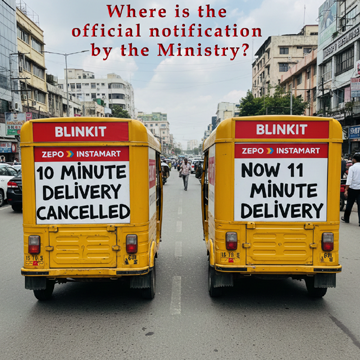
Public discourse in India often moves faster than policy itself. Nowhere was this more visible than in the recent uproar around so-called “10-minute delivery” services offered by hyper-local delivery platforms and quick service restaurants. Headlines screamed of a ban. Television studios debated worker exploitation. Social media amplified outrage and celebration in equal measure. Yet, when the noise settled, a simple and inconvenient fact remained: there was no ban at all.
Let us be very clear. The Government of India never issued an official notification prohibiting 10-minute delivery services. There was no gazette publication. There was no circular from the Ministry of Labour. There was no inter-ministerial directive. There was not even a written advisory. What existed instead was a meeting—one meeting—where the Labour Minister verbally expressed discomfort with the branding of “10-minute delivery” and suggested that companies rethink how they advertise and position such services.
That distinction between law and optics, between enforceable regulation and verbal persuasion, lies at the heart of this episode. And it raises deeper questions about governance, political theatre, media responsibility, and the curious ability of narratives to triumph over facts in modern India.
What actually happened: The facts on record
The sequence of events is uncomplicated, though deliberately complicated by commentary. A meeting was convened by the Minister for Labour with representatives of companies offering ultra-fast delivery services. The minister raised concerns about worker safety, stress, and the symbolism of the “10-minute” promise. Importantly, the minister did not issue any formal order to shut down or suspend services. Instead, he verbally insisted that companies drop the “10-minute” branding from advertisements and delivery personnel uniforms.
That is where the state’s involvement ended.
No notification followed. No ministry—neither Labour, Commerce, Consumer Affairs, nor Road Transport—issued a directive asking companies to discontinue the service. No enforcement agencies were activated. No penalties were prescribed. No compliance deadlines were set. In administrative terms, nothing moved beyond conversation.
On the ground, predictably, nothing changed.
Customers continue to place orders. Riders continue to deliver them. Apps continue to optimise routes and inventories. The only visible change is semantic: “10 minutes” quietly becomes “11 minutes” or “fastest delivery” or “express.” The service survives intact, merely cosmetically altered.
Regulation by suggestion: A peculiar indian phenomenon
This episode exemplifies a uniquely Indian mode of governance: regulation by suggestion rather than statute. Ministers often use meetings, statements, and televised remarks as instruments of control, fully aware that companies—especially those dependent on licenses, goodwill, or future policy—will comply voluntarily to avoid confrontation.
Such soft power governance has its advantages. It avoids bureaucratic delays. It prevents litigation. It allows flexibility. But it also comes at a cost: ambiguity. When there is no written order, there is no clarity. When there is no law, there is no accountability. When there is no enforcement mechanism, there is no uniformity.
In this case, companies were not told to stop delivering in ten minutes. They were told, informally, to stop saying they do. That distinction reveals the government’s real concern was not operational risk but reputational optics. The problem was not speed itself, but how speed looked.
The semantics of speed and the illusion of safety
By shifting from “10 minutes” to “11 minutes,” the industry exposed the fragility of the entire debate. If one extra minute can supposedly resolve concerns about worker safety, then the problem was never speed—it was branding.
No delivery executive suddenly becomes safer because the app shows 11 instead of 10. No road becomes less congested. No traffic signal changes its cycle. No incentive structure inside these platforms meaningfully alters overnight. Algorithms still push for efficiency. Customers still expect immediacy. Riders are still rewarded for faster completion.
What changes is the narrative. And narratives, in modern governance, often matter more than material reality.
The government can claim intervention. Companies can claim compliance. The media can claim impact. Meanwhile, the lived experience of workers remains largely untouched.
Media amplification and the creation of a ban that never was
One of the most striking aspects of this episode was how quickly the idea of a “ban” took root. Without a single official document to support it, news outlets reported that the government had “banned 10-minute delivery.” Social media commentators celebrated the supposed triumph of labour rights. Critics accused the government of being anti-startup. None paused to ask a basic question: where is the order?
This is not merely a journalistic lapse. It is a systemic failure of verification. In a country governed by written law, policy does not exist unless it is notified. Verbal instructions, no matter how authoritative, do not carry legal force. Yet the public was encouraged to believe that a decisive regulatory intervention had taken place.
The result was collective self-deception—one that benefited all players except the truth.
The curious case of MP Raghav Chaddha and political optics
Into this confusion stepped Raghav Chaddha, whose intervention amplified the issue’s visibility. His statements framed the episode as a moral victory—workers protected, exploitation challenged, capitalism restrained. For his supporters, it reinforced his image as a voice of the urban working class. For critics, it appeared opportunistic.
What is undeniable, however, is that the episode enhanced his political visibility without producing measurable policy change. By engaging with a controversy that required no legislative follow-through, political capital was accrued at minimal institutional cost.
At the same time, the ruling government emerged relatively unscathed. By avoiding a formal ban, it protected India’s startup ecosystem from regulatory shock while projecting sensitivity to labour concerns. It managed to appear both pro-worker and pro-business, a rare political balancing act.
In that sense, the only thing that truly changed was perception: Raghav Chaddha’s popularity received a boost, and the government retained its reputation for pragmatic restraint.
The startup ecosystem and the fear of formal regulation
India’s hyper-local delivery sector is deeply sensitive to regulatory signals. Investors watch ministries closely. Founders parse ministerial language like lawyers. A formal ban or notification would have triggered panic—valuation corrections, layoffs, investor exits.
By keeping the intervention informal, the government avoided spooking capital while still asserting moral authority. This is a deliberate strategy. India wants to be seen as a startup-friendly nation, especially at a time when global venture funding is cautious. Heavy-handed regulation would contradict that narrative.
Thus, the absence of an official ban was not an oversight. It was the point.
Labour rights: Substance deferred, symbolism delivered
From a labour perspective, the episode is sobering. Real issues faced by delivery workers—long hours, algorithmic pressure, lack of social security, road safety risks—remain unresolved. None of these were addressed through structural reform, mandatory insurance norms, or enforceable safety standards.
Instead, attention was diverted to the symbolism of “10 minutes.” This allowed all stakeholders to claim moral positioning without undertaking difficult reforms. Workers were invoked rhetorically but not empowered materially.
True labour protection would require codifying gig work under labour laws, enforcing minimum guarantees, and regulating algorithmic incentives. None of that happened. A slogan was erased, and the system moved on.
Governance without paper trails
The absence of any written communication raises concerns about institutional transparency. Governance by meeting minutes and media leaks undermines the rule-based nature of administration. If companies comply today because a minister suggested something verbally, what happens tomorrow when another minister suggests the opposite?
Written notifications exist precisely to prevent such uncertainty. They allow courts to adjudicate. They allow companies to plan. They allow citizens to understand their rights and obligations.
In this case, ambiguity served political convenience, but it weakened institutional clarity.
Consumers and the illusion of choice
For consumers, the episode changed nothing except the numbers on their screens. Orders still arrive at roughly the same speed. Expectations remain unchanged. Behaviour remains conditioned by years of instant gratification.
This reveals another uncomfortable truth: demand, not supply, drives hyper-fast delivery. As long as consumers reward speed, platforms will chase it. Removing a number from branding does not undo consumer psychology.
If society truly believes such services are unethical, the debate must extend beyond companies and ministers to consumer responsibility. That conversation, however, is far more uncomfortable—and therefore avoided.
The politics of doing just enough
This episode perfectly illustrates the politics of doing just enough. The government did enough to appear concerned. Companies did enough to appear compliant. Politicians did enough to appear relevant. The media did enough to appear vigilant.
But no one did enough to change reality.
And perhaps that is the most telling outcome of all.
When nothing changes, everything is claimed
So, let us return to the central question. Was there a ban on 10-minute delivery services? No. Was there a formal government directive? No. Was any ministry involved beyond a verbal intervention? No. Did services stop? No. Did workers’ conditions materially improve? No.
What changed, then?
Perceptions changed. Headlines changed. Political reputations shifted slightly. The ruling government preserved its image. Raghav Chaddha gained visibility. Companies tweaked language. The system absorbed the shock and carried on.
In effect, nothing changed on the ground—except that we can now order and receive our food in 11 minutes. And perhaps that is the most honest summary of modern policymaking: a great deal is said, very little is written, and almost nothing truly changes.