
Typically, faster real growth is accompanied by moderate price pressures, particularly in services, wages, and construction. A near-zero deflator suggests either an economy experiencing severe price compression or statistical distortions that are understating nominal activity
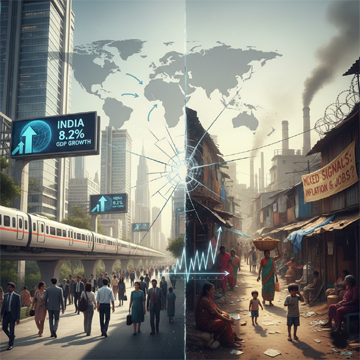
India’s strong GDP headline and the softer story beneath it: India’s growth story continues to attract global attention. An 8.2 per cent real GDP growth rate in the July–September quarter of 2025 places India firmly among the fastest-growing large economies in the world. At a time when advanced economies are struggling with stagnation, supply chain fragmentation, and protectionist trade policies, India’s headline number projects resilience and momentum. Yet, beneath this impressive surface lies a more complex and unsettling reality. Growth, while strong in appearance, is sending mixed and sometimes contradictory signals.
The concern is not that India is growing slowly; it is that the nature, composition, and measurement of this growth raise difficult questions. High real GDP growth combined with inflation hovering near the policy target should normally translate into robust nominal GDP growth. Instead, nominal growth has weakened sharply. This divergence between real and nominal GDP is not a technical footnote—it has material consequences for taxation, corporate profitability, fiscal planning, and private investment decisions. Celebrating the headline number without interrogating its foundations risks complacency at a time when clarity is most needed.
Understanding the real–nominal disconnect
Between Q4 of FY 2024–25 and Q2 of FY 2025–26, India’s real GDP growth accelerated steadily from 7.4 per cent to 7.8 per cent and then to 8.2 per cent. Over the same period, nominal GDP growth moved in the opposite direction. The principal driver of this divergence has been the sharp collapse in the implicit GDP deflator—from 3.7 per cent to a mere 0.5 per cent.
For a developing economy like India, such convergence between real and nominal GDP growth rates is highly unusual. Typically, faster real growth is accompanied by moderate price pressures, particularly in services, wages, and construction. A near-zero deflator suggests either an economy experiencing severe price compression or statistical distortions that are understating nominal activity. Either interpretation is troubling.
This real–nominal disconnect matters because nominal GDP is the base on which tax revenues, corporate earnings, debt sustainability, and fiscal arithmetic are built. Governments do not collect taxes in “real” terms; firms do not service loans in inflation-adjusted units. Weak nominal growth compresses fiscal space, complicates deficit management, and undermines confidence in revenue projections. When nominal numbers underperform persistently, the economy’s ability to translate growth into tangible financial outcomes comes into question.
Why weak nominal growth is a policy problem
Muted nominal growth directly affects the state’s capacity to act. Tax collections depend far more on nominal income and expenditure than on real output estimates. When deflators collapse, even strong real growth fails to generate commensurate tax buoyancy. This constrains government spending precisely when public investment and social support are needed to sustain demand and employment.
Corporate India feels this squeeze as well. Weak nominal growth translates into slower revenue growth, even if volumes appear healthy. This is visible in corporate earnings reports that have consistently underwhelmed relative to headline GDP claims. Firms facing stagnant pricing power and margin pressure are unlikely to embark on aggressive capacity expansion, regardless of how favourable credit conditions may be. In this sense, private investment is not “hesitant” or irrational—it is responding logically to muted returns and uncertain demand visibility.
Fiscal policy, too, becomes harder to calibrate. Budget assumptions based on optimistic real growth figures risk overestimating revenue inflows. This can lead either to expenditure compression later in the year or to higher borrowing than planned, both of which carry macroeconomic costs. The credibility of fiscal projections ultimately rests on nominal, not real, outcomes.
Consumption: Front-loaded and potentially fragile
A significant portion of India’s recent growth has been driven by consumption, particularly urban and upper-income consumption. While this has supported short-term momentum, the durability of this trend is far from assured. Consumption growth appears front-loaded, fuelled by post-pandemic normalisation, pent-up demand, and easier credit conditions rather than broad-based income growth.
The labour market tells a sobering story. Job creation remains weak relative to the pace of output expansion. Firms are scaling up production without proportionate hiring, relying instead on productivity gains, automation, and informal or contractual labour. Without robust job creation, consumption becomes increasingly dependent on a narrow segment of the population, making demand vulnerable to shocks.
Rural consumption, in particular, remains uneven. Agricultural incomes are exposed to climate volatility, while real wage growth in the informal sector has been subdued. Without a sustained improvement in employment and incomes, consumption-led growth risks losing steam. Demand without jobs is an illusion—temporarily persuasive, but structurally fragile.
Manufacturing momentum is already softening
Manufacturing, long seen as the missing link in India’s growth story, shows signs of deceleration. High-frequency indicators, including purchasing managers’ indices and capacity utilisation surveys, point to a loss of momentum. While government-led infrastructure spending has supported core industries, private manufacturing investment has not kept pace.
This softness reflects both domestic and global factors. Domestically, regulatory uncertainty, compliance burdens, and unpredictable policy shifts continue to weigh on investor sentiment. Internationally, fragmented supply chains, slowing global trade, and rising tariffs—particularly from the United States—have dampened export-oriented manufacturing prospects.
The risk is that manufacturing growth becomes episodic rather than structural, responding to short-term incentives rather than long-term competitiveness. Without sustained manufacturing expansion, India’s ambition to absorb its growing workforce into productive employment remains elusive.
Investment: Credit Is available, returns are not
One of the most revealing aspects of the current cycle is the divergence between credit availability and investment appetite. Banks are well-capitalised, non-performing assets are under control, and credit growth remains healthy. Yet private capital expenditure has not surged in tandem.
This disconnect underscores a critical point: investment decisions are driven by expected returns, not merely by access to finance. Weak nominal growth, uncertain demand visibility, and regulatory unpredictability reduce the attractiveness of long-term investments. Firms may borrow to optimise balance sheets or refinance existing debt, but they are reluctant to commit capital to new capacity without confidence in future cash flows.
In this context, the assertion that private investment is “hesitant” misdiagnoses the problem. Investment is rationally unconvinced. Until growth translates into pricing power, revenue visibility, and stable policy signals, capital will remain cautious.
Exports in a fragmenting global economy
India’s export sector faces formidable headwinds. Global trade is slowing, supply chains are being reconfigured along geopolitical lines, and protectionist measures are proliferating. Higher US tariffs and strategic trade restrictions have increased uncertainty for exporters, particularly in manufacturing and technology-intensive sectors.
While India has made strides in diversifying export markets and improving logistics, these gains are offset by global fragmentation. Services exports, especially IT and business services, continue to perform relatively well, but they are not immune to global slowdown and automation pressures.
Reviving export competitiveness requires more than bilateral trade agreements. It demands sustained improvements in productivity, regulatory simplicity, infrastructure efficiency, and skills development. Without a stronger export engine, India’s growth will remain overly reliant on domestic demand, amplifying the risks associated with weak job creation.
Statistical systems under strain
Perhaps the most underappreciated aspect of the current debate is the role of statistical systems. The widening gap between official GDP estimates, corporate earnings, tax collections, and high-frequency indicators has raised legitimate questions about data quality and interpretation.
Collapsing deflators risk overstating real activity, particularly when price indices fail to capture sectoral realities accurately. While no statistical system is perfect, persistent divergences undermine confidence in headline numbers and complicate policy formulation. Policymakers rely on accurate data to calibrate interest rates, fiscal interventions, and structural reforms. When data sends conflicting signals, the risk of policy missteps increases.
Modernising India’s statistical architecture is therefore not a technocratic luxury but an economic necessity. Cleaner data, transparent methodologies, and timely revisions are essential to restore credibility and ensure that policy is guided by clarity rather than confusion.
Regulatory clarity as a catalyst for investment
The importance of regulatory clarity cannot be overstated. Recent legislative actions, such as the passage of the nuclear Bill, demonstrate how clear, decisive policy frameworks can unlock long-term investment. When rules are stable, risks are quantifiable, and timelines are predictable, capital responds.
Demand visibility works in tandem with regulatory certainty. The reforms undertaken in 2025 have improved aspects of market access and compliance, but their impact on private capex will depend on consistent implementation. Signals generated at the policy level must travel upstream through supply chains, balance sheets, and boardrooms. Mixed or contradictory signals dilute this transmission.
For India to revive private investment meaningfully, it must reduce regulatory noise, streamline approvals, and provide credible long-term roadmaps in key sectors such as energy, manufacturing, logistics, and technology.
Growth quality over growth optics
The central lesson of the current moment is that growth quality matters more than growth optics. High real GDP growth accompanied by weak nominal expansion, limited job creation, and subdued investment is not a sustainable equilibrium. It may sustain optimism in the short term, but it cannot deliver inclusive prosperity over the long run.
Jobs are the missing link. Without employment growth, demand remains narrow, inequality widens, and political economy pressures intensify. Firms that scale without hiring weaken the very engine that sustains growth—household income and consumption. In such an environment, private investment rationally waits for clearer signals.
From resilience to credibility in 2026
If 2025 was about resilience—weathering global shocks, maintaining macro stability, and sustaining headline growth—then 2026 must be about credibility. Credibility in statistics, where numbers reflect lived economic realities. Credibility in policy, where signals are consistent and durable. And credibility in outcomes, where growth translates into jobs, incomes, and productivity gains that citizens can actually feel.
Moving beyond celebrating numbers requires a cultural shift in economic discourse. It means interrogating data, acknowledging trade-offs, and focusing on structural drivers rather than cyclical boosts. Reviving private investment, rebuilding export competitiveness, and modernising statistical systems are not optional add-ons; they are central to sustaining India’s growth trajectory. India’s GDP growth looks strong—and in many ways, it is. But the harder task lies ahead: ensuring that growth is real not only in statistical terms, but in the everyday economic experience of its people.

