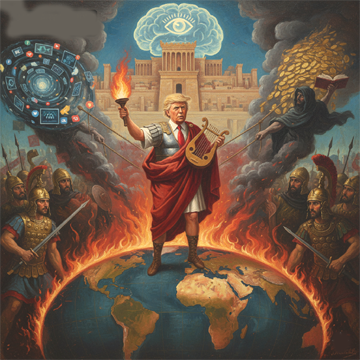
Persian Empire, theocracy, and the long war over the Persian mind that is going on from all directions. Meanwhile, Trump’s Nero moment persists with fire as foreign policy over the whole world. Trump is about white supremacy of the United States where Greenland, Iran, Russia and the immigrants inside USA are vassals
The standoff between Washington and Tehran, along with the nuclear dispute is a multilayered struggle over Iran’s future identity: whether it remains trapped in blind Sharia absolutism, or whether it can once again re-emerge as a liberal, scientific, and culturally confident nation. This struggle is being shaped overtly by American military pressure under Donald Trump’s autocratic global vision, and covertly by intelligence alignments — particularly the quiet convergence of Indian and Israeli interests aimed at weakening Iran’s authoritarian regime.
Iran’s long-anticipated “Arab Spring moment” has arrived late and malformed. Instead of a clean rupture, it has turned into what can only be described as a veritable mattress of springs — compressed revolts, suppressed uprisings, and half-crushed aspirations that refuse to lie still.
Iran today sits once again at the centre of a global contest that is older than the Islamic Republic itself. Long before clerics ruled from Qom and Tehran, Persia was a civilisational powerhouse — scientific, poetic, artistic, and philosophically curious. The modern Iranian tragedy lies not merely in sanctions or bombs, but in the prolonged suffocation of that civilisational impulse by an inflexible theocratic state that mistakes ideological rigidity for national strength.
The Islamic republic: Ideology as national prison
The Iranian regime is not merely authoritarian; it is doctrinal. Its power flows not from popular consent but from clerical interpretation of divine will. Sharia law in Iran is not a legal framework open to reform or reinterpretation; it is an instrument of social control, enforced by morality police, revolutionary courts, and a security apparatus that treats dissent as heresy.
This rigidity has hollowed out the Iranian state. Scientific institutions exist but are politically constrained. Art survives only in coded, underground forms. Women, the most dynamic demographic force in the country, live in constant negotiation with a regime that views autonomy as rebellion. Iran’s young population — educated, globally aware, digitally connected — is governed by men who still speak the language of 1979.
The result is a nation locked in ideological stasis, incapable of evolving internally, and therefore perpetually vulnerable to external pressure.
Trump’s Nero moment: Fire as foreign policy
Donald Trump’s approach to Iran fits a broader pattern in his worldview: power is theatrical, intimidation is policy, and diplomacy is something that happens after devastation. Like Nero fiddling while Rome burned — or more accurately, lighting the fire to demonstrate control — Trump has oscillated between annihilatory rhetoric and sudden calls for “fair and equitable deals.”
The pivot has been abrupt. Only weeks after US bombing raids on Iranian nuclear facilities in June, Trump declared Iran’s nuclear programme “obliterated.” Yet days later, in a social media post, he demanded Tehran negotiate a deal guaranteeing “NO NUCLEAR WEAPONS,” abandoning earlier moral outrage over Iran’s violent suppression of protests.
This contradiction is not accidental. It reflects Trump’s transactional understanding of geopolitics: human rights are leverage when useful, expendable when inconvenient.
The armada as argument
The arrival of the USS Abraham Lincoln carrier strike group in the region is not merely a military deployment; it is a statement of intent. The armada includes six Tomahawk-enabled guided missile destroyers, approximately 45 aircraft — including F-35C stealth fighters — and is supported by over 30,000 US troops already stationed across the region.
The message is clear: The United States is positioning itself to strike without permission.
Saudi Arabia and the United Arab Emirates, wary of Iranian retaliation, have publicly warned that their airspace will not be used for attacks. This reluctance highlights a key shift in Middle Eastern geopolitics: America’s traditional allies want containment without escalation, pressure without becoming targets.
The carrier group solves this problem neatly. As Michael Eisenstadt of the Washington Institute for Near East Policy noted, carrier-based aircraft allow the US to operate independently of regional consent. In imperial terms, the sea becomes sovereign territory.
Yet even this show of force has limits. A truly serious strike on Iran’s hardened infrastructure would require multiple carrier strike groups or extensive Air Force assets stationed ashore. The Lincoln group is a warning shot, not a knockout punch.
The nuclear question: Knowledge cannot be bombed
At the heart of the confrontation lies Iran’s nuclear programme — or more precisely, Western fear of it. While Iran acknowledges that its nuclear sites were severely damaged and that enrichment activities have been suspended, the International Atomic Energy Agency has not been allowed to resume full monitoring.
This is the crux of the problem. Nuclear infrastructure can be destroyed; nuclear knowledge cannot.
IAEA Director General Rafael Mariano Grossi has been blunt: Iran retains the scientific expertise to reconstitute its enrichment programme relatively quickly. Bombing alone cannot eliminate Iran’s stockpile of highly enriched uranium — the most dangerous component, because it can be rapidly weaponised.
Worse still, striking stockpiles without physical verification risks dispersing radioactive material, transforming a strategic problem into an environmental and humanitarian one. Military force here does not eliminate danger; it redistributes it.
Capitulation or chaos: Trump’s diplomatic trap
Trump’s demand for rapid capitulation has placed Iran’s leadership in an impossible position. Long-standing nuclear negotiations are complex, technical, and politically fraught. They require time, trust, and incremental concessions — all things Trump disdains.
By abruptly shifting from pressure over protest crackdowns to demands for immediate nuclear concessions, the US has destabilised even the internal Iranian factions that favour negotiation. There have been no credible attempts to resume talks for weeks, and the sudden insistence on a quick deal reportedly caught even seasoned negotiators by surprise.
This creates a dangerous vacuum: diplomacy has stalled, but war has not yet begun. Historically, this is when miscalculations thrive.
Israel, India, and the shadow war
While the American approach is loud and theatrical, a quieter campaign is unfolding beneath the surface. Israel’s Mossad has long been engaged in covert operations aimed at slowing Iran’s nuclear and military capabilities. Assassinations of scientists, cyber-attacks, sabotage — these are the tools of a shadow war.
India’s intelligence alignment with Israel in this context is driven less by ideology and more by cold strategy. A destabilised Iran weakens Pakistan’s regional leverage, disrupts extremist networks, and reshapes energy geopolitics. For New Delhi, Iran under clerical authoritarianism is a strategic liability; a liberal, scientifically open Iran would be a civilisational partner.
This convergence does not mean India seeks chaos. Rather, it reflects a belief that the Islamic Republic, in its current form, is unsustainable.
The mattress of springs: Iran’s broken Arab spring
Iran’s protest movements have been persistent but fragmented. Unlike Tunisia or Egypt, there was no single catalytic moment. Instead, Iran has experienced repeated cycles of unrest — over fuel prices, women’s rights, corruption, ethnic marginalisation — each brutally suppressed, each leaving behind compressed social tension.
Like a mattress filled with springs, every crackdown pushes resistance downward, storing energy rather than eliminating it. The regime survives, but at the cost of legitimacy. The state remains intact, but trust erodes.
This is why external pressure resonates internally. Sanctions, military threats, and covert operations do not create dissent — they amplify what already exists.
The risk of imperial miscalculation
Yet there is a profound danger in assuming that external force can engineer internal liberation. History offers sobering lessons: Iraq, Libya, Afghanistan. Authoritarian regimes can fall quickly; the vacuum they leave behind can last generations.
Iran is not a blank slate. It is a complex, multi-ethnic, historically proud society with deep memories of foreign interference — from British oil manipulation to the CIA-backed overthrow of Mohammad Mossadegh in 1953. Any perception that regime change is externally imposed risks delegitimising genuine internal reform movements.
Trump’s Nero-style brinkmanship may weaken the regime, but it could also rally nationalist sentiment around it.
Reimagining Iran: Science, art, and civilisation
The tragedy is that the alternative to the Islamic Republic is not chaos, but continuity with Iran’s deeper civilisational identity. A liberal Iran would not be a Western puppet; it would be a Persian renaissance — reconnecting with its scientific heritage, artistic traditions, and regional leadership role.
This is the Iran that once produced Avicenna, Hafez, and Khayyam. The Iran whose students already excel globally despite ideological constraints. The Iran whose women refuse to disappear behind enforced symbolism.
The question is not whether Iran can change, but whether the forces now pressing upon it will allow that change to emerge organically.
Fire temples, faith, and the future
Iran stands at a fault line between empire and theocracy, between coercion and creativity. The United States, under Trump, offers fire and ultimatums. Israel and its intelligence partners offer precision and patience. India watches, calculating long-term civilisational alignment.
None of these external actors truly control Iran’s destiny.
That power lies, ultimately, with the Iranian people — trapped for now beneath a regime that fears their intelligence more than foreign bombs. Whether this moment becomes a liberation or another crushed spring depends on whether pressure gives way to possibility, and whether Iran is allowed not just to survive, but to remember who it once was.