
CBAM functions as the most sophisticated non-tariff trade barrier the world has ever seen. Unlike tariffs, CBAM is dynamic. It tracks emissions embedded in every tonne of steel, aluminium, cement, fertiliser, and eventually a much broader basket of industrial goods
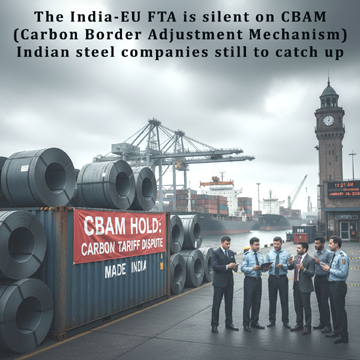
When India and the European Union finally announced the conclusion of their long-running free trade negotiations, there was a palpable sense of relief in Indian industry. After years of stops, starts, political hesitations, and bureaucratic deadlocks, the FTA was supposed to be the umbrella that sheltered Indian exporters from a rapidly hardening global trade environment. Nowhere was that hope stronger than in steel.
Europe is India’s most valuable premium steel market. It is where margins are higher, quality benchmarks are clearer, and long-term contracts actually mean something. As the EU prepared to roll out its Carbon Border Adjustment Mechanism (CBAM), many Indian producers assumed — or perhaps simply wished — that the FTA would include exemptions, transitional carve-outs, or at least a softer landing for Indian steel.
That hope has now evaporated over that great expectation from Brussels.
The India–EU FTA is silent on CBAM. Not ambiguous. Not deferred. Silent. And in global trade, silence is rarely neutral. It is usually a verdict.
CBAM: From climate instrument to trade weapon
The Carbon Border Adjustment Mechanism is officially framed as a climate policy. The EU argues that CBAM merely levels the playing field between European manufacturers, who already pay for carbon emissions under the EU Emissions Trading System (ETS), and foreign producers who do not. In theory, it prevents “carbon leakage” — the outsourcing of dirty production to countries with looser environmental rules.
In practice, CBAM functions as the most sophisticated non-tariff trade barrier the world has ever seen.
Unlike tariffs, CBAM is dynamic. It tracks emissions embedded in every tonne of steel, aluminium, cement, fertiliser, and eventually a much broader basket of industrial goods. Unlike quotas, it cannot be negotiated away once production processes are locked in. And unlike traditional environmental standards, it demands data, verification, digital reporting, and traceability that most developing-country firms simply do not possess today.
For Indian steel producers, CBAM is not a future risk. It is a present shock.
The FTA that didn’t protect
Trade agreements are not just about tariffs. In the 21st century, they are about regulatory alignment, transitional protections, and mutual recognition of standards. Indian negotiators knew CBAM was coming. The EU never hid it. Yet the final text of the FTA offers no relief mechanism for Indian steel exporters.
There is no phased exemption.
No grace period tied to development status.
No recognition of India’s lower historical emissions.
No linkage between India’s domestic carbon markets and the EU ETS.
No special treatment for MSME exporters.
The implicit message is brutal in its clarity: access to the European market will now be conditional on carbon performance, not diplomatic goodwill.
For large Indian conglomerates, this is painful but survivable. For small and mid-sized steel exporters, it is existential.
The first CBAM casualties
The warning signs are already materialising on the ground. Indian steel shipments have begun getting stuck at European ports — not because of quality issues, not because of dumping allegations, but because of incomplete or non-compliant carbon documentation.
Orders are being deferred.
Contracts are being renegotiated downward.
Some buyers are simply walking away.
Small exporters, who operate on thin margins and limited working capital, cannot absorb delays of weeks or months. CBAM reporting alone requires third-party verification, emissions audits, and digital submissions that cost more than the profit on many consignments.
This is India’s first CBAM shock. It will not be the last.
Why Indian steel is structurally vulnerable
India is the world’s second-largest steel producer, but size hides fragility. The industry is sharply bifurcated.
At one end are large integrated players — Tata Steel, JSW, AMNS — with balance sheets, captive power, and access to global capital. At the other end are hundreds of smaller producers reliant on coal-based blast furnaces, sponge iron, and outdated energy systems.
India’s steel sector is still heavily coal-dependent. While the country has made progress in renewable energy, decarbonising steel is far harder than decarbonising power. Green hydrogen, electric arc furnaces powered by clean electricity, and carbon capture technologies are still expensive and scarce.
Europe knows this. CBAM is calibrated precisely to exploit this structural gap.
Europe’s strategic hypocrisy
The EU presents CBAM as climate leadership. But there is an unspoken industrial strategy embedded within it.
European steelmakers have already offshored much of their dirtiest production. They now face rising energy costs, labour costs, and geopolitical uncertainty. CBAM allows them to re-shore selectively, protect domestic producers, and lock in technological advantage — all under the banner of environmental responsibility.
This is not illegal. It is smart power.
But it does mean that CBAM is not a neutral climate instrument. It is a carbon wall, carefully designed to preserve Europe’s industrial base while reshaping global supply chains in its favour.
The silent bargain India lost
Trade negotiations are about trade-offs. India likely prioritised market access for pharmaceuticals, IT services, and labour mobility over hard industrial concessions on steel and aluminium. That calculation may make sense on paper, but it leaves a critical sector exposed.
Steel is not just another export. It is foundational — to infrastructure, defence, manufacturing, and employment. Allowing CBAM to apply unmitigated means accepting that a core Indian industry will be disciplined externally rather than transformed internally on India’s own terms.
This is the silent bargain India lost in Brussels.
MSMEs: The unseen casualties
The most dangerous consequence of CBAM is not reduced exports, but industrial consolidation. Large firms will adapt. They will invest in emissions monitoring, buy carbon credits, and eventually shift to cleaner processes.
Small firms will not.
India’s steel MSMEs lack:
– Capital for decarbonisation
– Technical expertise in emissions accounting
– Access to global auditors
– Pricing power with European buyers
As CBAM compliance costs rise, European buyers will simply shift to fewer, larger, “cleaner” suppliers. India’s steel export ecosystem will shrink even if total tonnage holds steady.
This is de-industrialisation by filtration.
Carbon as the new currency of trade
CBAM signals a deeper transformation in global commerce. Carbon is becoming a currency. Embedded emissions will soon matter as much as price, quality, or delivery time.
Countries that fail to internalise this reality will find themselves locked out of premium markets — not by sanctions, but by standards.
India cannot afford to treat CBAM as a European problem. The same logic will soon appear in other markets — the UK, Japan, possibly even the US under future administrations.
The era of “export now, clean later” is over.
What India should have demanded
India missed an opportunity in the FTA negotiations to shape the CBAM framework rather than merely submit to it. Several options were available:
A transitional exemption period linked to India’s per capita emissions.
Mutual recognition of India’s domestic carbon pricing mechanisms.
Technical assistance funding for MSME compliance.
A joint EU–India decarbonisation fund for steel and cement.
Phased reporting requirements rather than immediate penalties.
None made it into the final agreement.
The domestic policy gap
CBAM also exposes India’s internal policy vacuum. India does not yet have a robust, unified carbon pricing system. Emissions reporting is fragmented. Industrial decarbonisation incentives are limited and slow.
Without a domestic carbon market aligned to global norms, Indian exporters will always be reactive — adjusting to foreign rules rather than shaping them.
CBAM is forcing India to confront a truth it has postponed for too long: climate policy is now industrial policy.
Can Indian steel catch up?
The answer is yes — but not without pain.
India has advantages Europe does not: scale, renewable energy potential, and lower labour costs. If green hydrogen becomes affordable, India could eventually leapfrog Europe in green steel.
But this requires:
– Massive capital investment
– Clear policy signals
– Long-term financing
– Technology partnerships
– Protection for MSMEs during transition
Without these, CBAM will not accelerate decarbonisation; it will simply accelerate market exit.
The strategic choice ahead
India now faces a stark choice. Either it treats CBAM as an external imposition and absorbs the losses, or it uses this shock to force a domestic industrial reset.
The FTA has closed one door — negotiated relief from Europe. It has opened another — reform at home.
Steel producers already understand this. Policymakers are only beginning to.
When silence becomes strategy
The India–EU Free Trade Agreement was supposed to future-proof Indian exports. In steel, it did the opposite. By remaining silent on CBAM, it allowed Europe’s carbon rules to speak louder than tariffs ever could.
Indian steel exporters are hearing that message now — at ports, in contracts, and on balance sheets.
CBAM is not a distant climate aspiration. It is a hard-commercial reality. And unless India responds with speed, clarity, and ambition, the clean-up Europe demands will be paid for not by carbon, but by Indian jobs, firms, and industrial sovereignty. The carbon wall has risen. The question is whether India will climb it — or be shut out by it.