
Malice in Wonderland; that’s what it seems to be under Donald Trump presidency in the USA – the land of curdled milk and soured honey. Trump and his ICE troopers are behaving just like Hitler and the SS when they believed they were invincible
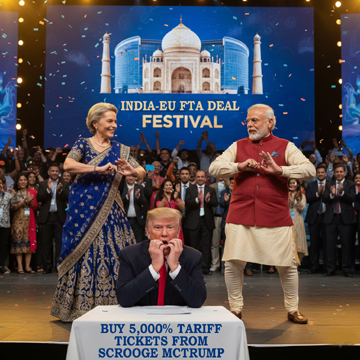
If the world waits until November 2028, the next U.S. presidential election, it may find that America has withered into something unrecognizable: a superpower wrapped in horsehide, bound tightly with tariff directives, and sealed by executive orders that read more like medieval toll charters than modern economic policy. Under what many critics have begun to call “Scrooge McTrump economics,” the United States risks becoming a museum of its former global relevance—impressive in scale, but inert in function.
America at the Crossroads of Hubris and Decline
History rarely announces its turning points with trumpet calls. More often, decline creeps in disguised as bravado, self-assurance, and the loud theatrics of power. The United States today stands at such a moment. Beneath the chest-thumping rhetoric of tariffs, walls, and “America First” directives lies a nation increasingly isolated from the very global system it once designed, dominated, and benefited from. The warning signs are everywhere—fractured alliances, rising domestic hardship, and a world that is quietly, methodically learning how to do business without Washington.
Malice in Wonderland: Power Without Prudence
There is a surreal quality to contemporary American governance under Donald Trump, a quality that feels less like strategic leadership and more like “Malice in Wonderland.” The familiar imagery of abundance—the land of milk and honey—has curdled. What remains is sourness: suspicion of allies, hostility toward migrants, and a governing philosophy built not on cooperation but on coercion.
Trump’s political instincts have always been rooted in domination rather than negotiation. His worldview divides the globe into winners and losers, creditors and debtors, patriots and traitors. In this framework, compromise is weakness and multilateralism is a scam. Institutions are obstacles. Rules are shackles. Allies are freeloaders waiting to be punished.
It is within this mindset that federal agencies, particularly immigration enforcement bodies, have been weaponized as instruments of spectacle and fear. Critics argue that the aggressive posture of ICE troopers—raids, detentions, and performative crackdowns—echoes a darker historical logic: the belief that power is invincible when it is most cruel. History, however, has shown repeatedly that such confidence is often the prelude to collapse.
The Domestic Cost: When the American Dream Goes Bankrupt
While Washington wages tariff wars and ideological crusades abroad, American households are fighting quieter, more desperate battles at home. Grocery bills have become a source of anxiety rather than routine. School fees, once manageable, now require credit cards. Rent consumes an ever-larger share of income, while healthcare and insurance premiums quietly hollow out what remains.
For millions of Americans, the so-called American Dream has been shrink-wrapped, sealed into a rusting steel drum, and lowered into economic burial. Upward mobility has stalled. Job security has eroded. The promise that each generation would live better than the last no longer holds. Instead, families are learning to live with less—less certainty, less protection, and less hope.
Tariffs, marketed as patriotic tools to revive domestic industry, function in practice as hidden taxes on consumers. Imported essentials—pharmaceuticals, electronics, auto components, household goods—grow steadily more expensive. Wages do not keep pace. Savings evaporate. The rhetoric of strength masks a reality of fragility.
A World Moves On: The EU–India Trade Breakthrough
Against this backdrop of American retrenchment comes a development of historic scale: the long-awaited trade agreement between the European Union and India. Signed after 19 years of stalemate, negotiation, and political hesitation, this deal is not merely a commercial arrangement. It is a strategic declaration.
Together, the EU and India represent roughly 25 percent of global GDP and nearly one-third of global trade volume. The agreement slashes tariffs to zero on a wide range of goods, including machinery, transport equipment, and industrial components. It opens doors to services, finance, technology, and mobility on a scale unseen in modern trade diplomacy.
More importantly, it signals intent. This is not just about growth; it is about autonomy. European capitals and New Delhi alike understand that dependence on an unpredictable United States has become a strategic liability. The deal is, in essence, a geopolitical panic button—pressed quietly but decisively.
Zero Tariffs, Infinite Consequences
The contrast could not be sharper. As Washington raises barriers, Brussels and New Delhi dismantle them. While the U.S. doubles down on protectionism, the EU–India axis embraces integration. Zero tariffs are not merely a pricing mechanism; they are a philosophical statement about openness, trust, and long-term cooperation.
For manufacturers, this means frictionless supply chains and reduced costs. For consumers, it promises affordability and choice. For governments, it creates interdependence that discourages conflict. Trade, in this model, is not a weapon but a stabilizer.
The implications ripple outward. Asian manufacturing hubs recalibrate supply chains toward Europe. European firms rethink Asia strategies with India at the center rather than China alone. The global economic map subtly redraws itself, leaving the United States on the margins of conversations it once dominated.
Banking on India: Markets Cast Their Vote
Financial markets are often more honest than political speeches. In the days following the EU–India agreement, European banking indices surged. Shares of major institutions such as HSBC and BNP Paribas hit record highs. Investors were not celebrating symbolism; they were pricing in access.
India’s services market—1.4 billion people, a young workforce, and rapidly digitizing infrastructure—represents one of the largest untapped opportunities in the global economy. Enhanced access for European banks, insurers, asset managers, and professional services firms changes growth trajectories overnight.
The message from markets was unambiguous: capital flows toward openness, not isolation. Confidence accrues to systems that prioritize predictability over posturing. In this calculus, the United States increasingly looks like a high-risk jurisdiction—not because of lack of capacity, but because of policy volatility.
Fortress America: Losing the War for Shared Prosperity
The tragedy of America’s current trajectory lies in its irony. The United States once championed shared prosperity through trade, institutions, and alliances. Today, it is retreating behind tariff walls, convinced that exclusion equals strength.
But prosperity is not a zero-sum game. When the rest of the world builds economic overpasses—bridges of trade, finance, and technology—America is digging moats. And moats, while useful in medieval warfare, do little in a globalized digital economy.
Isolation breeds inefficiency. It raises costs, reduces innovation, and invites retaliation. Most dangerously, it erodes trust. Allies begin to hedge. Partners look elsewhere. The fortress stands tall, but it stands alone.
South Korea as Sacrificial Lamb
The announcement of the EU–India deal was followed almost immediately by another tariff shock from Washington: a hike on South Korean imports from 15 percent to 25 percent, targeting autos, pharmaceuticals, and lumber. The timing was not coincidental. It was reactive.
South Korea, a long-standing U.S. ally, appeared less a strategic partner and more a convenient outlet for frustration. The message was unmistakable: loyalty does not guarantee immunity. In Trump’s worldview, alliances are transactional and expendable.
Such moves send chills through allied capitals. If Seoul can be punished today, who is safe tomorrow? Tokyo? Berlin? Ottawa? Trust, once broken, is not easily restored.
Transatlantic Cracks and the Language of Betrayal
The response from Washington to the EU–India agreement was laced with bitterness. U.S. Treasury Secretary Scott Bessant publicly criticized the European Union, calling the deal an “act of betrayal,” particularly because it followed U.S. sanctions on India for purchasing Russian oil.
But the accusation misses the point. Europe is not obligated to subordinate its economic future to Washington’s geopolitical mood swings. Sovereignty, once asserted, rarely apologizes.
For European policymakers, the lesson is clear: strategic autonomy is no longer optional. Dependence on an erratic hegemon carries unacceptable risk. The EU–India deal is not anti-American; it is post-American.
Inflation as the New Normal
For American consumers, the consequences of these policies are already materializing. Tariffs raise prices. Retaliation narrows choices. Supply chain disruptions amplify volatility.
Pharmaceuticals become costlier. Cars inch out of reach. Everyday household items quietly inflate. The result is a slow-burn cost-of-living crisis that erodes purchasing power without dramatic headlines.
Inflation, once dismissed as transitory, begins to feel structural. And unlike abstract trade statistics, grocery bills are painfully real.
A Survival Strategy for a Fragmenting World
In this environment, citizens and investors alike are forced into adaptation. The old assumption—that domestic markets alone are sufficient—no longer holds.
Diversification becomes not just prudent, but necessary. International ETFs that benefit from the EU–India axis offer exposure to growth insulated from American trade turbulence. Capital, like water, seeks the path of least resistance.
Equally important is a focus on “border-immune” assets. Digital services, software infrastructure, cloud platforms, and core technologies are harder to tariff and easier to scale globally. In a world of walls, intangibles fly overhead.
Europe’s Quiet Declaration of Independence
At its core, the EU–India agreement is Europe’s declaration of economic adulthood. No longer content to be a junior partner in a Washington-centric order, Europe is asserting its own priorities.
This does not mean hostility toward the United States. It means realism. Predictable policy beats emotional politics. Rules beat improvisation. Stability beats spectacle.
India, too, emerges as a pivotal power—courted, respected, and increasingly central to global trade architecture. The old binaries of East versus West dissolve into a more complex, multipolar reality.
The End of the Dealer Economy
For decades, the United States functioned as the primary dealer in global trade—setting rules, arbitrating disputes, and underwriting stability. That role conferred immense benefits, both tangible and intangible.
But dealers must be trusted. When unpredictability replaces reliability, clients look elsewhere. The EU–India deal suggests that the world is already doing so.
This is not the end of America, but it may be the end of American centrality. Power does not vanish overnight; it leaks, slowly and silently, until one day it is gone.
Waiting for 2028
As the world looks toward November 2028, the question is no longer whether America will change, but whether it can. Rebuilding trust takes longer than breaking it. Restoring alliances requires humility rarely seen in populist politics.
If current trajectories hold, the United States risks entering that election diminished—not by external enemies, but by its own choices. Wrapped in tariffs, bound by grievance, and isolated by design, it may find that the world has already moved on. History will not be kind, but it will be clear. The age of unilateral dominance is ending. The age of shared, negotiated power has begun—without waiting for Washington’s permission.