The delivery of INS Taragiri to the Indian Navy under Project 17A marks a watershed moment for India’s maritime ambitions. It is a symbol of strategic maturity, of home-grown design and manufacturing capability
On 28 November 2025, Mazagon Dock Shipbuilding Ltd (MDL) delivered INS Taragiri — the fourth warship of the Nilgiri-class frigates under Project 17A — to the Indian Navy. This ceremony is more than just an addition to the fleet: Taragiri epitomizes India’s growing self-reliance (“Aatmanirbharta”) in advanced warship design and construction — a major leap in maritime capability.
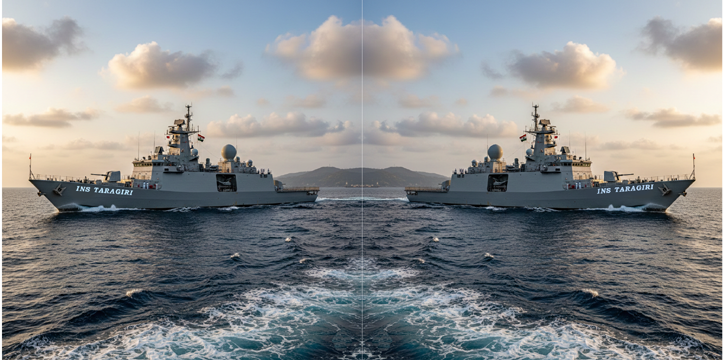
The induction of Taragiri and its sister ships under Project 17A significantly strengthens India’s surface combatant fleet. In a rapidly evolving maritime security environment, such enhancements are vital to deterrence, force projection, and safeguarding India’s strategic interests — from the Arabian Sea to the Indian Ocean and beyond.
In this article, we examine what makes Taragiri (and the broader Nilgiri-class) special, compare it to some of the world’s leading navies and their frigates, and explore scenarios — “war situations” or strategic contexts — where India could leverage these capabilities to its advantage.
Design philosophy and indigenous capability
- Project 17A (P17A) is the follow-on program to the earlier Shivalik-class (P17) frigates. The Nilgiri-class ships are built with enhanced stealth, sensors, weapons, and automation.
- The design was done in-house by the Navy’s Warship Design Bureau (WDB), and construction is handled by MDL (Mumbai) and Garden Reach Shipbuilders & Engineers (GRSE, Kolkata).
- Taragiri’s delivery — within 81 months (shorter than the 93 months for the lead ship) — shows the growing maturity and efficiency of India’s ship-building ecosystem.
- The project has about 75% indigenous content, involving over 200 MSMEs and generating thousands of direct and indirect jobs.
In essence, Project 17A isn’t just about adding new ships — it’s about building an indigenous capability for advanced warship design, manufacturing, and maintenance: a major strategic asset for long-term naval autonomy.
Technical and combat capabilities of Nilgiri-class / Taragiri
Some of the key specifications and capabilities of Nilgiri-class (and thus of Taragiri) are:
- Approximate displacement: ~ 6,700 tons.
- Length: 149 meters; Breadth: 17.8 m; Draught: ~5.22 m.
- Propulsion: Combined Diesel or Gas (CODOG) — diesel engines + LM2500 gas turbines driving controllable pitch propellers, managed through an Integrated Platform Management System (IPMS).
- Speed: ~ 28 knots; Range: ~ 5,500 nautical miles at cruising speed.
- Sensor and combat suite: Includes AESA radar (IAI MF-STAR), medium-range surface-to-air missiles (MRSAM / Barak-8), supersonic surface-to-surface missiles (BrahMos missile), 76 mm rapid gun, Close-In Weapon Systems (CIWS: 30 mm and 12.7 mm), rockets and torpedoes for anti-submarine warfare; hull-mounted sonar; possibility for helicopter operations.
- Stealth & survivability: Reduced radar cross-section (RCS) by design features (sloped superstructure, radar-absorbent or transparent materials, vertical missile launchers, concealed deck fittings), reduced noise and heat signatures, better manoeuvrability and sea-keeping compared to earlier Indian designs.
According to Indian naval analysts, such a combination makes the Nilgiri-class among the most capable and powerful frigates in the global context — offering a balanced mix of stealth, firepower, anti-air, anti-surface, and anti-submarine capabilities.
In short: Taragiri (and its sister ships) are true multi-mission frigates — able to operate in blue-water (open ocean) roles, escort duties, littoral operations, maritime patrol, anti-submarine warfare (ASW), surface warfare (ASuW), air defense, and power projection.
How Nilgiri-class stacks against global modern frigates
To appreciate the significance of Project 17A, it helps to compare Nilgiri-class with contemporary frigates of advanced navies around the world.
Overview: The global frigate landscape
Modern navies — e.g., those of France, Italy, Japan, Singapore, Netherlands, etc. — use frigates as their primary workhorses for a variety of missions: escorting carriers or task groups, protecting sea-lanes, ASW, anti-air, and general surface warfare. Classes like the French/Italian FREMM-class (Aquitaine / Carlo Bergamini), Japanese Mogami-class, Singapore’s Formidable-class, and others are often cited among the best contemporary frigates.
What then is the gap (if any) — and the parity — between Nilgiri and these global platforms?
Capabilities and comparisons
- Stealth and Signature Management: Nilgiri-class incorporates modern stealth design elements — reduced RCS, sloped superstructure, radar-absorbent materials, concealed fittings — akin to global stealth frigates. FREMM, Formidable, Mogami also follow similar design philosophies. This makes Nilgiri competitive in modern naval warfare scenarios where detection avoidance is critical.
- Weapons & Multi-Mission Role: With BrahMos supersonic missiles, medium-range SAMs, CIWS, rockets/torpedoes, and capability to operate helicopters — Nilgiri has broad-spectrum capability: anti-surface, anti-air, anti-submarine, and maritime patrol. This aligns with, or even surpasses in some aspects, what other navies expect from frontline frigates. For example, many FREMMs and Formidables emphasize ASW + air defense + surface strike; Nilgiri’s BrahMos gives it substantial anti-ship punch.
- Sensors and Radar: The adoption of AESA radar (MF-STAR) and modern sensor suite gives Nilgiri effective target detection, tracking and engagement — on par with global standards.
- Endurance & Blue-Water Capability: With 6,700-ton displacement, range of ~5,500 nmi, and modern propulsion, Nilgiri-class can operate in deep-sea and long-range missions — fulfilling the “blue-water navy” requirement. This enables deployment from the Indian Ocean to more distant theatres, akin to other major navies.
While each global navy’s frigates have their own strengths — e.g., specialization in ASW, advanced VLS capacity, or integration in larger carrier battle groups — Nilgiri-class offers a balanced, modern multi-role capability that is broadly comparable to many world-class frigates. Its major advantage: largely indigenous content and design tailored to India’s strategic environment.
How India could leverage Nilgiri-class advantage
Given its capabilities and India’s geopolitical context, here are some potential war or conflict scenarios where the inheritance of Taragiri and other Nilgiri-class ships could tilt the balance in India’s favor.
1. Securing Sea Lanes & Deterrence in the Indian Ocean Region (IOR)
- Context: The Indian Ocean has become a zone of strategic competition — for resources, trade routes, and maritime influence. Control over sea lanes, chokepoints (like Strait of Malacca, Strait of Hormuz), and maritime security is vital.
- Nilgiri-class Role: These frigates, with their long-range, multi-mission capabilities, can be deployed for sustained presence missions — escorting merchant vessels, ensuring sea-lane security, conducting surveillance, and showing deterrence. Their stealth and sensor capability helps them avoid detection while patrolling, giving India a credible under-sea and surface surveillance posture.
- Advantage: The combination of BrahMos anti-ship missiles + surface-to-air missiles + ASW capability means these frigates can counter surface threats, submarine threats, and even aerial threats — making them versatile guardians of the sea lanes.
2. Anti-Submarine Warfare (ASW) and Underwater Threat Management
- Context: In potential conflict scenarios (e.g., presence of hostile submarines in the Indian Ocean, or near coasts), ASW becomes crucial.
- Nilgiri-class Role: With hull-mounted sonar, torpedoes, rockets, and capability to operate helicopters (which can deploy sonar buoys / ASW torpedoes), these warships can detect, track, and neutralize submarine threats. Their stealth reduces the chance of detection while conducting ASW patrols.
- Advantage: Compared to older or less capable ships in the region, Nilgiri’s multi-layered defense and offense — across air, surface, sub-surface — offer a credible ASW deterrent, vital for safeguarding Indian maritime interests.
3. Sea-Control & Surface Warfare — Deterring or Engaging Enemy Surface Forces
- Context: In high-intensity maritime conflict (e.g., confrontations near chokepoints, or safeguarding exclusive economic zone (EEZ) / maritime boundaries), surface combatants matter.
- Nilgiri-class Role: The BrahMos missiles give long-range anti-ship strike capability; the 76 mm main gun and CIWS offer close-in defense; medium-range SAMs provide air threat coverage. Combined with stealth — risk of detection is reduced, increasing survivability in hostile environments.
- Advantage: India could use these frigates to form task groups for maritime dominance, surface strikes, or denial-of-access strategies. Their flexibility means they can operate independently or as part of larger naval formations — giving strategic depth.
4. Escort & Carrier-Task-Force / Carrier Protection
- Context: As India builds up its carrier capabilities (with existing and future aircraft carriers), it will need capable escort ships to defend against air, surface, and submarine threats.
- Nilgiri-class Role: These frigates, with comprehensive air-defense and ASW suites, can act as escorts or screening vessels, safeguarding high-value assets like carriers or amphibious forces. Their stealth and sensors make them well suited for such protective duties.
- Advantage: By providing credible escort cover, India can project layered naval power, ensuring the survivability and effectiveness of its carrier or task forces even in contested environments.
5. Peacetime & “Gray Zone” Operations — Humanitarian, Patrols, Diplomacy
- Context: Navies often partake in non-combat missions: humanitarian assistance, disaster relief, maritime diplomacy, anti-piracy, evacuations, etc.
- Nilgiri-class Role: Their endurance, automation (reducing crew requirements), versatility, and ship-borne helicopter capability make them excellent platforms for such missions — even when not engaged in combat. Their modern design and relatively low operational overhead (thanks to IPMS and integrated construction) help sustain long deployments.
- Advantage: This gives India a flexible tool for power projection, maritime diplomacy, coastal security, and presence missions — reinforcing India’s image as a stable maritime power in the region.
Challenges: What India should watch out for
While Nilgiri-class (and Taragiri) bring major strengths, there are also some limitations and broader strategic factors India must reckon with:
- Limited numbers (so far): Project 17A envisages seven frigates; with other ongoing and future programs (e.g., destroyers, corvettes, submarines), fleet size will remain a critical variable. For sustained blue-water operations or large-scale surface task groups, India will need robust numbers, support ships, logistics, and constant manufacturing cadence.
- ASW limitations: While equipped for ASW, the absence (as publicly known) of advanced towed-array sonar systems (common in some global frigates) could limit anti-submarine detection range, especially in deeper waters. (This is an observation also noted by some naval experts.)
- Need for networked operations: In modern naval combat, data sharing, networked sensors, interoperability with aircraft/submarines/aircraft carriers, and logistical support are as important as individual ship capability. For Nilgiri-class to truly shine, India needs to build such a supporting architecture — including satellite communication, maritime domain awareness, aerial reconnaissance, and support vessels.
- Strategic and geopolitical constraints: India’s adversaries may attempt to counter its naval buildup with asymmetric methods — submarines, missiles, mine warfare, cyber/EW threats, long-range anti-ship weapons — requiring India to continuously upgrade and adapt.
What Nilgiri-class signals for India — A strategic shift
The induction of Taragiri and its sister ships marks a broader shift in India’s maritime strategy:
- From coastal and littoral focus to true blue-water ambitions: With 6,700-ton frigates equipped for all-weather, multi-domain operations, India is signalling its intent to operate far beyond its coastal waters, safeguard its sea-lines of communication (SLOCs), and project power in the wider Indian Ocean region.
- Self-reliance in defence manufacturing: With ~75% indigenous content, use of locally sourced steel (e.g., low-carbon micro-alloy DMR 249A), and design by Indian bureaus, the Navy is building a sustainable domestic warship-production ecosystem. This not only reduces dependency on foreign suppliers — but also builds internal capability for future naval projects (destroyers, corvettes, carriers).
- Economy and industrial benefits + job creation: Involving 200 MSMEs, generating thousands of jobs — meaning defense modernization is also boosting industry and economy.
- Flexible response capability: The versatility of these ships allows India to respond to a variety of situations — from full-scale conflict to humanitarian missions — giving the country agility in maritime diplomacy and security.
If employed strategically, this could significantly enhance India’s deterrence posture, regional influence, and readiness for future naval challenges.
INS Taragiri is a symbol of strategic maturity
The delivery of INS Taragiri under Project 17A marks a watershed moment for the Indian Navy and India’s maritime ambitions. It is not just a new ship — it is a symbol of strategic maturity, of home-grown design and manufacturing capability, of self-reliance, of economic and industrial foresight, and of a navy poised to take on complex challenges in the modern maritime world.
When we compare Nilgiri-class with contemporary global frigates — from Europe, Asia or elsewhere — we find that India is no longer merely a “consumer” of foreign designs. Instead, it now produces world-class warships capable of holding their own alongside global peers. In various hypothetical war or conflict scenarios — sea-lane protection, ASW, surface warfare, carrier protection, maritime diplomacy — the multi-mission capability of the Nilgiri-class gives India real teeth.
Of course, ships are only part of the equation: numbers, supporting logistics, networked sensor & communication systems, trained manpower, and strategic doctrine are equally important. But with Taragiri, India has delivered a key building block — and signaled that its naval ambitions are serious, long-term, and rooted in national capability. In the coming years, as the rest of Project 17A — and perhaps follow-up projects (destroyers, corvettes) — come online, the Indian Navy may well emerge as one of the most formidable regional maritime forces. For India, Taragiri is not just a new frigate — it’s a step closer to mastering the seas.