This article explores the technology, evaluates expert commentary from Jane’s Defence Weekly, RAND, CSIS, and European defence institutes, assesses the likelihood of India acquiring similar capability
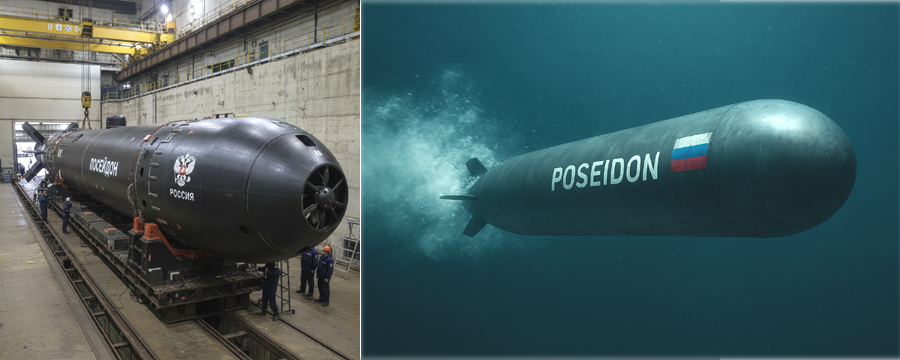
Russia’s Poseidon—an autonomous, nuclear-powered, intercontinental torpedo-submarine hybrid—may be the most disruptive underwater weapons system since the advent of nuclear submarines. Achieving reported underwater speeds above 200 km/h using supercavitation, diving to 1,000 meters, and capable of carrying a nuclear payload, Poseidon blends strategic deterrence with autonomous lethality in ways that could redefine 21st-century naval warfare.
While Russia calls the weapon “unstoppable,” the global defence community views it more cautiously—agreeing the technology is real, but questioning long-term operational reliability, doctrinal utility, and escalation risks. Still, supercavitating autonomous torpedoes are clearly the direction the world is heading. The United States, China, Germany, Iran, and even smaller navies are pursuing variants of the same physics.
This article explores the technology, evaluates expert commentary from Jane’s Defence Weekly, RAND, CSIS, and European defence institutes, assesses the likelihood of India acquiring similar capability, and analyses how autonomy in torpedoes will intensify naval competition in the decades ahead.
1. The Physics Behind Poseidon: Super-cavitation and Nuclear Propulsion
Super-cavitation allows an underwater object to travel inside a self-generated bubble of gas, removing water resistance—an obstacle 800 times denser than air. Russia’s technology is an evolution of the Soviet VA-111 Shkval, tested in the 1970s and achieving extraordinary speeds.
According to Jane’s Naval Weapons 2024–25, Shkval-type systems previously reached up to 370 km/h in instrumented tests, validating supercavitation. Poseidon simply scales this idea to a vessel the size of a mini-submarine, with modern nuclear mini-reactors and AI-based navigation.
Key Capabilities Attributed to Poseidon
- Speed: 200–220 km/h underwater via supercavitation
- Range: 10,000–12,000 km using a compact nuclear reactor
- Endurance: Months of submerged loitering
- Depth: 1,000+ meters (below most ASW weapon envelopes)
- Payload: Strategic nuclear warhead (reportedly multi-megaton)
- Autonomy: No crew; AI-driven navigation and target acquisition
A 2025 study by the British Royal United Services Institute (RUSI) called Poseidon “a strategic weapon designed to bypass missile defences by shifting deterrence to the underwater domain.”
2. Is Poseidon Really “Unstoppable”? The View from Global Defence Analysts
Russia markets Poseidon as an undefeatable system, but leading Western think-tanks strike a more nuanced balance.
RAND Corporation (2025)
In its 2025 undersea warfare brief, RAND analysts concluded:
- Supercavitating autonomous weapons are real and deployable.
- However, Poseidon’s strategic value depends on reliability, communication, and guidance robustness—not merely speed.
RAND also noted that Russia’s nuclear mini-reactor technology historically suffers from operational inconsistency, referencing incidents like the 2019 Nyonoksa reactor explosion.
US Naval War College
American analysts argue that the weapon is “dangerous but not invincible,” pointing to:
- Acoustic signatures from Super-cavitation that could leave detection traces
- The potential vulnerability of launch platforms (e.g., the Belgorod submarine)
- The difficulty of long-range autonomous target discrimination
Jane’s Defence Weekly
Jane’s reports that Poseidon is likely functional, but emphasizes:
- The weapon has not been tested in an intercontinental operational profile
- Its autonomous AI navigation is unverified
- Its nuclear warhead claims remain “politically stated, not technically proven”
NATO Naval Analysts
NATO’s Maritime Command (MARCOM) 2024 assessment estimated that:
- Poseidon could evade current NATO missile shields
- But new NATO seabed sensors and AI-driven tracking systems may partially neutralize its stealth advantage by 2030
Thus, while Poseidon is a technological breakthrough, experts agree it is neither mythical nor flawless.
3. Which Navies Already Use or Are Developing Super-cavitation Technology?
While Poseidon is Russia’s flagship project, multiple navies have been pursuing supercavitating or high-speed autonomous torpedo systems.
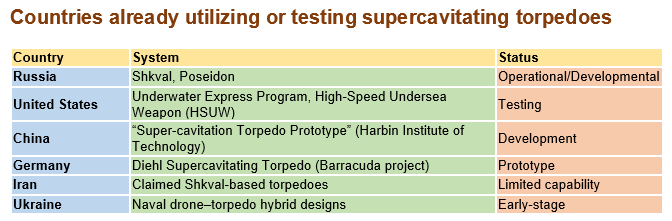
According to Center for Strategic and International Studies (CSIS), China is particularly aggressive, developing multi-stage propulsion torpedoes that could reach 100–150 km/h by 2030.
4. The Era of Autonomous Torpedoes: Why AI is the Real Game-Changer
Super-cavitation is only half the transformation. The other half is autonomy.
Why Autonomous Torpedoes Change Naval Warfare
- No communication needed:
A fully autonomous torpedo can navigate silently, unjammable, and independent of satellite links. - Loitering capability:
A nuclear-powered underwater drone could wait near ports for months—something no submarine crew could tolerate. - Swarm potential:
AI navigation could enable a swarm of high-speed torpedoes overwhelming enemy ASW systems. - Algorithm-driven targeting:
AI improves:- Evasion
- Path optimisation
- Threat recognition
Threat of Escalation
The more autonomous torpedoes become:
- The faster underwater combat will move
- The less time leaders will have to verify threats
- The greater the risk of autonomous misinterpretation
The International Institute for Strategic Studies (IISS) warns that “autonomous underwater weapons may compress decision-making timelines to seconds, increasing the likelihood of miscalculation.”
5. Could India Acquire or Develop Similar Technology?
India has strong undersea ambitions, but Super-cavitation and nuclear autonomous drones represent an entirely different level of capability. The likelihood can be assessed across several dimensions.
1. India’s Current Torpedo and Submarine Capability
India already possesses:
- Varunastra heavy torpedo (DRDO)
- Black Shark (in procurement debate)
- Advanced Technology Vessel (Arihant-class) nuclear submarines
- DRDO Autonomous Underwater Vehicles (AUVs) in prototype stage
India’s torpedo tech is world-class, but not yet in the Super-cavitation category.
2. Indian Defence R&D on Supercavitation
According to Indian naval analysts and DRDO briefings cited by ORF (Observer Research Foundation):
- DRDO has conducted early-stage research into “high-speed Super-cavitation effects” since the mid-2010s
- No official programme mirrors Poseidon’s scale
- India is studying hybrid AUV–torpedo systems for deep ocean missions
3. Strategic Barriers to India Acquiring Such Technology
- Russia is unlikely to export Poseidon systems
- Super-cavitation torpedoes are tightly restricted under MTCR and Wassenaar regimes
- The nuclear propulsion mini-reactor technology is among the most closely guarded military secrets globally
4. Strategic Motivation for India
Despite barriers, India has long-term incentives:
- Counter China’s growing undersea footprint
- Strengthen anti-submarine deterrence in the Indian Ocean
- Enhance survivable second-strike capability
5. Expert Assessment
Global defence scholars such as Dr. James Acton (Carnegie Endowment) argue India is capable of building “a non-nuclear super-cavitating autonomous torpedo” within 10–12 years, but a nuclear-powered Poseidon-like system may take two decades or more, requiring:
- Breakthrough mini-reactor designs
- AI navigation suited for deep-water autonomy
- High-strength hulls for Super-cavitation at scale
Likelihood Score (Based on Current Capability and Strategic Will)
- Developing high-speed supercavitating torpedo: Moderately likely by 2035
- Developing nuclear-powered autonomous torpedo drone: Possible only long-term (2040–2050)
- Acquiring technology from Russia: Highly unlikely
6. How Poseidon Drives Sharper Conflict in Global Seas
1. Arms Race in the Underwater Domain
Once one major power deploys an unstoppable weapon, others must respond. The US, UK, France, and China now view supercavitating autonomous torpedoes as essential to:
- Protect aircraft carriers
- Counter high-speed threats
- Guard SSBN fleets
2. Collapse of Traditional Anti-Submarine Warfare (ASW) Assumptions
ASW is based on:
- Detecting sound signatures
- Predictable submarine speeds
- Layered defensive patterns
Super-cavitation undermines all three.
3. Underwater Nuclear Deterrence Gets More Complex
Poseidon is essentially a slow-moving underwater ICBM, crossing oceans undetected and striking coastal cities. This opens:
- A new leg of the nuclear triad
- New escalation pathways
- New demands for seabed surveillance
A 2025 report by the European Union Institute for Security Studies (EUISS) warns that underwater autonomy may produce “a destabilising form of perpetual undersea crisis.”
4. Autonomous Torpedoes Reduce Human Control
As weapons get faster, deeper, and more autonomous:
- Human oversight decreases
- Risk of unintended escalation increases
- Naval AI arms race accelerates
The ocean—once the slowest battlefield—may become the fastest and least predictable.
7. Civilian Implications: Super-cavitation as a Transportation Revolution
Super-cavitation isn’t only military. Researchers at:
- MIT
- Tsinghua University
- Russian Academy of Sciences
have proposed underwater high-speed transportation at 300–400 km/h, connecting coastal megacities. Jane’s Naval Technology notes that Russia and China have already tested sub-scale passenger capsules.
If realised, this could enable:
- Mumbai–Dubai underwater travel
- Shanghai–Nagasaki 1-hour commutes
- Mediterranean underwater railway systems
The technology is still experimental, but the physics is sound.
8. Has Russia Created an Unstoppable Weapon?
The answer—based on assessments from Jane’s, RAND, MARCOM, and global naval analysts—is:
Poseidon is not unstoppable, but it is revolutionary.
What is certain
- Supercavitating autonomous torpedoes represent the next era of naval warfare
- Russia is ahead in demonstrating an integrated nuclear-powered, AI-driven variant
- Western navies are actively developing countermeasures
- The technology will proliferate
What is uncertain
- Poseidon’s operational reliability
- Its actual stealth and survivability
- Russia’s ability to mass-produce and maintain it
What is inevitable
Torpedoes of the future will be:
- Faster
- Fully autonomous
- Harder to detect
- Strategically destabilising
The oceans of the future will be occupied by intelligent machines racing through cavitation bubbles at airplane-like speeds. Poseidon is the first. It will not be the last.
India, like all major naval powers, will eventually need to decide:
- Whether to join this autonomous undersea revolution
- How to counter it
- And how to prevent it from pushing the world toward underwater nuclear instability
The underwater battlespace is entering its most transformative century. Poseidon is only the beginning.