
What rules did the cowboys of the United States follow so that they did not get killed? Always sit or stand on overground, always sit or stand with your back to the wall where the wall must be bullet proof, always watch out for people drawing their guns, react instantly, always keep your sidearm loaded with bullets, always keep spare bullets, always eat and drink with your eyes on the surrounding areas. Travel light don’t wear clothes that impede shooting. Well, teach them to USA kids today.
When people imagine the cowboys of the United States, they picture dusty saloons, duels at high noon, revolvers, and a rugged landscape where law travelled slower than bullets. But beneath this mythology, cowboys were not reckless wanderers. They survived because they followed rules—a practical code of conduct forged from danger, isolation, and the knowledge that a single mistake could end a life.
The text you provided lists several unwritten rules of the American West:
Always stay on higher ground. Keep your back to a bullet-proof wall. Watch hands, not faces. Keep your sidearm loaded. Carry spare bullets. Eat facing the door. Travel light so you can draw fast.
These were not romantic rituals—they were survival instincts.
Today, ironically, many analysts and sociologists argue that the United States—despite being a hyper-modern society—still lives with the same underlying tension: every public space can become a potential site of an armed confrontation. Mass shootings occur in schools, shopping malls, churches, parking lots, cinemas, workplaces, and even hospitals. The Wild West never completely disappeared; it simply moved indoors.
This raises the central question of this article:
If cowboy instincts were shaped by the constant threat of gun violence, how should the modern-day American citizen behave today? How should schools, universities, professionals, immigrants, and ordinary shoppers navigate a society where firearms are widespread? And can lessons from cowboy logic actually apply in 2025?
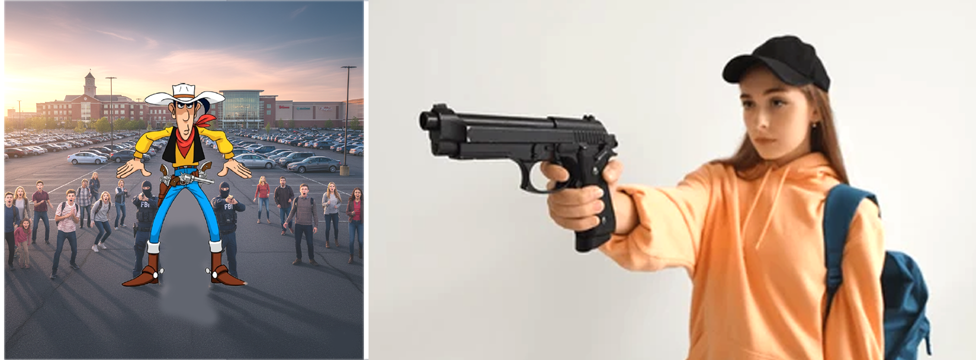
Cowboy survival rules: Why they existed
To understand how these rules translate into today’s world, one must first understand their original purpose. Cowboys, outlaws, ranchers, and sheriffs lived in a time where:
- Law enforcement was hours away.
- Disputes were settled informally.
- Everyone carried a gun.
- Ambushes were common.
- Bars, gambling halls, and dusty roads had no structured security system.
Thus, cowboys followed simple principles:
1. “Always sit or stand on overground.”
Being on higher ground gave visibility, reaction time, and tactical advantage.
2. “Always keep your back against a bullet-proof wall.”
Not for comfort, but to avoid getting shot from behind.
3. “Watch out for people drawing guns.”
Hands were more important than facial expressions. A smile meant nothing; a quick move towards the belt meant everything.
4. “Always keep your sidearm loaded and carry spare bullets.”
A gun was as essential as breathing—because danger was constant.
5. “Eat and drink facing the room.”
Meals were the most vulnerable moments; situational awareness was crucial.
6. “Travel light—don’t let clothing impede shooting.”
Being weighed down could mean death.
These were rules of practicality, not paranoia. And now, some Americans feel that these rules have metaphorically returned.
Modern America: A society where civilian spaces mirror frontier exposure
The United States is one of the only developed nations where the civilian gun ownership rate exceeds the population itself—more than 120 firearms per 100 people. Whether one sees this as a right or a problem, the consequence remains: guns are everywhere.
Thus the analogy to cowboy survival instincts becomes eerily relevant.
But the way these instincts translate today must be different. Citizens shouldn’t walk around ready to draw guns; instead, they must cultivate:
- situational awareness
- emergency preparedness
- responsible behaviour
- self-protective habits
- and a calm mindset, not paranoia
Below are the modern equivalents of cowboy rules for different parts of American society.
How modern-day American citizens should live: A civilian survival code
Cowboys taught one core lesson: the world is safer when people respect danger without fearing it. Today’s Americans can adapt that logic as follows:
1. Always maintain situational awareness (Cowboy rule: Watch hands, watch the door)
In modern terms:
- Know where exits are in a mall, stadium, concert, school, or subway.
- Avoid walking while absorbed in phones in unknown neighborhoods.
- Pay attention to unusual behaviour:
people carrying large concealed objects, nervous movements, aggressive arguments escalating.
Situational awareness is not paranoia—it is awareness of your surroundings just like driving a car.
2. Sit Facing the Entrance (Cowboy Rule: Eat with eyes on the room)
This is a common modern safety recommendation:
- When dining or meeting in public places, choose seats that give you visibility.
- Sit where you can see entrances and exits.
- Avoid being completely boxed in by walls or corners.
This is not about expecting a shootout, but about being able to respond faster in any emergency—fire, evacuation, or violence.
3. Travel Light and Keep Hands Free (Cowboy Rule: Clothes should not impede movement)
Today this means:
- Avoid carrying overloaded bags in crowded public places.
- Keep personal belongings organized so you can move quickly in an evacuation.
- Do not block your own mobility by wearing extremely restrictive clothing or shoes during large public events.
This is everyday risk-reduction, not cowboy theatrics.
4. Choose Environments Consciously (Cowboy Rule: Stay on higher ground)
In modern life:
- Prefer well-lit parking lots.
- Avoid isolated alleys or gas stations at night.
- Choose public transportation cars near other passengers.
- Avoid chaotic environments where alcohol and conflict mix.
Cowboys avoided blind spots; modern citizens should too.
5. Stay Prepared Without Being Armed (Cowboy Rule: Keep your weapon ready)
Most Americans today do not carry guns, and most do not want to. Preparedness now includes:
- Knowing how to call 911 and what to say
- Learning basic first aid
- Knowing lockdown procedures at workplaces, malls, and schools
- Keeping your phone charged
- Understanding local emergency protocols
Preparedness replaces the cowboy’s weapon.
How should school principals behave in today’s gun-exposed society in the USA?
School principals in the U.S. manage institutions where safety concerns are extremely high. Their equivalent of cowboy awareness should include:
1. Implement layered security without making schools feel like prisons
- Controlled entry points
- Visitor management systems
- Emergency communication networks
2. Conduct regular drills
Not only “active shooter drills”, but also:
- Fire
- Evacuation
- Lockdown
- Medical emergency
Drills save lives.
3. Build psychological early-warning systems
Conflict, bullying, mental health issues, and behavioural red flags must be spotted early. Schools should:
- Train teachers to observe signs
- Maintain counsellor teams
- Encourage students to report anonymously
Most violent incidents have warning signals.
4. Foster a culture of trust, not fear
Students should not feel like cowboys ready for a shootout. Instead, safety should be embedded calmly into school culture.
How should college principals behave?
College campuses differ from schools: they are open, dynamic, and harder to control. Their “modern cowboy” responsibilities include:
1. Risk assessment of campus open spaces
Universities must map:
- Areas with poor lighting
- Isolated walking paths
- Unauthorized access points
2. Collaborate with local police without over-policing students
Balanced security is essential.
3. Offer self-defense training and awareness sessions
College students often walk alone at odd hours.
4. Strengthen mental health infrastructure
Many violent events are connected to untreated crises. Universities must invest heavily in psychological services.
How should professionals from other countries behave in the USA?
Foreign professionals often come from countries with strict gun control (India, Japan, China, Europe). They may find U.S. gun culture shocking.
Their “cowboy-inspired” safety approach should include:
1. Learn the local safety norms
- Understand which areas of a city are safe or unsafe.
- Follow local workplace security protocols.
- Know emergency evacuation rules of offices, malls, airports.
2. Maintain situational awareness when traveling
Many immigrants underestimate the risk of road-rage incidents or personal disputes escalating due to firearms.
3. Avoid confrontation
Cowboys sometimes resolved issues violently—but immigrants must do the opposite:
- Avoid road rage
- Avoid physical altercations
- Use polite disengagement
- Call authorities rather than escalating arguments
4. Understand U.S. cultural triggers
Certain behaviours—yelling, banging on doors, sudden aggressive gestures—can be misinterpreted and lead to danger.
How should shoppers behave in American shopping malls?
Malls and supermarkets have seen many mass shootings. Yet millions shop safely daily. Practical cowboy-style guidance:
1. Identify exits when you enter.
A simple 2-second habit.
2. Avoid getting deeply distracted.
Especially on escalators and in parking lots.
3. If a disturbance begins, move diagonally away, not straight.
Crowds move unpredictably. Diagonal movement helps you escape faster.
4. Follow security instructions instantly.
Hesitation kills more people than bullets.
5. Don’t investigate noises.
Curiosity is dangerous in emergencies.
Modern America needs calm vigilance, not cowboy panic
The United States today, with its high rate of gun ownership, faces challenges that echo the risks of the Wild West. But while cowboys survived with guns and instincts, modern citizens must survive with awareness, preparedness, and emotional intelligence.
The lesson from cowboys is not to become trigger-happy.
The lesson is to respect danger, prepare calmly, and act intelligently.
Cowboys lived because they were alert.
Modern Americans will live better if they are aware, trained, and psychologically grounded. A society does not need to become the Wild West again—but it can learn from the discipline that the Wild West demanded.