
People in India, sincerely believe they are good citizens because they fulfil family obligations, respect traditions and perform charitable acts. Yet civic behaviour demands something entirely different. It requires individuals to consider strangers as deserving of the same respect as family members. That is an alien concept in India
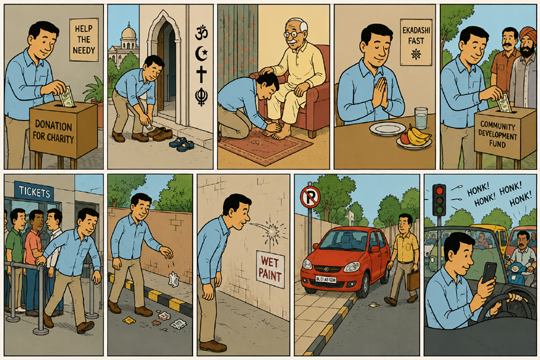
The contradiction is visible every single day. A person in India may donate generously to charity, remove shoes before entering a temple, mosque, church or gurudwara, touch the feet of elders with utmost respect, fast during religious festivals and contribute to community causes. The same individual may, within an hour, jump a queue, litter a public road, spit on a freshly painted wall, park across a footpath, honk continuously at a red light or drive while staring at a mobile phone.
Indians rush because for thousands of years, Indians lived off resources which were scarce. So, our parents always taught us to run and grab those scarce resources before our neighbours or peers could go and grab them before us. This is in the Indian DNA. All of us do it all the time. Grabbing our designated seats or unmarked seats in a state transport bus. Indians even start buying the same furniture or vegetables that they see their neighbours buy. This is to ensure that they do not miss out on those resources and to stop feeling guilty or like a lose as they did not buy those junk items in the first place before the neighbour did. If there is something that they cannot afford but the neighbour has bought it. Then they buy less of something similar to make themselves feel that they are good at living life too. Indians will never use their own brains and think what the best fit for them is or the what they really like to buy / consume. Indians are the largest herd on the planet.
Indians never stopped surviving and started living. It’s all about the next meal mentality. If I don’t, someone else will take the seat, get the hotter puri, get in queue, get quicker darshan, be there first. In India, cars parked without driving discipline, meaning parked without steering lock, gear lock, hand brake drive themselves during the night and park themselves in other spots. In Delhi NCR, self-drive cars mean just that, the cars drive themselves, since the drivers are almost always busy on their mobile phones.
Indian morality lives in compartments. People in India, sincerely believe they are good citizens because they fulfil family obligations, respect traditions and perform charitable acts. Yet civic behaviour demands something entirely different. It requires individuals to consider strangers as deserving of the same respect as family members. That is an alien concept in India.
Every society develops habits that are shaped by its history. For centuries, much of the Indian subcontinent experienced recurring famines, uncertain harvests, limited infrastructure, overcrowded settlements and intense competition for resources. Families learned to value thrift, seize opportunities quickly and avoid losing out to others. Such historical experiences can influence social behaviour across generations, although they do not determine it or make it universal. Europe experienced shortage of resources too but Europe never had plentiful rivers and forests to enable them to have unlimited number of children like Indians did. This is what created further shortage in India.
Even today, echoes of that mindset appear in everyday situations. The fear of missing out often overrides patience. At railway platforms, passengers crowd the train doors before passengers inside have exited. At airports, travellers leap out of their seats the instant the aircraft stops even though the doors remain closed for several minutes. At buffet counters, people form clusters around dishes that are constantly being replenished. During religious events, devotees may rush toward the shrine despite everyone eventually receiving the same opportunity for worship.
The underlying thought process often seems simple: if I hesitate, someone else will get ahead.
Such thinking is understandable in contexts where resources genuinely are scarce. The problem arises when this survival instinct continues operating in situations where scarcity no longer exists. The queue becomes meaningless. The rule becomes optional. Courtesy becomes an obstacle instead of a virtue.
Modern cities depend on millions of strangers cooperating with one another. Traffic signals, pedestrian crossings, parking regulations, waste segregation and public transport etiquette all function only when individuals voluntarily accept small inconveniences for the collective good. Once enough people begin ignoring those norms, everyone loses time, money and peace of mind.
Ironically, many Indians display exemplary civic behaviour abroad. Roads are cleaner, traffic discipline improves and rules are followed with remarkable consistency when people live in countries where enforcement is strict and social expectations are different. There, Indians behave for fear of reprisal. This further proves that law and order enforcement is absent in India or can be bought for a price.
When survival habits outlive scarcity
Human beings evolved to respond rapidly to competition. Throughout history, securing food, shelter and safety often depended upon acting before others did. In societies where shortages were common, hesitation carried real risks.
India’s long history contains numerous periods during which ordinary people had little certainty about tomorrow. Agricultural dependence, colonial extraction, population growth and uneven economic development reinforced a culture where grabbing opportunities quickly could appear rational.
Parents naturally transmitted practical advice to children. Do not be late. Do not miss your chance. Get there before everyone else. Secure your place. These lessons helped families navigate difficult circumstances. The difficulty begins when these instincts persist unchanged in an economy that increasingly operates through systems rather than scarcity.
Consider a bus stop. If passengers board systematically, everyone reaches their seats more efficiently. If everyone rushes simultaneously, boarding takes longer. Each individual believes rushing gives them an advantage. Collectively, everybody loses. Economists call this the tragedy of individual incentives conflicting with collective outcomes.
The same logic appears repeatedly. Drivers block intersections hoping to save thirty seconds, only to create traffic jams lasting fifteen minutes. People park wherever space exists rather than where parking is permitted, reducing movement for everyone else. Motorcyclists use footpaths, forcing pedestrians onto roads. Customers crowd service counters instead of forming orderly queues. Each person believes they are solving a personal problem. Together they create a much larger public problem.
Another visible manifestation is consumer behaviour. Many purchases are influenced less by personal need than by observation of neighbours, relatives or colleagues. Trends spread rapidly because individuals worry about being left behind socially. Sometimes this leads to useful diffusion of innovations. At other times it encourages unnecessary spending merely to match perceived status.
People purchase what others buy. Invest where others invest. Eat where others eat. Visit destinations because everyone else is posting photographs. The crowd itself becomes evidence. Independent thinking gradually weakens. Similar behaviour exists through fashion trends, speculative investment bubbles and viral social media phenomena.
A society becomes more resilient when citizens ask not merely, “What is everyone doing?” but also, “What actually makes sense for me?”
Public spaces reveal private attitudes
One can learn a surprising amount about a society simply by observing its public spaces. Roads are particularly revealing. Traffic is not merely about vehicles. It is about trust. Every driver trusts that others will stop at red lights. Every pedestrian trusts that crossings will be respected. Every cyclist trusts that motorists will maintain reasonable distance. When that trust weakens, chaos follows. Indian roads often illustrate this vividly. Lane markings become suggestions. Indicators are optional. Horns replace patience. Helmet straps remain unclipped. Seat belts stay unused until checkpoints appear.
Some motorists simultaneously steer, negotiate phone calls and monitor messaging applications, dividing attention among tasks that each deserve complete concentration. The consequences extend far beyond inconvenience. Road accidents impose enormous economic and human costs. Families lose earning members. Hospitals become overburdened. Insurance costs rise.
Productivity falls. Yet unsafe driving persists because immediate convenience frequently outweighs abstract risk in people’s minds. Parking habits offer another interesting example.
Vehicles are sometimes left blocking gates, footpaths or narrow lanes because finding a proper parking space requires additional walking. The inconvenience is transferred to dozens of strangers. Again, the calculation is personal.
“My work is only for five minutes.”
Unfortunately, hundreds of people making five-minute exceptions eventually produce permanent disorder. Public cleanliness reflects similar attitudes. Many households remain impeccably clean inside while rubbish appears acceptable outside the compound wall. The invisible boundary between private responsibility and public responsibility becomes striking. If something belongs to everyone, it gradually belongs to no one.
That mindset undermines urban life. Successful cities function because residents treat shared infrastructure almost as carefully as their own homes.
Footpaths remain usable. Public toilets remain functional. Parks stay clean. Public transport operates predictably. The infrastructure itself matters, but equally important is the behaviour surrounding it. Without civic cooperation, even expensive infrastructure deteriorates rapidly.
Religion, charity and the missing dimension of citizenship
India possesses one of the world’s richest traditions of religious practice and charitable giving. Across the country, millions contribute food, clothing, money and voluntary service every year. These acts deserve appreciation. Helping vulnerable people strengthens communities. Respecting elders enriches family life. Religious institutions often provide education, healthcare and disaster relief that governments alone cannot supply.
Yet civic responsibility operates on a different plane. It concerns strangers. The person waiting behind you in a queue. The pedestrian you have never met. The sanitation worker cleaning the road after someone litters. The ambulance delayed because drivers refused to make way.
The child breathing polluted air created by unnecessary idling. Citizenship asks whether we extend moral consideration beyond people we personally know. In many societies, public ethics become almost invisible because they are routine.
People queue automatically. Waste goes into bins. Noise levels remain moderate. Rules are followed even when enforcement is absent. The reward is collective. Everyone experiences smoother daily life. India increasingly possesses the wealth and education necessary to make this transition.
The remaining challenge is cultural. Schools can teach traffic rules. Governments can impose fines. Technology can install surveillance cameras. But lasting civic sense ultimately emerges when people internalize a simple principle: Public spaces deserve the same respect as private spaces. Once that shift occurs, remarkable changes follow.
Cities become quieter. Roads become safer. Queues become shorter. Services become faster. Stress declines. Economic productivity increases. Tourism improves. Quality of life rises. None of these improvements require revolutionary technology. They require millions of ordinary acts repeated consistently.
From herd behaviour to responsible citizenship
For decades, India has celebrated spectacular achievements. It has built highways where none existed, sent spacecraft to the Moon, become a global software powerhouse, developed world-class pharmaceutical capabilities and produced entrepreneurs who lead some of the world’s largest corporations. Yet there remains one area where progress stubbornly refuses to keep pace with economic growth: civic sense.
A society truly begins to prosper not when it merely becomes richer, but when its citizens understand that freedom includes responsibility. Personal success and public responsibility are not competing values; they reinforce one another. The strongest nations are not simply those with the tallest buildings or the largest economies. They are societies where millions of ordinary people perform small acts of consideration every day without expecting praise. That is the essence of civic sense, and it remains one of India’s greatest opportunities for transformation.