
Europe is one big heat oven. European architecture evolved in response to harsh winters rather than blistering summers. Houses in Scandinavia, the Alps, Germany, the Low Countries and much of Central Europe were designed to conserve every bit of precious warmth
Europe is among the world’s richest regions, with sophisticated engineering industries and consumers who can afford advanced household appliances. If Europeans wanted air conditioners on the same scale as Americans or residents of the Gulf states, they could have installed them decades ago. Their reluctance reflected a unique combination of history, geography, architecture, economics and cultural attitudes that made cooling technology appear unnecessary for much of the twentieth century.
The foundations of that attitude were laid long before electricity became widespread. European architecture evolved in response to harsh winters rather than blistering summers. Houses in Scandinavia, the Alps, Germany, the Low Countries and much of Central Europe were designed to conserve every bit of precious warmth. Thick masonry walls, compact room layouts, insulated roofs and comparatively small windows all helped families survive months of freezing temperatures. Every improvement in insulation represented money saved on expensive heating fuel.
As industrialisation progressed, engineers became even more adept at preventing heat from escaping buildings. Triple-glazed windows, airtight construction techniques and increasingly sophisticated insulation standards transformed homes into efficient thermal envelopes. These innovations dramatically reduced winter heating costs and lowered greenhouse gas emissions associated with burning fossil fuels.
For decades, this approach appeared almost perfect. Summers were generally mild. Even when daytime temperatures briefly climbed above 30 degrees Celsius, nights often became comfortably cool. Residents could simply open windows after sunset, allowing accumulated heat to escape before closing them again the following morning. Nature itself provided the cooling system.
This long-standing climatic pattern shaped not only buildings but also social habits. Afternoon siestas never became common across northern Europe because excessive heat was relatively rare. Schools, hospitals and offices generally functioned without mechanical cooling. Public transport systems relied on ventilation rather than refrigeration. Air conditioning remained associated with luxury hotels, international corporations or foreign tourists rather than ordinary households.
Economic considerations reinforced these habits. Electricity prices across much of Europe have traditionally been significantly higher than those in countries such as the United States, partly because of taxation, energy imports and environmental policies. Running a powerful air-conditioning unit throughout the summer could noticeably increase household expenses. When heatwaves lasted only a few days each year, many families concluded that purchasing an expensive cooling system made little financial sense.
Environmental awareness added another layer to this calculation. Europe has been a global leader in promoting energy conservation, renewable power and reductions in greenhouse-gas emissions. Citizens became accustomed to switching off unnecessary lights, insulating homes, recycling waste and using public transport. Within this cultural framework, air conditioning often acquired a reputation as an unnecessary consumer indulgence rather than an essential household appliance.
The technology also presented a visible contradiction. Air conditioners cool indoor spaces by transferring heat outdoors. On hot afternoons, dense neighbourhoods filled with air-conditioning units can become even warmer as each machine expels heated air into already sweltering streets. Urban planners and environmental campaigners frequently argued that widespread adoption of conventional cooling systems could worsen the very conditions they were intended to alleviate while simultaneously increasing electricity demand.
Historic preservation further complicated matters. Europe possesses some of the world’s most treasured architectural heritage. Medieval town centres, Renaissance palaces, Baroque streets and centuries-old apartment buildings define the identities of cities from Prague to Paris, from Florence to Amsterdam. Installing external compressor units on protected façades often clashes with strict conservation rules intended to preserve historic character.
Residents living inside listed buildings therefore faced practical obstacles that homeowners elsewhere seldom encountered. Drilling through ancient stone walls, attaching modern equipment to ornate façades or routing large refrigerant pipes across historic courtyards frequently required regulatory approval that was difficult, or impossible, to obtain. The visual harmony of centuries-old neighbourhoods often took precedence over modern conveniences.
These various influences reinforced one another. Mild summers reduced demand for cooling. Low demand discouraged manufacturers from aggressively marketing residential air conditioners. Limited installations prevented cooling from becoming a social norm. High electricity costs and environmental concerns further discouraged adoption. The result was a self-reinforcing cycle in which Europe developed a distinct identity: prosperous enough to afford air conditioning, yet culturally and structurally disinclined to embrace it.
That identity is now being challenged by forces that no architect, policymaker or homeowner can ignore.
For generations, Europe cultivated an image of temperate summers, shaded boulevards, cool evenings and stone buildings that remained pleasant even when the afternoon sun shone brightly. Visitors from tropical countries often remarked that homes, hotels and cafés rarely featured air conditioners, even in prosperous cities. While shopping malls, airports and a handful of modern office complexes offered mechanically cooled interiors, residential air conditioning remained remarkably uncommon compared with North America, the Middle East or many parts of Asia. This difference was never simply about wealth.
Across the continent, meteorological records that stood for decades are falling with alarming regularity. Cities that once experienced only occasional hot afternoons now endure prolonged periods of oppressive heat. Nights increasingly remain uncomfortably warm, preventing buildings from shedding accumulated heat and depriving people of restorative sleep. What was once regarded as an exceptional weather event has begun to resemble a recurring feature of European summers.
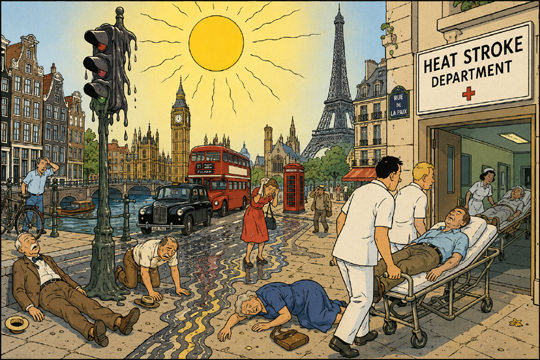
The consequences extend far beyond personal discomfort. Heat has emerged as one of Europe’s deadliest natural hazards, particularly for elderly people, infants and individuals with cardiovascular or respiratory illnesses. Hospitals report surges in admissions during severe heatwaves. Emergency services prepare for dehydration, heatstroke and complications among vulnerable populations. Public-health authorities now issue heat warnings with a seriousness once reserved mainly for winter storms.
Infrastructure is also revealing unexpected vulnerabilities. Railway tracks can buckle when exposed to prolonged extreme temperatures. Asphalt softens, affecting roads and airport runways. Bridges expand beyond design assumptions. Electrical networks face simultaneous pressure from increased cooling demand and reduced generation efficiency. Even public landmarks and urban furniture have shown signs of thermal stress, with reports emerging in some locations of traffic infrastructure, lighting fixtures and other materials deforming during exceptional heat events.
These developments have forced Europeans to reconsider assumptions that endured for generations. A home that excels at retaining warmth during winter can become uncomfortably hot when temperatures remain elevated for several consecutive days. Thick insulation that once represented energy efficiency may trap unwanted heat during summer if buildings lack adequate shading or mechanical cooling. Construction techniques optimised for one climate are being tested by another.
The debate surrounding air conditioning has therefore evolved into something far more complex than a discussion about comfort. It now encompasses public health, climate adaptation, urban planning, electricity infrastructure and social equity. Should cooling be regarded as a luxury, or is it becoming an essential public service in an increasingly warm world? Can societies expand access to cooling without dramatically increasing energy consumption and greenhouse-gas emissions? Is there a technological pathway that reconciles environmental responsibility with the basic human need for safe indoor temperatures?
When winter engineering meets summer extremes
These questions are particularly acute because Europe’s building stock represents decades, and in many cases centuries, of investment based on climatic assumptions that are rapidly changing. The continent contains millions of homes specifically engineered to minimise heat loss. Thick insulation, airtight construction and high-performance glazing remain excellent strategies for reducing winter energy use. Yet during prolonged heatwaves, these same features can unintentionally create what residents increasingly describe as an “oven effect.”
Sunlight entering through windows warms interior surfaces. Occupants, lighting, cooking appliances and electronic devices generate additional heat. Because the building envelope is designed to prevent thermal exchange with the outside environment, much of this heat becomes trapped indoors. If nighttime temperatures remain unusually high, opening windows provides only limited relief. By morning, buildings may begin another hot day without ever having cooled properly.
The experience can be particularly challenging in densely populated urban neighbourhoods where concrete, brick and asphalt absorb solar energy throughout the day and slowly release it overnight. This phenomenon, commonly known as the urban heat island effect, means city centres often remain several degrees warmer than surrounding rural areas. Residents therefore lose one of their traditional methods of coping with summer warmth: cool nights that naturally reset indoor temperatures.
Instead of abandoning their environmental values, however, many European countries are searching for solutions that align climate adaptation with climate mitigation. Rather than embracing conventional air conditioning exactly as other regions have done, they are increasingly investing in technologies that perform multiple functions while consuming less energy. Heat pumps capable of providing both winter heating and summer cooling, district cooling systems that utilise naturally cold-water sources, advanced ventilation strategies, external shading devices and greener urban design are all becoming central to this transformation.
Some of the most revealing examples of this evolving philosophy can be found in northern Europe, where countries once considered too cool to require any form of air conditioning are quietly becoming laboratories for sustainable cooling technologies. Scandinavia and the Netherlands, long regarded as champions of energy efficiency and environmentally conscious living, illustrate how rapidly changing climatic realities are reshaping long-held assumptions about what comfortable, and resilient, buildings should look like in the twenty-first century.
Scandinavia and the Netherlands reinvent the meaning of sustainable cooling
Few regions illustrate Europe’s changing relationship with indoor cooling more vividly than Scandinavia. For decades, Denmark, Norway, Sweden and Finland were regarded as places where air conditioning bordered on the absurd. Visitors from warmer climates often joked that these were countries where people looked forward to every sunny day, making the idea of mechanically cooling homes seem almost wasteful. Their reputation for environmental consciousness only reinforced this perception. Energy conservation was deeply embedded in public policy, architecture and everyday life, and households invested far more in efficient heating systems than in equipment designed to combat heat.
Nature appeared to justify that approach. Long winters dominated the calendar, while summers were generally brief and pleasant. Buildings were designed to keep warmth inside during months when temperatures frequently dropped well below freezing. Walls became thicker, roofs better insulated and windows more sophisticated with multiple layers of glazing. Construction standards evolved around the assumption that preventing heat loss represented the greatest engineering challenge. Over many decades, Scandinavia became a global benchmark for highly insulated, energy-efficient housing.
Climate, however, is proving to be an unreliable partner. During the past several years, northern Europe has experienced temperatures that previous generations would have considered almost unimaginable. Heatwaves have become more frequent, longer-lasting and geographically widespread. Areas close to or even within the Arctic Circle have recorded temperatures associated more with southern Europe than with the Nordic countries. These episodes are no longer isolated curiosities discussed briefly in weather reports. They increasingly influence public health planning, infrastructure management and building design.
The consequences are especially striking because Scandinavian buildings are exceptionally effective at retaining heat. Once sunshine raises indoor temperatures, the same insulation that protects residents during winter can prevent accumulated heat from escaping. If evenings remain unusually warm, homes cool only slowly, leaving bedrooms uncomfortable throughout the night. Families accustomed to sleeping under thick duvets have instead found themselves searching for fans, portable cooling devices and new ways to improve indoor comfort.
Hospitals, schools and care facilities have also encountered unexpected difficulties. Many public buildings were constructed without comprehensive cooling systems because engineers assumed they would never be required. During prolonged heatwaves, indoor temperatures can rise sufficiently to affect patient recovery, staff productivity and the safe operation of sensitive medical equipment. Administrators who once devoted almost all their attention to winter resilience are now developing plans for increasingly hot summers.
Rather than abandoning their environmental principles, the Nordic countries have responded by expanding technologies that serve multiple purposes throughout the year. The most important of these is the modern heat pump. Unlike conventional air conditioners that are purchased solely for cooling, reversible heat pumps can extract warmth from outdoor air during winter and transfer excess indoor heat outside during summer. One piece of equipment therefore performs two complementary functions.
This dual capability fits naturally within Scandinavian thinking about resource efficiency. A household that already owns a heat pump for winter heating does not need to purchase a separate air-conditioning unit. Instead, the same system can operate in reverse whenever temperatures become uncomfortable. Electricity consumption remains substantially lower than many older cooling technologies because heat pumps move thermal energy rather than creating it directly.
The rapid expansion of heat pumps has therefore transformed public perceptions of cooling. People are not necessarily embracing the image of permanently chilled interiors associated with some warmer countries. Instead, they are adopting technology that keeps indoor temperatures within a healthy range while supporting broader efforts to reduce dependence on fossil fuels. Cooling becomes one additional benefit of equipment that already contributes to decarbonising residential heating.
Urban planning has evolved in parallel. Scandinavian cities increasingly incorporate passive cooling strategies into new developments. External shading reduces direct solar gain before sunlight enters buildings. Ventilation systems recover energy while supplying fresh air. Tree-lined streets provide shade for pedestrians while lowering local surface temperatures. Green roofs absorb less solar radiation than conventional roofing materials and help moderate building temperatures. Even the orientation of new buildings is being reconsidered to minimise unwanted heat accumulation during increasingly intense summers.
Some cities have invested in district cooling systems that mirror the district heating networks already common across northern Europe. Instead of each building operating its own cooling equipment, chilled water produced centrally, or drawn from naturally cold lakes, rivers or deep seawater, is circulated through underground pipes. Large commercial buildings, hospitals and residential complexes can therefore be cooled efficiently without requiring thousands of individual outdoor compressor units.
Such systems demonstrate that sustainable cooling need not rely exclusively on traditional air conditioners. They also reduce noise, preserve architectural aesthetics and improve energy efficiency across entire neighbourhoods. As temperatures continue rising, district cooling is likely to become as familiar to northern Europeans as district heating has been for generations.
The Dutch experience reflects many of the same themes but is shaped by a different geographical and cultural context. The Netherlands has long prided itself on careful environmental management. Much of the country exists only because generations of engineers learned how to control water through dykes, canals and sophisticated pumping systems. Living with nature rather than attempting to dominate it became part of the national identity.
That philosophy influenced housing as well. Dutch homes were designed primarily to withstand damp winters and conserve warmth. Modern building regulations encouraged increasingly airtight construction combined with excellent insulation. These measures successfully reduced heating demand and contributed to national climate goals. Yet they also created homes that could become surprisingly warm when exposed to several consecutive days of strong sunshine.
Recent summers have exposed these vulnerabilities with remarkable clarity. Heatwaves once considered exceptional are becoming increasingly frequent, and temperatures have reached levels rarely associated with the country’s maritime climate. Government agencies now issue heat warnings more regularly, municipalities establish cooling centres for vulnerable residents and employers reconsider working practices during periods of extreme weather.
The Netherlands has responded by integrating cooling into its broader transition away from natural gas. Heat pumps again occupy a central role because they complement national efforts to electrify residential heating. Rather than installing equipment devoted solely to summer comfort, homeowners increasingly view reversible heat pumps as year-round climate management systems. Winter heating remains their primary purpose, but their cooling capability provides valuable protection during increasingly hot summers.
Where structural renovation proves difficult, particularly in older buildings, portable and room-based cooling systems have become more common. Their popularity reflects practical realities. Millions of residents live in apartments or historic buildings where installing permanent exterior equipment may be technically difficult or subject to planning restrictions. Portable units offer an imperfect but accessible solution for households confronting indoor temperatures that previous generations rarely experienced.
Historic preservation remains an relevant topic of consideration throughout Dutch cities. Amsterdam, Utrecht, Leiden and many smaller towns possess canal-side streets and centuries-old buildings that define both national heritage and international tourism. Authorities therefore continue balancing the desire for modern comfort with the responsibility to preserve irreplaceable urban landscapes. Engineers are increasingly challenged to conceal cooling equipment within buildings or integrate new technologies without compromising historic character.
Perhaps the most innovative Dutch contribution lies beneath the ground rather than above it. Engineers have refined systems that store thermal energy in underground aquifers, allowing naturally cool water accumulated during winter to assist with summer cooling. These seasonal thermal storage techniques reduce electricity demand and demonstrate how careful management of natural resources can provide climate resilience without excessive environmental cost.
Passive measures remain equally important. External blinds and shutters prevent sunlight from entering through windows before indoor temperatures rise. Green roofs reduce heat absorbed by buildings while improving stormwater management. Trees planted along streets and canals provide shade that benefits both pedestrians and adjacent buildings. Collectively these measures illustrate an important principle: the cleanest unit of cooling energy is often the one that never needs to be generated because heat has been prevented from entering the building in the first place.
The experiences of Scandinavia and the Netherlands reveal a broader transformation unfolding across Europe. Air conditioning is no longer discussed simply as an appliance. It has become part of a much larger conversation about architecture, urban planning, public health, renewable electricity, social equity and climate resilience. The objective is increasingly not to imitate the cooling habits of hotter regions but to develop systems suited to European conditions and environmental priorities.
This transition reflects a subtle but significant philosophical shift. Earlier generations largely viewed cooling as an unnecessary luxury because the climate rarely demanded it. Today’s policymakers increasingly recognise that protecting people from dangerous indoor temperatures can be as essential as protecting them from winter cold. At the same time, they remain determined to avoid solutions that substantially increase greenhouse-gas emissions or place unsustainable pressure on electricity networks.
Reconciling these objectives will require continued innovation. Buildings of the future are likely to combine superior insulation with dynamic shading, intelligent ventilation, renewable electricity, thermal storage and highly efficient heat pumps. Streets may contain more vegetation, reflective materials and water features designed to moderate local temperatures. Cooling may become an integrated feature of neighbourhood infrastructure rather than merely an appliance purchased by individual households.
Europe’s challenge therefore extends beyond installing more cooling equipment. It involves reimagining entire cities for a climate that is evolving more rapidly than previous generations anticipated. Understanding why that climate is changing so dramatically is essential to understanding why the continent’s long-standing resistance to air conditioning is steadily giving way to a new era of sustainable adaptation.
Why Europe is heating faster than much of the world
Europe’s search for sustainable cooling cannot be understood without examining the extraordinary pace at which its climate is changing. While every inhabited continent is experiencing the consequences of a warming planet, Europe has emerged as one of the regions where rising temperatures are being felt with particular intensity. Scientists attribute this to a combination of global climate change and several regional processes that reinforce one another, making heatwaves more frequent, more prolonged and more severe than those experienced by previous generations.
One of the most visible drivers of recent European heatwaves has been the development of persistent high-pressure systems popularly known as “heat domes.” Under such conditions, sinking air suppresses cloud formation, allowing uninterrupted sunshine to heat the land surface day after day. The descending air itself also warms through compression, creating an atmosphere that resembles a lid placed over a saucepan. Cooler weather systems that would normally sweep across the continent are diverted elsewhere, leaving the same regions exposed to relentless sunshine and stagnant air.
These weather patterns are not entirely new. Europe has always experienced occasional blocking high-pressure systems. What has changed is the background climate in which they occur. A heat dome forming over a continent that has already warmed significantly will produce higher temperatures than an identical weather pattern several decades ago. In effect, climate change has raised the baseline upon which natural weather variability operates. The result is that events once considered exceptionally rare are becoming increasingly likely.
Another important influence is Europe’s geographical relationship with the Arctic. The polar regions are warming considerably faster than the global average because of a phenomenon often described as Arctic amplification. Snow and ice, which naturally reflect a large proportion of incoming sunlight back into space, are retreating as temperatures rise. They are replaced by darker rock, soil and open water, all of which absorb far more solar energy. This additional absorption accelerates regional warming, creating a feedback loop that extends its influence well beyond the Arctic itself.
The Alps provide a striking illustration of this process. Mountain glaciers that have survived for centuries are shrinking at unprecedented rates. Seasonal snow cover arrives later, melts earlier and persists for shorter periods. As reflective white surfaces disappear, darker ground absorbs more heat, contributing to higher regional temperatures. The implications extend beyond skiing and tourism. Alpine snowfields have traditionally acted as natural water reservoirs, gradually releasing meltwater into rivers throughout the warmer months. Their decline affects agriculture, hydroelectric power generation, ecosystems and drinking water supplies across much of Europe.
Researchers are also studying how a warming Arctic may influence the behaviour of the jet stream, the high-altitude ribbon of fast-moving air that helps steer weather systems across the Northern Hemisphere. Although many scientific questions remain under active investigation, there is growing evidence that periods of slow-moving atmospheric circulation can allow heatwaves to persist longer over the same regions. Instead of weather systems passing quickly, communities may endure many consecutive days of oppressive heat with little opportunity for relief.
Urbanisation further magnifies these climatic changes. Modern cities contain vast expanses of concrete, asphalt, brick and glass, materials that readily absorb solar radiation during daylight hours. These surfaces store heat and gradually release it overnight, preventing temperatures from falling as rapidly as they do in surrounding countryside. The resulting urban heat island effect means that city residents frequently experience warmer nights than people living only a few kilometres away in rural areas.
Night-time temperatures are particularly important for human health. During the day, people can often reduce exposure by seeking shade, remaining indoors or limiting physical activity. At night, however, the body depends upon cooler surroundings to recover from daytime heat stress. When overnight temperatures remain elevated, the risk of heat-related illness increases significantly, especially among elderly people, infants and those with chronic medical conditions.
The health consequences of repeated heatwaves are increasingly shaping public policy. Heat is sometimes described as a “silent disaster” because its victims rarely attract the dramatic media coverage associated with floods, earthquakes or hurricanes. Yet prolonged periods of extreme heat can claim thousands of lives through dehydration, cardiovascular stress, respiratory complications and heatstroke. Public health authorities therefore view cooling not merely as a matter of comfort but as an increasingly important component of climate adaptation.
The economic implications are equally profound. Agricultural productivity suffers when crops are exposed to prolonged high temperatures and drought. Livestock experience heat stress that reduces milk production, fertility and growth rates. River levels may fall sufficiently to disrupt inland shipping, while warmer water reduces the efficiency of power stations that rely on rivers for cooling. Tourism patterns may gradually shift as travellers reconsider visiting traditional destinations during the hottest weeks of summer.
Businesses also face mounting challenges. Outdoor construction work becomes more hazardous, reducing productivity during heatwaves. Warehouses, factories and distribution centres require greater investment in temperature control to protect workers and equipment. Data centres, which form the backbone of Europe’s digital economy, consume increasing amounts of energy to maintain stable operating temperatures for servers.
Transport infrastructure, long designed around historical climate norms, is likewise being tested. Railway operators monitor tracks for thermal expansion, airport authorities assess runway conditions during periods of exceptional heat and road maintenance agencies confront softened asphalt surfaces. Although modern engineering can accommodate many of these challenges, adaptation requires investment, planning and continual revision of design standards based on evolving climatic realities.
The interaction between climate policy and adaptation presents one of Europe’s most delicate balancing acts. The continent has committed itself to ambitious reductions in greenhouse-gas emissions while simultaneously recognising that a warmer climate demands greater resilience. Expanding cooling capacity without dramatically increasing electricity consumption therefore becomes a technological and political challenge rather than simply a consumer choice.
Fortunately, innovation is providing reasons for optimism. Advances in building materials, glazing technologies, insulation systems and intelligent controls are making it possible to maintain comfortable indoor environments using substantially less energy than older cooling methods. Smart buildings equipped with sensors can automatically lower external blinds, optimise ventilation and coordinate heating and cooling systems according to weather forecasts and occupancy patterns. Renewable electricity from solar panels and wind farms increasingly powers these systems, reducing their environmental footprint.
Urban planners are also rediscovering lessons that predate mechanical air conditioning. Streets lined with mature trees create cooler microclimates through shade and evapotranspiration. Parks and open green spaces interrupt expanses of heat-absorbing concrete. Reflective roofing materials reduce solar heat gain, while permeable surfaces help moderate temperatures and improve stormwater management. Water features, when carefully designed, can contribute modest local cooling while enhancing public spaces.
Architects are increasingly combining traditional wisdom with modern engineering. Deep roof overhangs, external shutters, naturally ventilated courtyards and carefully oriented windows have existed for centuries in many warmer regions of the world. Integrating such passive cooling techniques into contemporary European architecture allows buildings to remain comfortable while reducing dependence on mechanical systems.
Public attitudes are evolving alongside technology. Increasingly, discussions about cooling focus not on luxury but on resilience, productivity and health. Employers recognise that excessively hot workplaces reduce efficiency and increase safety risks. Schools explore methods for maintaining acceptable classroom temperatures during examination periods. Hospitals incorporate cooling into emergency preparedness planning, recognising that vulnerable patients require stable indoor conditions regardless of outdoor weather.
Nevertheless, Europe’s future will not be determined solely by engineering. Limiting the long-term severity of heatwaves ultimately depends upon reducing global greenhouse-gas emissions. Adaptation can help societies cope with a warmer climate, but there are practical and economic limits to how much heat cities, ecosystems and infrastructure can endure. Cooling technologies may protect individual buildings, yet they cannot substitute for broader efforts to stabilise the Earth’s climate.
Europe therefore stands at an important crossroads. The continent that once considered residential air conditioning largely unnecessary is learning that resilience in the twenty-first century requires a more nuanced approach. Preserving historical architecture, maintaining ambitious environmental goals and protecting public health need not be mutually exclusive objectives. By investing in efficient heat pumps, district cooling, passive building design, renewable energy, greener cities and climate-conscious planning, Europe has an opportunity to demonstrate that adaptation and sustainability can reinforce rather than undermine one another. The transformation now underway extends beyond household appliances. It represents a rethinking of how cities are designed, how buildings interact with their environment and how societies prepare for climatic conditions that are becoming increasingly unlike those of the recent past. Air conditioning, once viewed as an unnecessary indulgence, is gradually assuming a new identity: one element within a broader system of intelligent, energy-efficient climate management. If Europe succeeds in balancing human comfort with environmental responsibility, it may provide a blueprint for other regions confronting the same challenge, a warming world in which the most effective response is not simply to generate more cooling, but to create communities that remain livable, resilient and sustainable despite the heat.