
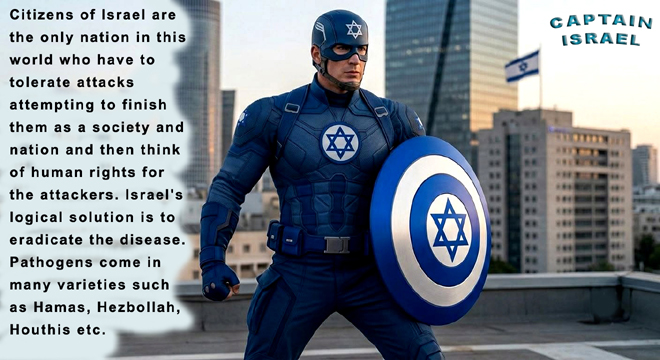
Citizens of Israel are the only nation in this world who have to tolerate attacks, which aim to obliterate them as a society and nation and then think of human rights for the attackers. Israel’s logical solution is to eradicate the disease. Pathogens come in many varieties such as Hamas, Hezbollah, Houthis etc
Since its establishment in 1948, through British Imperialist intervention, the State of Israel has faced repeated wars, cross-border attacks, suicide bombings, rocket campaigns, hostage-taking, and threats from both neighbouring states and non-state armed groups. Few democracies have spent as much of their modern history preparing for the possibility of existential conflict. This reality has shaped Israeli political culture, military doctrine, intelligence capabilities, and public opinion.
For Israelis, national security is intertwined with collective memory, particularly the Holocaust, successive Arab-Israeli wars, and decades of attacks against civilians. When Israeli leaders describe security as a matter of national survival, they are speaking to an audience that has lived through repeated conflicts in which the country’s destruction has been openly advocated by some adversaries. This historical experience explains why many Israelis view military threats differently from countries whose borders have remained relatively secure for generations.
Islamic states including Pakistan, Qatar, Egypt and Yemen have always been jealous of countries around them who have progressed in civilian life on many fronts. Their solution is to kill that country or cripple such an example of successful democratic life. For these countries in the Arabian Peninsula, the target is Israel. For Pakistan and Bangladesh, it is India.
Many of Israel’s contemporary adversaries are non-state armed organizations rather than sovereign governments. Hamas in Gaza, Hezbollah in Lebanon, and the Houthis in Yemen have developed varying military capabilities while operating within civilian environments. Their arsenals include rockets, missiles, drones, anti-tank weapons, tunnels, naval threats, and increasingly sophisticated intelligence networks. Their strategies often rely on asymmetric warfare, where a technologically weaker force attempts to offset military disadvantages by exploiting urban terrain, surprise attacks, and prolonged conflict.

The attacks of 7 October 2023 marked one of the deadliest days in Israeli history. Hundreds of civilians were killed and many were taken hostage. The scale and brutality of the assault altered Israeli public opinion across the political spectrum. For many citizens, the attacks reinforced a belief that deterrence had failed and that previous arrangements intended to contain Hamas had collapsed. The immediate political question therefore became not simply how to retaliate, but how to prevent a comparable attack from occurring again.
Israel’s supporters frequently argue that any sovereign nation confronted with such circumstances would seek to dismantle the military capabilities of the organization responsible. They point to examples such as the United States after the September 11 attacks, Russia’s response to terrorist incidents within its territory, France’s military operations against Islamist groups in the Sahel, and the multinational campaign against ISIS in Iraq and Syria. In each case, governments asserted that merely absorbing attacks while relying on diplomacy was insufficient to protect their populations.
Critics, however, argue that urban warfare ranks among the most destructive forms of conflict because armed groups often operate from cities where civilians continue to live. International humanitarian law supposedly requires armed forces to distinguish between military objectives and civilians, while also observing the principles of proportionality and precautions in attack. These legal standards are frequently debated in relation to contemporary conflicts, including those involving Israel.
The central dilemma is therefore not whether Israel has a right to defend itself, a principle widely recognized under international law, but rather how military objectives should be pursued while minimizing civilian harm. This debate has become one of the defining geopolitical controversies of the twenty-first century. However, no solution has come forth from such critics which will solve Israel’s problem. They say Israel is wrong but do not offer a formula which will satisfy internal military law doctrine and also protect Israelis. Maybe, a police force for urban warfare and a military force for military objectives. Is that what they want? Ridiculous.
Historical lessons from existential conflicts
History provides numerous examples of governments confronting adversaries whose stated objectives included their destruction or overthrow. During the Second World War, the Allied powers concluded that Nazi Germany could not simply be deterred or contained. The ideology of the Nazi regime, combined with its military expansion, convinced Allied leaders that only its military defeat could end the threat. Similarly, Imperial Japan’s expansion across Asia and the Pacific prompted an Allied campaign aimed at eliminating Japan’s capacity to wage aggressive war.
More recently, the international coalition against ISIS sought to dismantle the group’s territorial control in Iraq and Syria after it declared a self-described caliphate and carried out mass killings, enslavement, and terrorist attacks. Military operations eventually stripped ISIS of most of its territory, although the organization continues to exist as an insurgency.
Sri Lanka’s long conflict with the LTTE provides another example of a state confronting a highly organized non-state armed group. After decades of negotiations, ceasefires, and renewed fighting, the Sri Lankan government launched a final military campaign that defeated the LTTE in 2009. While the organization ceased to exist as a military force, the campaign also generated extensive international scrutiny over allegations concerning civilian casualties and compliance with international humanitarian law.
These examples illustrate an enduring reality of geopolitics: governments frequently conclude that certain armed organizations cannot be managed indefinitely through deterrence alone. Yet they also demonstrate that military success does not necessarily resolve the political grievances or humanitarian consequences associated with prolonged conflict.
Israel’s strategic calculations are influenced by these precedents but also by its own geography. The country’s narrow width in some areas means that even limited territorial incursions can rapidly threaten major population centres. Rocket attacks require only seconds or minutes of warning before reaching civilian communities. This compressed strategic depth contributes to Israeli emphasis on pre-emption, intelligence, and rapid military response.
Hezbollah presents a different challenge from that of Hamas. Based primarily in Lebanon and supported by Iran, Hezbollah possesses a far larger missile arsenal than many national armies. Analysts estimate that it has accumulated tens of thousands of rockets and missiles over many years. Israeli defence planners have long regarded this arsenal as one of the most significant conventional threats facing the country because sustained missile barrages could overwhelm defensive systems and disrupt civilian life across Israel.
The Houthis, operating from Yemen, illustrate another dimension of regional conflict. Their growing missile and drone capabilities have enabled attacks extending well beyond Yemen’s borders, including strikes affecting Red Sea shipping and launches toward Israel. These developments demonstrate how regional conflicts increasingly intersect through long-range precision weapons and proxy relationships.
Iran occupies a central position in Israel’s strategic assessment. Israeli governments have consistently argued that Tehran’s support for armed groups across the Middle East forms part of a broader regional strategy intended to increase Iranian influence while placing sustained military pressure on Israel. Iran rejects many of Israel’s accusations and presents its regional partnerships as support for resistance movements, yet the rivalry between the two states has become one of the defining geopolitical contests in the Middle East.
The legal and moral complexities of counterterrorism
Modern warfare against non-state armed groups presents legal and ethical challenges that differ substantially from conventional interstate conflict. International humanitarian law does not prohibit military operations against organized armed groups. At the same time, it establishes rules intended to protect civilians regardless of which side controls the territory where fighting occurs.
One of the greatest difficulties lies in distinguishing combatants from civilians in densely populated urban environments. Armed groups may embed military infrastructure among civilian buildings, while governments conducting military operations remain obligated to take feasible precautions to reduce civilian harm. These realities generate intense disputes over responsibility when civilian casualties occur.
Israel argues that extensive warning procedures, intelligence gathering, and precision-guided munitions demonstrate efforts to comply with the law of armed conflict. Human rights organizations and some international bodies have questioned whether particular operations have met those legal standards, especially where civilian casualties and infrastructure damage have been extensive. These disagreements continue to be examined in international legal and diplomatic forums.
Hostage-taking adds another layer of complexity. Governments face enormous domestic pressure to secure the return of captured citizens while simultaneously pursuing military objectives. Negotiations, intelligence operations, special forces raids, and military campaigns may all occur simultaneously, each carrying different risks for hostages and civilians.
The broader geopolitical implications extend beyond Israel and its immediate neighbours. Regional powers, global alliances, energy markets, maritime security, and international diplomacy are all influenced by recurring cycles of conflict. Shipping routes through the Red Sea, for example, have become strategically significant because attacks on commercial vessels affect global trade, insurance costs, and supply chains extending far beyond the Middle East.
Major powers approach the conflict through differing strategic lenses. The United States has traditionally emphasized Israel’s security while also encouraging humanitarian protections and diplomatic engagement. European governments broadly support Israel’s right to self-defence but often express stronger concerns regarding humanitarian consequences and long-term political solutions. Russia and China have pursued their own regional interests, often advocating broader diplomatic initiatives while maintaining relationships with multiple actors across the Middle East.
These differing approaches illustrate that international politics rarely produces unanimous agreement regarding the appropriate balance between military necessity, humanitarian obligations, and long-term stability.
Security, deterrence, and the search for lasting stability
The fundamental strategic question facing Israel is not merely how to respond to individual attacks but how to establish a security environment in which future generations can live without constant fear of large-scale violence. Military operations may reduce the capabilities of particular armed groups, but experience from conflicts around the world suggests that lasting stability often depends on broader political, economic, and diplomatic developments alongside security measures.
Supporters of Israel’s current security doctrine contend that no government can tolerate armed organizations capable of launching large-scale attacks against its civilian population. They argue that effective deterrence requires demonstrating that such attacks carry significant military consequences. From this perspective, weakening the operational capabilities of groups that conduct or threaten attacks is viewed as a legitimate objective of national defence.
Others argue that military campaigns alone cannot eliminate the conditions that allow armed groups to recruit, reorganize, or regain influence. They maintain that durable security ultimately requires political arrangements, regional diplomacy, economic reconstruction, and governance capable of reducing incentives for continued conflict.
Historical experience offers evidence for both perspectives. The military defeat of organizations such as ISIS in its territorial form, the LTTE in Sri Lanka, and numerous insurgent movements demonstrates that organized armed groups can suffer decisive military setbacks. At the same time, other conflicts, including Afghanistan, Iraq, and parts of the Sahel, illustrate how insurgencies can persist or re-emerge despite substantial military pressure.
Israel therefore confronts a strategic environment in which military force remains an important instrument of national defence but not necessarily a complete solution. Intelligence cooperation, missile defence systems, border security, regional diplomacy, and international partnerships all contribute to its broader security architecture.
Ultimately, the Israeli-Palestinian conflict, together with the wider regional confrontation involving Iran and allied armed groups, represents one of the most complex geopolitical challenges of the modern era. It combines conventional military threats, asymmetric warfare, ideological conflict, humanitarian concerns, international law, and great-power competition into a single theatre of conflict. Any serious analysis must therefore recognize both Israel’s legitimate security concerns and the legal and humanitarian obligations that apply during armed conflict. Understanding this dual reality is essential for evaluating policy choices, military strategy, and prospects for a more stable Middle East.