
You can feed a score or at least a dozen orphanages if we could collect the food that well-off families throw away. Culinary minimalism is how panic manifests itself over the constant worriers with the belief that the best way to eat is to eat less of the food itself, less fat, less smell, less texture, less character. The end goal appears to be a plate so refined, so purified, that it barely resembles food at all. Some people throw away egg yolks because they do not eat them for fear of cholesterol. Some people throw away fish intestines, again cholesterol and the smell. Some people do not eat the core of a carrot or the core of a pineapple. What about people who throw away the remnants of a coffee jar or the gravy of curry for fear of eating the component which has too much spices. No butter. No sides of the bread. Or no edges of the crusty cover of the loaf. No fish heads, no tripe when they eat meat. Not the stalk of a coriander. Its panic vs panacea
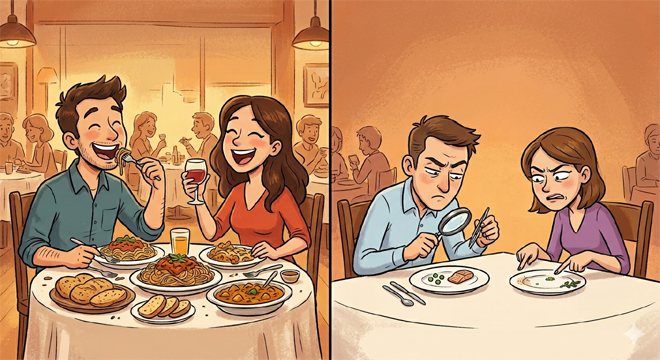
There are two parallel universes operating in every modern kitchen. In one, food is celebrated, respected, occasionally overcooked, but ultimately eaten. In the other, food is judged, filtered, trimmed, and selectively exiled like a reality show contestant who didn’t quite bring enough personality to the plate. The tragedy is that both universes exist in the same refrigerator.
Let us begin with the egg, that humble, oval ambassador of nutrition. Crack it open, and you are immediately confronted with a moral dilemma. The white is clean, ascetic, almost monastic in its restraint. The yolk, however, is indulgent. Golden. Decadent. Suspiciously cheerful. And so, millions of people around the world perform the great yolk separation ritual. The white is whisked into protein shakes, omelettes, and fitness aspirations. The yolk? Quietly escorted to the bin like a disgraced aristocrat who knew too much.
This is not cooking. This is food profiling.
And eggs are only the opening act. Move to fish, and the drama escalates. The fish arrives whole, a complete ecosystem of edible possibility. But by the time it reaches the plate, it has been stripped down to a polite fillet, its personality surgically removed. The head is too confronting. The intestines are too aromatic. The bones are too complicated. What remains is a bland, socially acceptable version of fish that could pass for anything from tofu to a philosophical concept.
Somewhere in this process, we have mistaken convenience for civilisation. The less a food reminds us of its origins, the more acceptable it becomes. The fish must forget it was once a fish. The egg must forget it had a yolk. The carrot must forget it had a core. And we, in turn, forget what food actually is.
The cult of culinary minimalism
There is a curious ideology at play here, one that might be called culinary minimalism. It is the belief that the best way to eat is to eat less of the food itself, less fat, less smell, less texture, less character. The end goal appears to be a plate so refined, so purified, that it barely resembles food at all.
Consider the apple. Once upon a time, people ate apples the way nature intended: whole, skin and all, occasionally with a satisfying crunch that echoed through orchards and childhood memories. Today, the apple is often peeled, its skin removed with surgical precision. Why? Pesticides, some say. Texture, say others. Habit, say most. The result is a pale, slightly embarrassed fruit that seems to apologise for existing.
Carrots suffer a similar fate. Their skins are peeled away, their cores scrutinised, their identity reduced to neat, orange cylinders that look like they were designed by an engineer rather than grown in soil. Gourds, too, are stripped of their skins, as though the very idea of a vegetable having layers is somehow offensive.
And then there is pineapple, that tropical paradox. Its sweet, juicy flesh is adored, but its core, firm, fibrous, and slightly rebellious, is rejected. The core, which contains much of the fruit’s structural integrity and a surprising amount of nutrition, is treated like an inconvenient truth. It is chewed once, perhaps twice, and then discreetly discarded, as though it had committed a minor social faux pas.
This is not minimalism in the artistic sense. This is minimalism in the nutritional sense, an enthusiastic removal of everything that makes food interesting.
The fear of flavour and the war on smell
If texture is one battlefield, smell is another. Modern eaters have developed an almost heroic aversion to strong aromas. Food must smell pleasant, certainly, but not too pleasant. It must hint at flavour without committing to it. Anything that crosses this invisible line is immediately suspect.
Fish intestines, for instance, are rich, complex, and deeply flavourful. They are also, admittedly, aromatic. But instead of embracing this aroma as part of the culinary experience, many people treat it like a chemical hazard. The same goes for offal, tripe, and other parts of animals that have nourished humans for centuries. These foods are not just rejected, they are actively feared, as though they might leap off the plate and demand respect.
Even gravy is not spared. The remnants of a curry, thick with spices and history, are often left behind. “Too rich,” someone says. “Too oily,” says another. The gravy, which is essentially the soul of the dish, is abandoned in favour of the safer, drier components. It is like attending a concert and leaving just before the climax because the music became too intense.
Coffee, too, is subject to this strange caution. The last bit in the jar, the concentrated essence of countless scoops, is often ignored. It sits there, dark and potent, a reminder that flavour, when allowed to accumulate, becomes something powerful, and therefore, apparently, undesirable.
In this war on smell and intensity, we have declared victory over flavour itself. The casualties are numerous, and they include joy.
The bread crust controversy and other edible injustices
Bread, that most democratic of foods, has not escaped scrutiny. It arrives as a loaf, proud and complete, only to be dismantled by those who insist on eating “just the soft part.” The crust, that beautifully browned exterior, is deemed too hard, too chewy, too much. It is sliced off, left behind, or worse, never even considered.
This is particularly tragic because the crust is where much of the flavour resides. It is the result of heat, time, and chemistry, a culinary achievement in its own right. To discard it is to reject the very process that made the bread what it is.
Butter, too, has been caught in the crossfire. Once a symbol of indulgence and comfort, it is now often avoided with the seriousness of a moral decision. “No butter,” people say, as though they are taking a stand against an oppressive regime. The bread, now crustless and butterless, becomes a metaphor for modern eating: safe, controlled, and faintly disappointing.
Coriander stalks, meanwhile, are quietly discarded despite being packed with flavour. The leaves are celebrated, garnished, Instagrammed. The stalks are treated like backstage crew, essential, but invisible. Fish heads, rich in nutrients and flavour, are rejected for being too… fishy. Offal and tripe are dismissed for being too honest about what meat actually is.
At this point, one begins to suspect that the problem is not the food, but our expectations of it. We want food to be nourishing, but not challenging; flavourful, but not intense; natural, but not too natural. It is a delicate balance, and one that often results in a plate that is less than the sum of its parts.
The arithmetic of waste and the illusion of abundance
Now, let us do some simple, slightly uncomfortable arithmetic. Imagine a well-off household that discards just a little from each meal: a few egg yolks here, some bread crusts there, the skins of fruits and vegetables, the gravy left in the bowl, the fish head politely declined. Individually, these seem insignificant. Collectively, they form a mountain.
Multiply this behaviour across neighbourhoods, cities, countries, and suddenly you have a staggering amount of edible food being thrown away. Not spoiled food. Not unsafe food. Perfectly edible, often highly nutritious food that simply did not meet someone’s personal criteria for consumption.
Now imagine redirecting this food. Not in a literal, logistically nightmarish sense, but as a thought experiment. The discarded yolks alone could enrich countless meals. The bread crusts could become breadcrumbs, soups, or snacks. The vegetable skins could be transformed into stocks and crisps. The fish heads and offal could create dishes of extraordinary depth and flavour.
It is not unreasonable to say that this “waste” could feed a dozen orphanages, perhaps more. The irony is almost poetic. In a world where food insecurity remains a pressing issue, we have pockets of abundance so excessive that they result in deliberate, habitual waste.
This is not a failure of supply. It is a failure of imagination, and perhaps of appreciation.
Tradition, memory, and the forgotten art of using everything
There was a time, not so long ago, when throwing away parts of food was unthinkable. Not because people were virtuous, but because they were practical. Every part of an ingredient had a purpose. Skins became stocks. Bones became broths. Leftovers became new dishes. Nothing was wasted because everything was valued.
This approach was not just economical; it was deeply creative. It required cooks to understand their ingredients, to experiment, to adapt. It gave rise to cuisines that were rich, diverse, and resourceful. Offal was not a last resort; it was a delicacy. Fish heads were not avoided; they were prized. Vegetable skins were not discarded; they were transformed.
Somewhere along the way, we lost this mindset. Convenience replaced creativity. Abundance replaced appreciation. And in the process, we forgot that food is not just something to be consumed, it is something to be respected.
The modern kitchen, with its pre-packaged ingredients and neatly trimmed produce, has made it easier than ever to ignore the full potential of food. But it has also made it easier to waste it. When everything is readily available, nothing feels precious.
And yet, the knowledge has not disappeared entirely. It lingers in traditional recipes, in the practices of older generations, in the cuisines that still embrace the whole ingredient. It waits patiently, like a forgotten cookbook on a dusty shelf, ready to be rediscovered.
A modest proposal for radical eating
So what is to be done? Must we all suddenly start eating fish intestines and pineapple cores with evangelical zeal? Not necessarily. But perhaps we can begin with something simpler: curiosity.
What happens if you eat the yolk? (Spoiler: nothing catastrophic.) What happens if you keep the apple skin? What if you try cooking with vegetable peels, or using bread crusts in a creative way? What if you taste the gravy instead of abandoning it?
These are small experiments, but they have the potential to shift perspective. They remind us that food is not an enemy to be managed, but a resource to be explored. They encourage us to move away from fear-based eating and towards a more balanced, informed approach.
And yes, they might even make meals more interesting. Imagine that.
Radical eating, it turns out, is not about extreme diets or exotic ingredients. It is about using what you already have, fully and thoughtfully. It is about recognising that the parts we discard are often the parts that carry the most flavour, the most nutrition, and the most story.
In praise of the overlooked and the undervalued
In the end, this is not just about food. It is about how we perceive value. The egg yolk, the bread crust, the coriander stalk, the fish head, these are not just ingredients. They are symbols of a broader tendency to overlook, to undervalue, to discard.
Perhaps the real question is not why we throw these things away, but what we lose in the process. Flavour, certainly. Nutrition, undoubtedly. But also a connection, to tradition, to resourcefulness, to the simple act of eating with awareness.
So the next time you find yourself about to discard a perfectly edible part of your meal, pause for a moment. Consider its journey, its potential, its place in the grand, slightly absurd theatre of human eating habits. And then, if you’re feeling adventurous, give it a chance.
After all, in a world where we are constantly searching for more, more flavour, more nutrition, more meaning, it is entirely possible that we have been throwing it away all along.