
Delhi’s geographical position — between the Thar Desert and the Indo-Gangetic plains — made water management a civilizational necessity. Pollution grew when this truth was neglected
Delhi’s pollution crisis did not descend overnight, nor did it arrive on the smoke trails of distant farms alone. The story is far more local, far more uncomfortable, and far more indicting. Delhi’s air became poisonous because Delhi’s water was systematically erased. Lakes were filled, wetlands were buried, ponds were rebranded as “vacant land,” and in their place rose dense, poorly ventilated concrete clusters marketed as progress. Pollution did not merely grow alongside this transformation — it was engineered into the city.
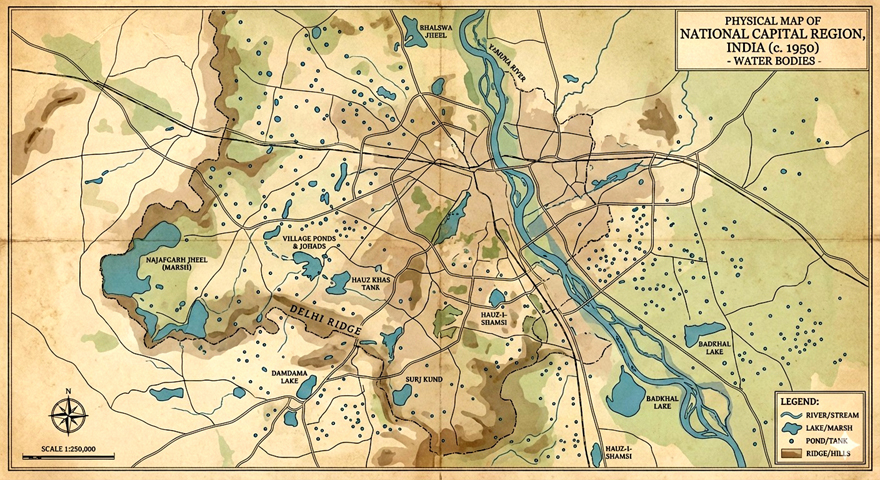
For decades, Delhi functioned as a water-shaped city. Seasonal lakes, johads, baolis, floodplains, and marshes formed a living ecological network that cooled the air, suppressed dust, recharged groundwater, and supported biodiversity. That network is now largely gone. What replaced it is not urban sophistication, but ecological fragility.
A city once designed around water
Delhi’s geographical position — between the Thar Desert and the Indo-Gangetic plains — made water management a civilizational necessity. Every major historical phase of Delhi, from the Rajputs to the Mughals and even early British planners, understood this. Settlements grew around water bodies, not over them.
Hundreds of ponds, stepwells, and wetlands once dotted the region. These were not ornamental features. They moderated temperature, trapped particulate matter, maintained soil moisture, and allowed wind to move freely through open ecological corridors. Birds, insects, amphibians, reptiles, and mammals thrived in this mosaic of blue and green, creating a resilient urban microclimate.
Dhaula Kuan: A lake turned into a flyover
Few places illustrate Delhi’s ecological self-harm more starkly than Dhaula Kuan. Today it is synonymous with traffic snarls and flyovers. Yet it was once a monsoon lake that attracted migratory birds — herons, ducks, cranes — and sustained surrounding vegetation.
As post-Independence Delhi expanded, this lake was reclassified from ecology to “underutilised land.” Instead of being revived or integrated into urban planning, it was filled, levelled, and built over. Roads, cantonment infrastructure, and commercial development replaced a functioning wetland. The disappearance was complete — not only of water, but of memory.
Dhaula Kuan is not an exception. It is the template.
How real estate rewrote Delhi’s ecology
The most decisive ecological turning point came when property speculation, backed by political patronage, entered Delhi’s planning ecosystem. Water bodies were easy targets. They were common land, poorly documented, and politically defenceless.
Builders used three repeatable methods. First, ponds were used as dumping grounds for construction debris until they became shallow and stagnant. Second, these degraded sites were then declared “wastelands.” Third, legal loopholes and administrative silence enabled conversion into apartment blocks, malls, and banquet halls.
This pattern played out across urban villages, unauthorised colonies, and peri-urban zones. The result was not just loss of water bodies, but loss of ventilation corridors, green buffers, and dust-suppressing landscapes.
Predictable and documented ecological consequences
The disappearance of wetlands triggered cascading failures. Birds lost resting and breeding grounds, altering migration patterns. Bees and butterflies declined with the loss of flowering shrubs and water sources, weakening pollination cycles. Frogs — reliable indicators of ecological health — vanished early, followed by snakes and other wetland-dependent species.
At the human scale, the consequences were brutal. Areas where lakes once cooled entire neighbourhoods experienced a sharp rise in temperatures, intensifying the urban heat island effect. Groundwater levels collapsed as recharge stopped but extraction continued at industrial scale. During monsoons, the city flooded more easily because ponds that once absorbed runoff were gone. During winters, dust rose unchecked from dry, exposed soil.
Pollution is local, structural, and home-grown
Scientific source-apportionment consistently shows that a major share of Delhi’s particulate pollution comes from road dust, construction dust, and local soil exposure — not distant agricultural fires alone. Construction activity, continuous groundwater extraction, and loss of wetlands dry out the city’s skin, making particulate matter easier to lift and harder to suppress.
Stubble burning contributes episodically but framing it as the primary or singular cause is a political convenience. It shifts blame outward, consumes administrative bandwidth, and delays confrontation with Delhi’s own planning failures. It is a red herring that allows local ecological destruction to continue unchallenged.
The Aravallis and the missing shield
Delhi’s ecological collapse cannot be separated from the degradation of the Aravalli range. These ancient hills historically acted as a wind-break, moisture retainer, and dust filter for the NCR. Mining, deforestation, and construction have fragmented this protective shield.
As vegetation was stripped and soil exposed, dust entrainment increased. Combined with the loss of Delhi’s internal wetlands, this removed both the external barrier and the internal sinks that once moderated particulate levels. Pollution, in this sense, is not an accident — it is the outcome of landscape dismantling.
Why courts and laws failed to protect water
India does not lack environmental judgments. Courts have repeatedly ordered protection of lakes, wetlands, and ridges. Yet enforcement collapsed under political pressure, ambiguous land records, overlapping jurisdictions, and routine corruption at lower administrative levels.
Water bodies disappeared faster than agencies could even catalogue them. Once filled and built over, ecological loss became legally irreversible. This failure was institutional, not judicial — a gap between law on paper and bulldozers on ground.
The cultural loss no one measured
Beyond data and dust, Delhi lost something harder to quantify. Ponds were social spaces. Stepwells were gathering points. Festivals, daily routines, and seasonal rhythms revolved around water. Older residents remember cooler mornings, birdsong, and the smell of wet earth after rain.
An entire generation has grown up without this lived experience. Pollution is not just a health crisis; it is a cultural amputation.
Lessons from cities that chose water over concrete
Global examples show that this trajectory is reversible. Seoul dismantled an elevated highway to restore the Cheonggyecheon stream, cooling the city and reviving biodiversity. Singapore transformed concrete drains into living rivers. London has daylighted buried waterways.
These cities succeeded because they reversed a flawed assumption: that water obstructs development. In reality, water enables livability. Delhi, despite deeper historical knowledge of water management, chose the opposite path.
What restoration would actually require
Restoring Delhi’s ecological resilience demands structural change, not cosmetic fixes. Historical mapping of lost water bodies using satellite and archival data must precede any planning. Construction on natural drainage lines must stop. Encroached wetlands must be reclaimed using administrative and legal force. Ponds must be integrated into storm-water management rather than beautification projects.
Equally critical is a rethink of urban density. Narrow lanes, unplanned vertical growth, and conversion of houses into flats choke airflow and trap pollutants. Without ventilation corridors, no amount of vehicle regulation will deliver breathable air.
The stubble burning narrative must end
Blaming farmers for Delhi’s air allows the city to avoid accountability. It masks the reality that pollution intensified as lakes vanished, groundwater collapsed, construction became perpetual, and forests were fragmented. Until Delhi confronts the fact that it destroyed its own ecological infrastructure, pollution control will remain seasonal, punitive, and ineffective.
A city that forgot its water forgot its future
Delhi did not lose its lakes by accident. They were erased deliberately, incrementally, and profitably. Ugly flats replaced living water, and pollution filled the vacuum left behind. Nature does not negotiate. The city now lives with unbreathable air, extreme heat, flooding, and water scarcity because it chose short-term real estate gains over long-term survival. The past shows what Delhi once was. The present reveals the cost of forgetting. The future depends on whether the city is willing to remember water again.