
India does not suffer from a shortage of traffic laws. It suffers from a catastrophic shortage of consequences. India currently has ₹9,000 crore in outstanding traffic violation fines
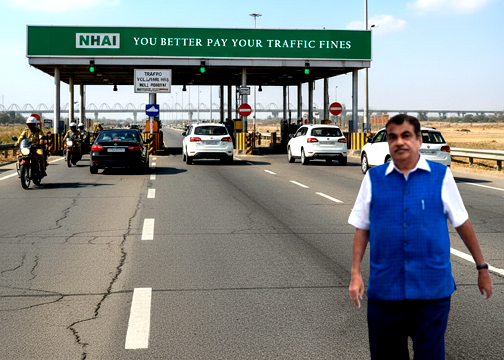
Last year alone, governments across India issued staggering 8 crore traffic challans—for speeding, jumping signals, riding without helmets, dangerous parking, and other routine violations. On paper, this looks like enforcement at scale. In reality, it is theatre. Nearly 75% of these challans were never paid, leaving ₹9,000 crore in outstanding fines. Delhi, often projected as the model city for digital governance, performs even worse: over 94% of challans remain unpaid.
This is not a gap in compliance. This is a collapse of deterrence.
Traffic challans are supposed to enforce accountability and protect public safety. Instead, they have become optional suggestions—easily ignored, routinely negotiated away, and structurally toothless. The only rational conclusion is this: as long as traffic penalties remain easy to dodge, people will continue to dodge them. The solution is not more challans. The solution is unavoidable consequences—specifically, linking unpaid traffic violations directly to insurance premiums, license validity, and vehicle usability.
A national public health crisis disguised as “traffic management”
India is the road accident capital of the world. Last year, we lost 1.8 lakh lives on our roads. That is the equivalent of a medium-sized city wiped out annually. These are not abstract statistics; they represent families destroyed, incomes erased, and lifelong disabilities inflicted. Road accidents are not merely transport issues—they are a public health emergency.
Yet the disconnect between enforcement and outcomes is staggering. If challans worked as deterrents, accident rates would be falling sharply. They are not. The reason is simple: drivers do not perceive traffic violations as serious offenses. And why would they, when the system itself does not take them seriously?
A quick glance at public behaviour confirms this. The most common online searches related to traffic challans are not about compliance or responsibility. They are:
- How to avoid paying traffic challan?
- What happens if we don’t pay the challan?
- How to get a discount in challan?
This is not accidental. It reflects a rational response to a weak enforcement regime. When punishment is uncertain, delayed, or negotiable, non-compliance becomes the default strategy.
The failure of higher penalties alone
The Motor Vehicles (Amendment) Act, 2019 attempted to address this by increasing fines dramatically. The logic was straightforward: higher penalties would hurt more and therefore deter violations. In practice, it failed.
Why? Because severity without certainty does not work.
Drivers quickly learned that enforcement remained inconsistent. Cameras malfunctioned. Notices went unpaid without consequence. Police discretion continued to dominate outcomes. Bribes, negotiations, and “adjustments” remained cheaper and faster than formal compliance.
In India, people do not follow traffic rules; they follow cops and cameras. Remove either, and behaviour collapses. This tells us everything we need to know: traffic discipline here is externally enforced, not internally accepted. And external enforcement only works when consequences are automatic and unavoidable.
What we have instead is a system of negotiation, not compliance. Get caught, bargain your way out. Get challaned digitally, ignore it. Nothing really happens.
Why nobody pays: The cost-benefit reality
From a driver’s perspective, not paying a challan is often the most rational choice.
- There is no immediate penalty.
- License renewal continues unhindered.
- Insurance premiums remain unaffected.
- Vehicle resale is unaffected.
- No interest accrues meaningfully.
- No enforcement agency follows up seriously.
Lok Adalats were meant to clear backlog, but they inadvertently reinforced the idea that fines are flexible, negotiable, and eventually discounted. This may ease administrative load, but it destroys deterrence.
As long as unpaid challans remain administrative paperwork instead of personal consequences, people will continue to ignore them.
The only language drivers understand: Pain that cannot be escaped
If traffic discipline is to improve, the system needs real teeth. Not theoretical penalties, but consequences that hurt and cannot be negotiated away.
One solution stands out for its simplicity and effectiveness: add unpaid traffic challans to car insurance premiums at renewal.
Insurance is one bill that nobody ignores. Drive uninsured, and your vehicle becomes illegal overnight. Add financial pain there, and compliance will skyrocket.
This is not radical. It is logical.
Insurance companies already assess risk. Traffic violations are among the strongest predictors of accidents. A driver with repeated unpaid challans is demonstrably higher risk. Making them pay higher premiums is not punishment—it is actuarial honesty.
How insurance-linked enforcement changes everything
Linking unpaid challans to insurance renewal achieves multiple goals simultaneously:
- Automatic Recovery
Outstanding fines get recovered without police follow-ups, courts, or Lok Adalats. - Unavoidable Consequences
You cannot negotiate with an algorithm at renewal time. - Fairness
Law-abiding drivers stop subsidising reckless ones. - Behavioural Change
Once drivers know violations will hit their wallet annually, compliance improves rapidly. - Administrative Efficiency
Enforcement moves from street-level discretion to backend automation.
This single reform would do more for road safety than a thousand awareness campaigns.
Complementary measures that strengthen the system
Insurance linkage alone is powerful, but it should be part of a broader enforcement framework:
- License Suspension After 90 Days of Non-Payment
No payment, no license. Simple. - FASTag-Based Automatic Deduction
For certain categories of violations, fines can be auto-deducted, with prior consent baked into vehicle registration. - Escalating Premiums for Repeat Offenders
First-time mistake is forgivable. Patterns of recklessness are not. - AI-Driven Cameras
Remove the human, bribe-able interface. Let machines record violations and generate penalties without bias or negotiation.
None of this requires futuristic technology. Most of it already exists. What is missing is political and bureaucratic will.
Enforcement is the missing link in Vision 2030
The Ministry of Road Transport and Highways, under Nitin Gadkari, has set an ambitious target: reduce road fatalities by 50% by 2030. This is a worthy goal—but without enforcement reform, it remains a fantasy.
You cannot lecture your way out of a compliance crisis. You cannot educate your way past structural incentives. People respond to systems, not sermons.
India does not need more rules. It needs a system that actually works, where breaking the law reliably leads to consequences that hurt enough to matter.
From negotiation to compliance
The biggest cultural shift required is this: traffic violations must stop being seen as negotiable inconveniences and start being treated as non-negotiable offenses.
That shift will not come from moral appeals. It will come when:
- Ignoring a challan costs more than paying it.
- Repeated violations follow you year after year.
- Compliance becomes the cheapest, easiest option.
Linking unpaid challans to insurance premiums does exactly that. It aligns incentives. It makes responsibility economically rational.
Until penalties are severe and certain, nothing will change. And certainty—not severity—is the key.
India’s roads will not become safer because we issue more challans. They will become safer when every challan follows you home, into your insurance renewal, your license validity, and your ability to legally drive. Only then will traffic laws stop being jokes—and start saving lives.