
As the global space economy shifts toward private innovation, India too is opening its gates. Skyroot’s mission is not just about a single rocket
India’s space sector, long dominated by the Indian Space Research Organisation (ISRO), is on the verge of a historic transformation. Hyderabad-based Skyroot Aerospace, founded by two former ISRO scientists — Pawan Chandana and Naga Bharath Daka — is preparing to launch India’s first private commercial rocket within the next three months, as reported by Mint. This event is poised to mark the beginning of a new era: the commercialization and privatization of Indian spaceflight.
Until recently, the story of India’s achievements in space was synonymous with ISRO — from the Mars Orbiter Mission to Chandrayaan and the Gaganyaan crewed mission in progress. But as the global space economy shifts toward private innovation, India too is opening its gates. Skyroot’s mission is not just about a single rocket; it is about creating a competitive, sustainable private ecosystem for space technology within India.
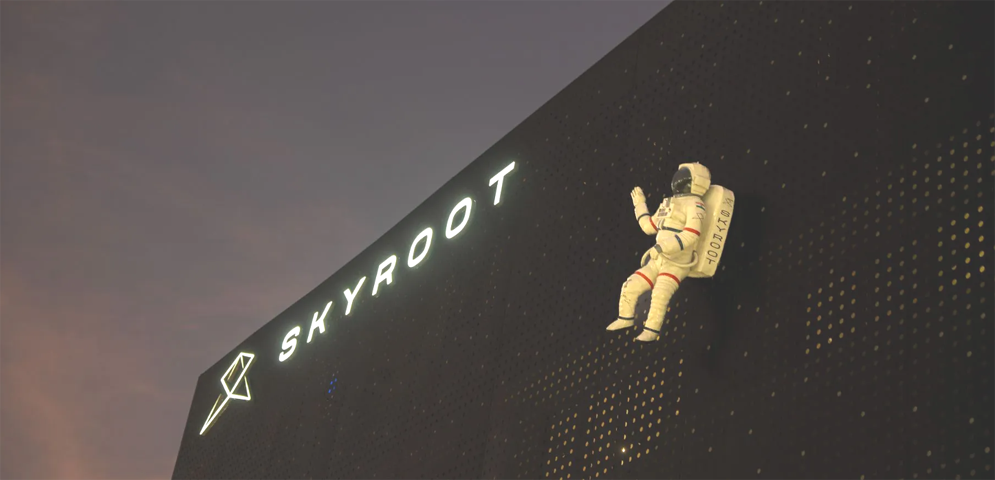
The Emergence of Skyroot Aerospace
Skyroot Aerospace was founded in 2018 with a clear vision — to make access to space “as reliable, affordable, and regular as air travel.” Its founders, Pawan Chandana (CEO) and Naga Bharath Daka (COO), both alumni of ISRO’s prestigious Vikram Sarabhai Space Centre, brought with them decades of cumulative experience in rocket systems, propulsion design, and launch operations.
Their decision to leave ISRO and create a private venture was driven by a global shift. In the United States, private companies like SpaceX, Rocket Lab, and Relativity Space were redefining the economics of satellite launch services. Skyroot’s founders envisioned a similar trajectory for India — a country with a deep talent pool, a robust engineering ecosystem, and a government increasingly open to private participation in space.
In November 2022, Skyroot achieved a milestone that would define its identity: the successful launch of Vikram-S, India’s first privately built suborbital rocket. The launch demonstrated not just engineering prowess but also regulatory coordination with ISRO and the newly established Indian National Space Promotion and Authorization Centre (IN-SPACe) — the body facilitating private participation in space activities.
That success proved that India’s private spacetech dream was technically feasible and operationally viable.
The Upcoming Launch: A New Milestone
According to Skyroot’s co-founder Pawan Chandana, the company’s first full-scale commercial satellite mission is scheduled for January 2026. Preparations are already underway for a demonstration launch — India’s first private orbital rocket mission — within the next three months.
The upcoming mission will carry both domestic and international payloads, signaling Skyroot’s entry into the global commercial launch market. Chandana revealed that manufacturing a single rocket takes eight to nine months and costs $2–3 million, while the company expects to earn roughly $5 million per launch — essentially doubling its investment on each mission.
Skyroot’s operational strategy is ambitious: it aims to conduct one launch every three months in 2026, scaling up to monthly launches by 2027. If realized, this would make it one of the most active small satellite launch companies in Asia, positioning India as a low-cost, high-efficiency competitor to Western players like Rocket Lab and Firefly Aerospace.
The Vikram Rocket Series
Skyroot’s rocket family is named after Dr. Vikram Sarabhai, the father of the Indian space program. The Vikram series — Vikram I, II, and III — is designed to cater to a variety of payload sizes and orbital requirements.
Each rocket uses carbon-fiber composite structures, 3D-printed engines, and modular solid-liquid propulsion stages, allowing for scalability and rapid assembly. The design philosophy is clear: minimize cost and turnaround time, while maintaining ISRO-grade reliability.
Skyroot’s Raman Engine, named after Nobel laureate C.V. Raman, is a 3D-printed cryogenic engine that symbolizes the company’s deep technological integration with India’s scientific legacy. By combining advanced materials, digital manufacturing, and automation, Skyroot’s team has drastically reduced the time needed to build and test rocket components — a key factor in achieving their high launch frequency targets.
India’s Private Space Policy Revolution
Skyroot’s rise is part of a broader policy shift in India’s space governance. In 2020, the Indian government introduced the SpaceCom and SpaceRS policies, followed by the Indian Space Policy 2023, which formally allowed private players to build, launch, and operate space assets.
The creation of IN-SPACe (Indian National Space Promotion and Authorization Centre) was pivotal. It functions as the single-window regulator and facilitator for private companies, ensuring safe and coordinated use of ISRO’s infrastructure while granting autonomy to startups.
The government’s intent is clear: to create an Indian version of NASA’s “commercial launch services” model, where private players handle routine launches, freeing up ISRO to focus on deep-space exploration and high-value research.
Skyroot’s first commercial launch, therefore, is more than a technical milestone — it is a policy victory, proving that India’s new space governance framework can attract private investment, foster innovation, and deliver results.
The Investors Fueling India’s Space Ambition
Skyroot has raised $95.5 million since its founding, making it one of India’s best-funded spacetech startups. Its investors include global heavyweights like Temasek Holdings and GIC (Singapore’s sovereign wealth fund), along with Lahari Ventures, Wami Capital, and Greenko Group founders Anil Kumar Chalamalasetty and Mahesh Kolli.
The entry of such high-profile backers demonstrates growing investor confidence in India’s space sector. In 2022, the Indian spacetech startup ecosystem attracted nearly $120 million in total funding — a record high, according to a PwC India report. Analysts project that the Indian private space economy could reach $40 billion by 2040, up from about $8 billion today.
Skyroot’s model — low-cost launches for small and medium satellites — directly aligns with global market trends. The small satellite market, driven by applications in communication, Earth observation, and data analytics, is projected to grow to $62 billion by 2030 (Allied Market Research).
This expanding demand presents a golden opportunity for Indian startups that can offer launch services at one-third the global cost. Skyroot’s ability to achieve reliable orbital launches could establish it as Asia’s leading small-satellite launcher, alongside companies in the U.S. and Europe.
A Global Shift Toward Privatization
The rise of Skyroot mirrors the global trend toward space privatization. Over the past two decades, the U.S., Europe, and China have transitioned from state-run space programs to public-private partnerships that encourage innovation.
In the U.S., SpaceX disrupted the launch market by drastically reducing costs through reusable rockets. Rocket Lab, based in New Zealand, focused on small satellite launches with its Electron rocket. Relativity Space went a step further, developing rockets that are almost entirely 3D-printed.
India, long admired for ISRO’s cost-effective missions, is now taking the next step — creating a private ecosystem of launch providers, component manufacturers, and satellite developers. The emergence of startups like Agnikul Cosmos, Pixxel, and Bellatrix Aerospace reinforces this momentum.
Skyroot’s first orbital mission could serve as the SpaceX “Falcon 1 moment” for India — the point at which private spaceflight becomes a proven, profitable reality.
Engineering Excellence and Indigenous Innovation
Skyroot’s technological backbone rests on indigenous innovation. Its team of more than 300 engineers and scientists has developed propulsion systems, avionics, and launch infrastructure from the ground up.
The company uses 3D printing not just for prototyping but for full-scale production of rocket engines — cutting manufacturing time by up to 80% and cost by nearly 50% compared to traditional methods.
Skyroot’s cleanroom assembly, digital testing, and modular integration systems are located in Hyderabad’s growing aerospace corridor. The city has become a hub for space and defense startups, supported by Telangana’s proactive industrial policies and its collaboration with the central government’s Atmanirbhar Bharat (self-reliance) initiative.
Every aspect of Skyroot’s development — from design software to testing facilities — reflects a “Made in India, for the world” approach.
Economic and Strategic Implications for India
Skyroot’s success carries significant implications for India’s economy, security, and global standing.
- Economic Growth and Job Creation:
The private space sector is expected to create thousands of high-skill jobs in engineering, manufacturing, and data services. According to EY India’s 2023 SpaceTech report, every $1 invested in space manufacturing and launch generates $6–8 in economic returns through downstream industries like communications, navigation, and remote sensing. - Reducing Dependence on Foreign Launches:
Currently, many Indian startups and institutions rely on foreign launch vehicles (such as SpaceX’s Falcon 9) to place their small satellites into orbit. Skyroot’s entry will provide domestic alternatives, reducing costs and boosting self-reliance. - Global Strategic Positioning:
As countries like the U.S., China, and Japan vie for dominance in space, India’s ability to support private launch providers will enhance its geostrategic influence. Affordable launch services could make India the preferred partner for emerging nations seeking to deploy satellites for climate monitoring, agriculture, or communication. - Catalyst for Collaboration:
Skyroot’s growth could also inspire international collaborations with universities, research organizations, and startups. The company’s model of carrying both domestic and international payloads in its first mission highlights India’s potential to become a global commercial space hub.
Challenges Ahead
Despite the optimism, challenges remain. Rocket development is high-risk and capital-intensive, with long gestation periods and complex supply chains.
- Funding sustainability: Even with $95 million raised, scaling to frequent launches will require continuous capital inflow, especially for building reusable systems or larger vehicles.
- Infrastructure access: Coordination with ISRO for shared launchpads and telemetry facilities is crucial. While IN-SPACe facilitates this, real-time collaboration must be seamless.
- Regulatory clarity: India’s space law, though evolving, still requires detailed guidelines on insurance, liability, and export controls — critical for global partnerships.
- Technical reliability: Every failure or delay in launch could affect investor confidence. Maintaining consistent success rates will be vital for Skyroot’s credibility.
However, Skyroot’s founders — trained in ISRO’s culture of discipline and precision — are aware of these realities. Their operational plan emphasizes incremental scaling, extensive testing, and cost efficiency through technology reuse.
The Broader Indian Spacetech Ecosystem
Skyroot’s journey also symbolizes a renaissance in India’s space entrepreneurship.
Other startups, such as Agnikul Cosmos (IIT-Madras) with its “Agnibaan” launch vehicle, Pixxel with its hyperspectral imaging satellites, and Dhruva Space with modular satellite buses, represent the diverse layers of India’s emerging ecosystem.
Together, these companies are building an end-to-end private space value chain — from design and manufacture to launch and data analytics. ISRO, acting as mentor and facilitator, has embraced this collaborative role, recognizing that government and startups can together multiply capacity.
Toward the Future: Monthly Launches, Global Impact
Skyroot’s plan to conduct monthly launches by 2027 represents a vision of industrial-scale efficiency. If achieved, it would make India one of the few countries capable of routine commercial launches through private industry.
The implications extend beyond economics. Regular private launches will accelerate innovation in telecommunications, environmental monitoring, defense, and agriculture, all of which depend on satellite constellations for real-time data.
In the long term, Skyroot also envisions contributing to India’s lunar and interplanetary ambitions — offering propulsion modules, orbital tugs, and even payload delivery systems for deep-space missions.
Conclusion: India’s Private Space Dawn
When Skyroot’s next rocket lifts off — carrying the hopes of hundreds of engineers, the support of visionary investors, and the spirit of India’s scientific pioneers — it will represent much more than a technical achievement.
It will mark the moment India’s private space industry truly takes flight.
From the first spark at ISRO to the upcoming commercial launchpad in Hyderabad, India’s journey has been one of innovation, discipline, and national pride. Skyroot Aerospace now stands at the forefront of a new chapter — one that could redefine India’s role in the global space economy and inspire a generation of private innovators to reach for the stars. As co-founder Pawan Chandana aptly puts it, “Our goal is to make space accessible, affordable, and repeatable — because the sky is not the limit anymore.”