
Longer working hours reveal bonded labour mentality not innovation. India’s startups are limited to delivering hot food, which gets stolen on the way but they do not give rise to global technological and manufacturing giants
When a few Indian business leaders recently glorified 70–90-hour workweeks as the new “national duty,” it struck a nerve. One even joked, “How long can you stare at your wife?” — reducing life outside work to a distraction rather than a necessity. Yet, behind the macho posturing of “grind culture” lies a deeper malaise: a corporate ecosystem trapped between feudal hierarchy and modern aspiration, where overwork is mistaken for productivity and obedience is valued above efficiency.
The truth is starker. According to the International Labour Organization’s (ILO) Working Time and Work-Life Balance report (2024), 51% of Indian workers clock more than 49 hours a week, averaging 46.7 hours — one of the highest globally. Yet, India’s productivity per hour is among the lowest in G20 economies. World Bank data show that India’s output per hour worked is roughly $8.5, compared to $55 in the U.S., $54 in Germany, and $37 in South Korea — countries where the average workweek is shorter by nearly 10–15 hours.
In other words, India is working harder — not smarter.
This is the reason why India’s startups are limited to delivering hot food, which gets stolen on the way but they do not give rise to global technological and manufacturing giants.
The Overwork Fallacy: When Effort Masks Inefficiency
The ILO warns that excessive working hours lead to burnout, mental health disorders, and productivity stagnation. McKinsey’s “Future of Productivity” report (2023) corroborates this: economies that reward efficiency rather than time-spent — like Japan after its “Work Style Reform Law” — saw a 20% productivity gain within five years by reducing overtime and enforcing rest periods.
In contrast, India continues to equate visibility with performance. The average salaried worker in urban India spends 2–3 hours daily commuting, according to the Centre for Monitoring Indian Economy (CMIE), and often stays late to signal loyalty. Yet, output growth has not kept pace with input time. The National Productivity Council (NPC) notes that India’s labour productivity growth slowed from 6.7% in 2010–2015 to under 4% in 2015–2023 — despite longer average working hours.
It’s a paradox: the more Indians work, the less they seem to produce per hour.
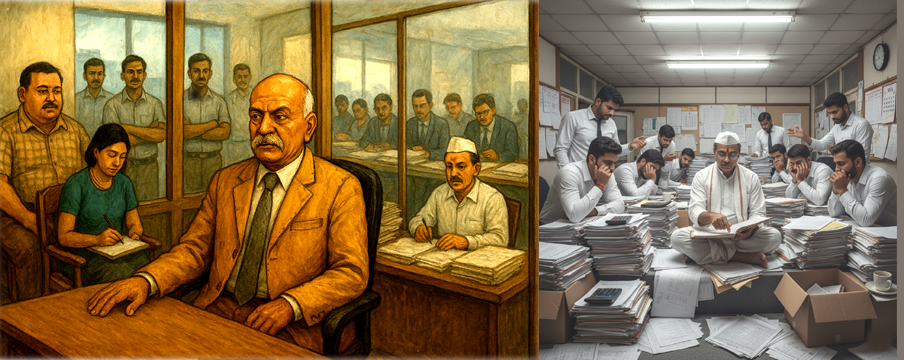
The Cultural Code Behind the Clock: The “Lala” Legacy
At the root of this contradiction lies not laziness or lack of skill — but the persistence of feudal corporate culture. India’s private sector, especially in small and mid-sized enterprises, still operates on what may be called the “lalaji system.”
In this setup, the business owner — the lalaji or sethji — acts as the patriarch of an extended professional “family.” His word is final. Every major decision must pass through him, even if the data or market signals say otherwise. As one senior manager in a manufacturing firm put it, “We don’t take decisions; we take permission.”
The World Bank’s India Enterprise Survey (2022) found that 41% of Indian businesses are “owner-managed”, compared to just 10% in the UK and 6% in Japan. This concentration of decision-making not only slows innovation but also breeds a culture of fear-driven compliance.
In such organizations:
- Managers hesitate to make autonomous decisions, fearing rebuke.
- Meetings are theatrical performances, meant to display loyalty rather than to discuss outcomes.
- Employees linger long after hours, not out of necessity but to signal subservience.
This paternalistic style, inherited from India’s joint-family system, worked in an era of scarcity and family-run trade. But in a digital economy, it’s a bottleneck. As Deloitte’s Human Capital Trends Report (2024) notes, companies with flatter decision structures are 2.6 times more likely to achieve above-average profitability and three times more likely to retain top talent.
Munshi Culture and the Shell Company Economy
The “munshi” — the trusted accountant or record-keeper — remains a symbol of continuity in many traditional Indian firms. But the loyalty of the munshi class, now extended to office managers and clerical staff, often perpetuates a shadow ecosystem of informal practices:
- Multiple shell companies are floated to stay below the taxable turnover threshold.
- Cash transactions continue in defiance of GST and digital finance norms.
- Nepotistic hiring replaces skill-based recruitment.
The Income Tax Department has in several reports estimated that informal or unaccounted-for business activity constitutes nearly 25% of India’s GDP. In 2023, the National Institute of Public Finance and Policy (NIPFP) flagged the proliferation of small enterprises intentionally “fragmented” to evade taxation. These practices, often legitimized by community networks of lalas and munshis, create inefficiency, distort competition, and depress wages.
Meanwhile, the Human Resources (HR) function — the supposed guardian of corporate culture — remains a formality in many lala-driven enterprises. Employees “report” to HR on paper but, in practice, answer to the patriarch. Recruitment, appraisals, and even dismissals depend on the owner’s personal relationships, not performance metrics.
This stands in stark contrast to global best practices. The OECD Employment Outlook (2023) highlights that firms with strong HR autonomy and data-driven performance systems report 22% higher labour productivity than family-managed counterparts.
The Psychological Toll: Burnout as Badge of Honour
India now faces an epidemic of silent burnout. The World Health Organization (WHO) lists burnout as an “occupational phenomenon” characterized by chronic workplace stress that has not been successfully managed. A LinkedIn India Workforce Confidence Index (2024) found that 46% of Indian professionals feel burned out, compared to 34% globally.
The cultural glorification of exhaustion — where being busy equals being important — leads to serious consequences:
- Increased cardiovascular disease and hypertension, per the Lancet Global Health Study (2023).
- High attrition in IT and startup sectors, where over 60-hour workweeks are routine.
- A collapse of creative problem-solving — McKinsey’s research on cognitive fatigue shows productivity drops by up to 40% after 50 hours per week.
The recent deaths of young employees in high-stress tech and finance roles have drawn comparisons to Japan’s “karoshi” — death by overwork. Yet India still lacks comprehensive legislation limiting working hours in the private sector.
The Factories Act, 1948, limits working hours to 48 per week, but it applies mainly to manufacturing. The Occupational Safety, Health and Working Conditions Code (2020) is yet to be implemented widely. White-collar sectors — from IT to finance — remain outside the effective reach of time regulation.
Global Lessons: Less Time, More Output
Global evidence shows that reducing work hours increases productivity, not the reverse.
- In Iceland, a government-backed trial (2015–2019) cut weekly hours from 40 to 35 without pay loss. Productivity remained constant or improved across all sectors, according to the Autonomy Institute.
- Microsoft Japan’s four-day workweek experiment led to a 40% jump in productivity and 23% lower electricity use.
- In France, after implementing the 35-hour week, GDP per hour rose steadily while unemployment fell, according to OECD Labour Statistics.
- Even in traditionally hard-working South Korea, the government reduced the legal maximum workweek from 68 to 52 hours in 2018, citing burnout and declining birth rates.
India, on the other hand, continues to fetishize long hours. The Economic Survey (2023–24) urged the private sector to “modernize workplace culture” and “focus on outcomes, not optics.” But the shift requires not just policy — it needs psychological reform.
The Economics of Time Mismanagement
India’s time-use inefficiency has measurable economic costs. A 2024 report by Boston Consulting Group (BCG) estimated that workplace inefficiency and poor process automation reduce India’s potential GDP by 7% annually. The McKinsey Global Institute (MGI) further estimates that improving time-use productivity — through data-driven decisions, automation, and flatter hierarchies — could add $500 billion to India’s GDP by 2030.
But such gains are impossible without a mindset shift. The “presence equals performance” culture anchors India’s private sector to a bygone era. The World Economic Forum’s Future of Jobs Report (2023) found that India ranks 68th globally in human capital efficiency — far below nations with fewer average work hours.
Breaking the Lala Cycle: From Feudalism to Functionalism
So how does India escape its “lalaji capitalism”? The solution isn’t in working harder but in working smarter and governing better.
- Institutionalize Corporate Governance
- Enforce board independence, even in privately held firms.
- Encourage professional CEOs and data-led decisions.
- Strengthen audit trails for tax and compliance transparency.
- Empower HR as a Real Function
- Shift HR from being a clerical or loyalty-verification arm to a strategic performance enabler.
- Use analytics for hiring and retention, not family recommendations.
- Reform Labour Laws for the Digital Age
- Extend working-hour protection to service sectors.
- Mandate right-to-disconnect policies, as adopted by France and Spain.
- Reward companies with shorter-hour, higher-output ratios through tax incentives.
- Promote Outcome-Based Management
- Tie performance bonuses to measurable output and innovation, not attendance.
- Adopt hybrid models that respect work-life balance.
- Cultural Reorientation
- Replace “loyalty to the boss” with “commitment to the mission.”
- Promote gender-neutral and inclusive work environments.
As India aims for a $5 trillion economy, the true barrier is not lack of effort — it’s misdirected effort. Until leadership replaces patriarchal control with trust-based systems, and employees replace obedience with accountability, India will remain a nation of tired workers building underperforming companies.
Conclusion: From Sweat to Strategy
A strong workforce isn’t one that sacrifices life for the desk. It’s one that sustains health, creativity, and focus long enough to build something enduring. Overwork corrodes capability; it doesn’t create it.
The next time a CEO boasts about 90-hour weeks, perhaps he should check the ILO report — or his own productivity metrics. Because nations don’t grow by counting hours; they grow by counting results.