For critical logistics missions — medical resupply, disaster response, spare-parts delivery to offshore rigs, battlefield resupply, and vaccine distribution in remote regions — that combination is compelling
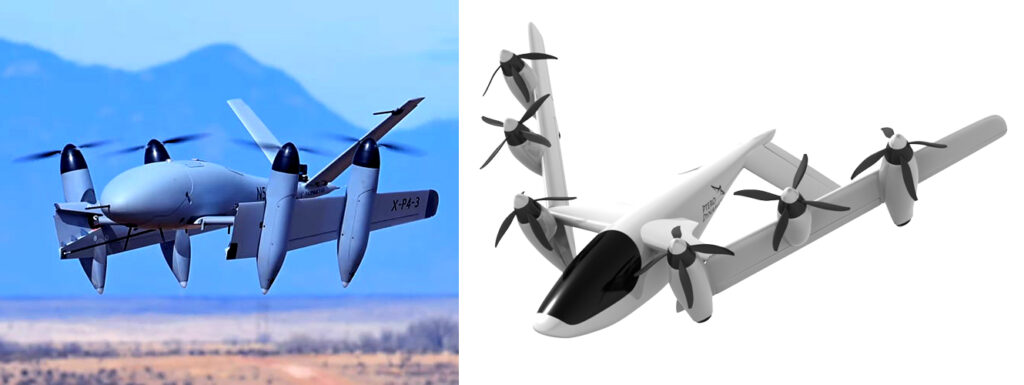
In the age of instant everything, logistics has outgrown trucks, ships and fixed air routes. The need to move life-saving supplies, time-sensitive parts and mission-critical payloads to hard-to-reach locations has driven a new class of aircraft: electric, vertical-takeoff-and-landing (VTOL) fixed-wing unmanned aerial vehicles (UAVs) with folding wings. At the center of this movement is the X-P4 — a practical, purpose-built UAV that blends the runway-free flexibility of multirotor with the energy efficiency and range of a small airplane. This article explains why the X-P4 matters, how it’s designed, and where it will make the most difference.
Why a hybrid VTOL fixed-wing UAV?
Traditional multirotor drones are great for short hops and precise hovering, but their range and payload capacity are limited by the inefficiency of vertical lift. Fixed-wing aircraft, conversely, are energy-efficient in cruise and can carry heavier loads over longer distances — but they typically require runways or catapult systems, and landing zones are constrained. Hybrid designs combine the two: takeoff and landing vertically like a helicopter; cruise with wings like an airplane. The X-P4’s folding-wing architecture brings an additional operational advantage — compact stowage and transport — enabling deployment from vehicles, ships, and tight urban environments.
For critical logistics missions — medical resupply, disaster response, spare-parts delivery to offshore rigs, battlefield resupply, and vaccine distribution in remote regions — that combination is compelling. The ability to launch within minutes from a roadside van, cruise efficiently for tens to hundreds of kilometers, and place a multi-kilogram payload precisely where it’s needed changes the calculus of last-mile logistics.
Core design principles
The X-P4 is built around four core principles: vertical mobility, cruise efficiency, payload flexibility, and rapid deployability.
- Vertical mobility: A set of electric tilt-rotors or dedicated lift rotors provide vertical climb and hover. For safety and redundancy, many designs use multiple lift motors so a single failure doesn’t compromise the mission.
- Cruise efficiency: Once aloft, the X-P4 transitions to wingborne flight. The wings generate lift far more efficiently than rotors, reducing energy consumption and extending range. Aerodynamic shaping, lightweight materials and optimized propeller/rotor systems all improve cruise performance.
- Payload flexibility: The X-P4’s fuselage includes a modular bay that accepts standardized payload pods — medical kits, small refrigeration modules, parachute drops, or equipment boxes. Quick-change payload interfaces let operators swap mission kits in minutes.
- Rapid deployability: Folding wings and a compact carriage footprint allow the X-P4 to be carried on a vehicle roof, in a ship’s locker, or inside a small van. The folding mechanism must be robust, simple to lock/unlock, and tolerant of dirt and saltwater exposure.
Key technical features
While individual X-P4 variants vary, several technical attributes are common:
• Electric propulsion: Silent, low-maintenance electric motors reduce logistical overhead (no aviation fuel) and simplify operations in remote areas. Battery technology is the limiting factor for range, so many X-P4s are designed to accept swappable battery packs or to use modular fuel-cells for extended endurance.
• Autonomy and navigation: High-reliability autopilots manage transition between hover and forward flight, plan energy-efficient routes, and perform precision landing. Sensor suites typically include GNSS, inertial navigation, altimeters, LIDAR or optical flow sensors for precision landing, and redundant communications links (line-of-sight, LTE/5G, SATCOM).
• Payload handling: Cargo can be released by parachute, lowered on a winch for pinpoint delivery, or set down on the ground for collection. For medical logistics, small active cooling units maintain a cold chain for vaccines.
• Durability and maintainability: Military and disaster-response applications demand rugged components with simple field maintenance. The folding wing joints, hinges, and latches use sealed bearings and quick-access replacement panels.
• Safety: Redundant flight control, safe-return-to-base features, parachute recovery systems, and geofencing help mitigate loss or uncontrolled descent.
Operational modes and mission workflows
The X-P4 supports multiple mission workflows tailored to the urgency and environment:
• Point-to-point rapid resupply: Ideal for medical labs, forward operating bases, or island communities. An operator loads a pre-staged payload, programs a mission on the ground control station, and launches. The X-P4 climbs vertically, transitions to cruise for the long leg, and executes a precision delivery at the destination coordinates.
• Distributed network logistics: Multiple base stations form a mesh of recharging or battery-swap sites. In humanitarian operations, temporary hubs can be set up close to the disaster zone to keep sorties short and increase sortie rates.
• On-demand emergency delivery: Integrated with health systems or emergency dispatch, the X-P4 can deliver defibrillators, bleed-control kits, or critical medications to scenes before ground responders arrive.
• Fleeted operations from a mobile platform: Mounted on trucks or ships, the X-P4 provides last-mile reach from mobile logistics convoys. Folding wings make it simple to stow several units in a small footprint.
Logistics payloads that matter
Not all cargo is created equal. The X-P4 shines for missions where speed and access outweigh volume:
• Medical supplies: Small, high-value items like blood units, antivenoms, diagnostic test kits, and vaccines. For temperature-sensitive payloads, compact active cooling or phase-change materials maintain integrity for the mission duration.
• Spare parts and tools: Critical components for power stations, telecom towers or maritime vessels — a gearbox sensor, a crucial circuit board — can be delivered hours faster than waiting for road or sea freight.
• Disaster relief essentials: Water-purification tablets, communication devices, satellite phones, or tarpaulins to coordinators in hard-hit zones.
• Reconnaissance and situational payloads: Sensors or lightweight drones that extend situational awareness for responders, delivered during the mission.
Challenges and limitations
No system is a panacea. The X-P4 faces technical and operational constraints:
• Batteries and range: Current lithium-ion batteries limit the endurance and payload. Swappable battery systems and hybrid approaches (fuel cells, range extenders) help but add complexity.
• Weather: Strong winds, heavy rain or icing can degrade performance. Fixed-wing cruise is efficient but sensitive to turbulence during transition phases.
• Regulation and airspace management: Delivering through urban or controlled airspace requires permissions, detect-and-avoid capabilities, and integration with air traffic systems. Regulatory frameworks vary widely by country and are evolving.
• Cost and logistics of scale: While individual X-P4 units can be cost-effective compared to helicopters, large-scale fleet operations need chargers, spare parts, trained operators and maintenance infrastructure.
• Security: In conflict zones or high-risk areas, UAVs can be jammed, spoofed or shot down. Robust communications, signal resilience, and tactical planning are essential.
Case studies and use scenarios
Imagine a coastal wind farm with a failed sensor and a technician two days away by boat. An X-P4 launched from the nearest port can deliver the replacement part, enabling the turbine to be back online within hours — preventing lost generation and major repair costs. In a different scenario, a remote clinic facing a sudden stockout of antivenom receives a bottle via an X-P4 in under an hour, potentially saving lives.
During humanitarian disasters, the X-P4’s ability to access areas cut off by floods or landslides makes it uniquely valuable. Small payloads of diagnostic kits and satellite communicators can restore triage and coordination even before roads are cleared.
Integration with systems and scale
The real power of the X-P4 appears when it’s integrated into logistics platforms: fleet management software, inventory systems, demand forecasting, and ground infrastructure. Automated scheduling, dynamic re-routing, and priority queuing ensure that the fastest, most energy-efficient aircraft handles each job. In larger operations, automated charging hubs or swap stations reduce turnaround time and enable high-tempo sorties.
Operator training and ground crew procedures are key. Standard operating procedures for payload packing, pre-flight checks, and contingency responses reduce human error and improve mission reliability.
Economic and environmental impact
Compared to helicopters and fixed-wing aircraft that require fossil fuel, electric VTOL UAVs drastically reduce per-mission emissions, noise, and operating cost. For high-value, time-sensitive deliveries — where speed trumps volume — the economics are increasingly compelling. Reduced downtime for industrial assets, fewer delayed medical treatments and improved disaster response effectiveness translate into measurable societal and economic benefits.
However, the total lifecycle environmental footprint depends on battery manufacturing and disposal practices. Sustainable battery recycling and second-life use cases (stationary energy storage) are necessary to maximize environmental gains.
The future: autonomy, range and ecosystems
The next phase for X-P4-type systems is not just improving batteries or aerodynamics; it’s systems thinking. Greater autonomy will let fleets self-organize, choose optimal charging points, and balance demand across hubs. Improved sense-and-avoid and secure communications will enable safe operations in dense urban airspaces and beyond visual line of sight (BVLOS). Hybrid energy systems — combining batteries with fuel cells or microturbines as range extenders — will push range and payload envelopes further.
Standardization of payload interfaces and mission APIs will help create a marketplace of certified payloads — medical pods, inspection sensors, refrigerated boxes — making the X-P4 an adaptable platform for many industries.
Conclusion
The X-P4 fixed-wing VTOL electric folding-wing UAV represents the convergence of several technological trends: electric propulsion, smart autonomy, modular payload design and compact transportability. For critical logistics missions where access, speed and precision matter more than sheer volume, the X-P4 offers a pragmatic and scalable solution. The challenges — battery limitations, regulatory barriers and weather sensitivity — are real but surmountable, and the benefits for healthcare, disaster response, industrial resilience and remote connectivity are substantial.
In a world that increasingly values speed and resilience, the X-P4 and its peers will become part of the logistics backbone — smaller than a cargo plane, more capable than a quadcopter, and designed to deliver exactly what matters, exactly when it matters.