
Education, and EduTech unlike banking or healthcare, cannot be safeguarded through compliance. It requires informed choice, critical inquiry, and long-term patience — all virtues that are in short supply in today’s instant-reward economy
In the last two decades, education has been “productized,” “packaged,” and “pitched” — not taught. What was once a vocation of patient mentorship has been recast as a business built on sales funnels, celebrity endorsements, and venture capital valuations. India’s EduTech industry, once the toast of investors, today stands as a cautionary tale of hype over honesty, valuation over value, and marketing over merit. From Byju’s to Unacademy, Educomp, Everonn, and Edserv, the story has repeated with uncanny regularity — easy money, easy promises, and inevitable failure.
The reason, however, lies not in the lack of regulation or the malice of entrepreneurs alone. It lies in the failure of customers — parents and students — to ask questions. The tragedy of the EduTech industry is that customers buy what is most heavily advertised, not what is most pedagogically sound. Education is not entertainment, yet it is being sold with the same formula of glitz, glamour, and celebrity endorsement.
Advertising as the Curriculum
In India, parents have a responsibility towards marrying off their children but not marrying off their children to the best possible human being after due diligence and groundwork. Similarly, in India parents have a responsibility towards admitting their child in the most expensive and advertised educational institutes not the ones which educate the best. In short, go through the motions but do not use your brains.
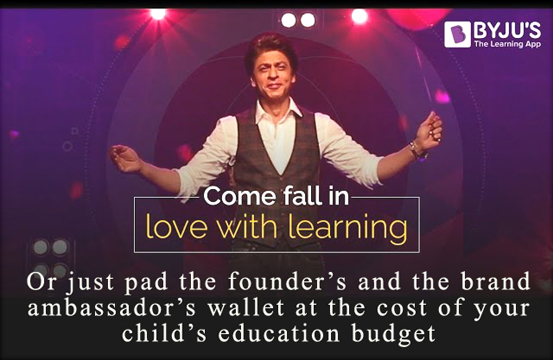
The single most fatal flaw of EduTech lies in its dependence on marketing to sell an intangible product — learning outcomes. Byju’s, once valued at $22 billion, spent over ₹2,000 crores annually on advertising, hiring Shah Rukh Khan as its brand ambassador and sponsoring the Indian cricket team jersey. The irony is stark — a company that claimed to democratize education ended up spending more on marketing than most universities spend on research.
When Everonn Education Ltd., one of India’s first e-learning companies, was founded in 2000, it promised to “digitize classrooms” across India. By 2012, it had collapsed under debt. Educomp Solutions, once listed on the NSE and considered India’s digital education pioneer, was found guilty of accounting fraud and siphoning off funds. Edserv Softsystems, another early entrant, was delisted after defaulting on payments. Each of these companies shared the same DNA — excessive advertising, weak teaching delivery, and financial engineering.
Parents bought into their narrative because glossy ads created the illusion of competence. Students became “users.” Education became “content.” And learning became “user engagement.” What was once a sacred human relationship between teacher and learner was reduced to a SaaS dashboard.
Regulation Is Not the Problem — Awareness Is
Many policymakers today argue that EduTech needs strict regulation. The Ministry of Education and AICTE (All India Council for Technical Education) have debated frameworks to monitor online degrees, data collection, and marketing claims. But the truth is — no amount of regulation can fix an uneducated consumer base.
The same phenomenon exists globally. In the U.S., companies like Coursera, Udemy, and 2U Inc. experienced valuation surges during the COVID-19 lockdown, only to face massive drop-offs in engagement later. 2U, once a $4 billion company, saw its market capitalization fall to under $200 million by 2024. Why? Because students realized they were buying certificates, not careers.
Similarly, in China, the government’s 2021 “Double Reduction Policy” crushed the country’s private tutoring giants like New Oriental Education and TAL Education. Billions were wiped out overnight. Beijing realized that private EduTech was making education unaffordable and stressful, not effective. Yet, even in China’s case, it was parents’ herd behavior — paying exorbitantly for after-school apps — that had triggered the crisis.
Education, unlike banking or healthcare, cannot be safeguarded through compliance. It requires informed choice, critical inquiry, and long-term patience — all virtues that are in short supply in today’s instant-reward economy.
The Business Model of Illusion
Running education as a company is structurally flawed. When you run a school or EduTech platform like a factory, you are bound by three compulsions:
- Advertise to acquire customers.
In the absence of regulatory caps, companies like Byju’s, Vedantu, and Unacademy splurged on mass media. Advertising became the largest cost center. - Cut costs in delivery.
To sustain margins, EduTech firms hired the cheapest available teachers — often contractual staff or freelancers paid per session. The best educators rarely stayed long. - Shorten research and feedback loops.
Pedagogical innovation was replaced by content recycling. “Gamification” and “AI learning paths” became buzzwords to impress investors, not improve learning.
As a result, EduTech disrupted education itself, not the system. The students suffered twice — once when they paid, and again when they realized the product was hollow.
The Role of Venture Capital and Celebrity IIT Graduates
Venture capital funds played a starring role in the EduTech bubble. Tiger Global, Sequoia Capital India (now Peak XV Partners), General Atlantic, and Chan Zuckerberg Initiative poured billions into Indian startups between 2014 and 2021. Byju Raveendran, an engineer from Kerala and a teacher-turned-entrepreneur, became the poster boy of Indian EduTech. His company, Byju’s, raised over $5.5 billion, making it India’s most valuable startup before its spectacular fall from grace.
Unacademy, founded by Gaurav Munjal (IIT Bombay), Hemesh Singh (IIT Roorkee), and Roman Saini (ex-IAS officer, AIIMS alumnus), followed the same trajectory — from promise to panic. Backed by SoftBank Vision Fund, Sequoia, and General Atlantic, Unacademy expanded aggressively into offline coaching, only to fire thousands of employees as losses mounted.
Vedantu, co-founded by Vamsi Krishna (IIT Bombay), Pulkit Jain (IIT Roorkee), and Anand Prakash (IIT Roorkee), also faced valuation markdowns in 2024. The story is repetitive — elite IIT graduates, global investors, exponential marketing, and eventual layoffs.
Ironically, these very IITs were built as non-profit, government institutions, run not for valuation but for nation-building. Their alumni, however, turned education into a venture capital instrument — chasing the same returns that their alma maters avoided by design.
Failures That No One Complained About
When Educomp committed accounting fraud, no parents filed class-action suits. When Byju’s tricked parents into taking loans via opaque payment gateways, no mass litigation followed. The Consumer Protection Act, 2019, and the Central Consumer Protection Authority (CCPA) empower citizens to file complaints for misleading advertisements and unfair trade practices. Yet, parents rarely use these mechanisms.
Even as reports surfaced in 2023 of Byju’s coercing customers into signing up for EMI-based courses without consent, few exercised their legal rights. The National Consumer Disputes Redressal Commission (NCDRC) could have been flooded with cases — it wasn’t. This shows the heart of the problem: lack of consumer education in the education market itself.
When education becomes a financial product, the least informed party — the parent — bears the maximum risk. The result is unemployable graduates, each saddled with ₹15–20 lakh loans, defaulting on EMIs, and contributing to India’s rising non-performing assets (NPAs) in education finance.
The False Promise of Self-Regulation
EduTech advocates argue for self-regulation — much like media companies did in the past. But self-regulation, as India’s media experience shows, only breeds chaos. The News Broadcasting Standards Authority (NBSA) exists in theory, yet the Indian media landscape is rife with misinformation and paid news. Newsrooms depend on advertisers they are supposed to critique.
Similarly, EduTech firms depend on the very customers they mislead. Their revenue targets depend on upselling and subscription renewals, not genuine educational progress. Left to market forces, only those who “play the system” — by aggressive marketing, not superior pedagogy — survive.
The parallels are obvious. In media, bad journalism thrives because of advertising incentives. In education, bad teaching thrives because of enrollment incentives.
The Boutique School Dilemma
While the giants burn billions, boutique schools and niche learning institutions — those that genuinely care about pedagogy — struggle to survive. Small liberal arts colleges, independent research centers, and rural education NGOs operate on thin budgets, often without access to capital.
Take, for example, Rishi Valley School (founded by Jiddu Krishnamurti Foundation), or the Aurobindo International Centre of Education in Puducherry, or RamaKrishna Mission in Bengal — both renowned for their student-centered, inquiry-based learning. These institutions charge modest fees, employ highly qualified teachers, and prioritize character over curriculum. Yet, they receive no media coverage, no venture funding, and no government incentives.
Globally, the same pattern holds. In the U.S., Montessori schools and Waldorf education centers maintain high standards but remain overshadowed by for-profit universities and online “bootcamps” that promise instant success. Quality institutions rely on charity, endowments, and philanthropy, not aggressive marketing — much like the great religious and charitable institutions that built education’s foundation.
When Education Became Event Management
Today’s EduTech startups are indistinguishable from event management firms. Their success depends on the size of the “launch,” the glitz of the “webinar,” and the virality of the “campaign.” Learning outcomes are a secondary concern.
Every new course is marketed as a blockbuster. In reality, most courses have poor completion rates — Coursera’s average completion rate globally is under 8%. The illusion of learning replaces actual learning. Data dashboards show “engagement,” not understanding.
The tragedy is that students themselves are complicit. The modern student, addicted to instant gratification, prefers a gamified quiz over a deep discussion. Education has become performative — a stage show of credentials, certificates, and CV enhancements.
Why Religious and Charitable Institutions Got It Right
The most sustainable education systems in history were not-for-profit and faith-driven. In medieval Europe, church schools and monasteries preserved literacy through centuries of turmoil. In India, gurukuls, maths, and temple universities like Nalanda and Takshashila were community-run. In Scotland, the Presbyterian school system, funded by the Church, built one of the highest literacy rates in the world by the 18th century.
These institutions operated on the principle that education was a social duty, not a business opportunity. The returns were spiritual and civilizational, not financial. Their success proves that education is a long-term investment — often taking decades to bear fruit.
Today’s venture-funded EduTechs, on the other hand, demand profitability in 18 months. That timeline alone ensures failure.
The Consumer as the First Line of Regulation
The solution does not lie in more rules. It lies in a more educated consumer. Just as financial literacy is vital to protect investors, education literacy is essential to protect learners.
Parents must ask:
- Who are the teachers?
- What are their qualifications and experience?
- What percentage of students actually complete the course?
- How are learning outcomes measured?
- What independent reviews exist?
- What is the refund and grievance mechanism?
These are not regulatory questions — they are consumer awareness questions. The Consumer Protection (E-Commerce) Rules, 2020 already empower buyers to demand transparent information from online platforms. What is missing is public will and media attention to enforce them.
The Way Forward: Integration, Not Isolation
Perhaps the only sustainable model for EduTech lies in integration, not independence. Education technology must be part of larger ecosystems — corporates, universities, or philanthropic trusts — that can subsidize it. Examples include:
- Tata ClassEdge, a CSR-driven education technology wing of Tata Group.
- Khan Academy, a U.S. non-profit funded by the Bill & Melinda Gates Foundation and Google.org, offering free education globally.
- Coursera for Government, where state programs subsidize learning for job creation.
These models work because they treat EduTech as a service, not a standalone profit center.
Conclusion: Awareness Over Regulation
The EduTech meltdown is not a story of corporate greed alone — it is a story of public gullibility. The retail customer suffers because they trust advertisements more than evidence. They seek instant results in a process that requires decades of persistence.
Education, unlike entertainment or retail, cannot be industrialized. It can only be nurtured. Every attempt to corporatize it will collapse under its own contradictions.
Regulation may punish fraud but cannot create wisdom. An aware, questioning, educated parent and student base — that is the only real safeguard. The moment consumers learn to interrogate brands, to ask uncomfortable questions, and to reject empty marketing, the industry will be forced to reform. Until then, education will remain a business of illusions — a world where the most heavily advertised school wins, and the best teachers lose.