
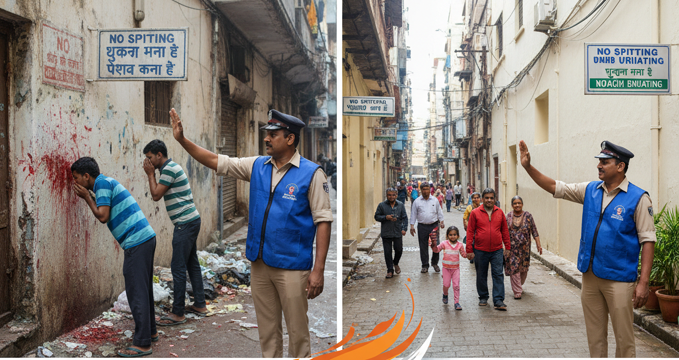
Civic sense and cleanlines are not part of the social curriculum in Indian homes. We may scrub our necks till they shine but we spit and pee on roads and pillars without any scruples
Travel in any air-conditioned bus from one state capital to another in India. You cannot find a single clean toilet either for men or for women. Moreover, there is no accountability anywhere for cleanliness in toilets and eating places. There is no regulated penalty for flouting any non-existent rules or laws. Forget toilets, even elevators (lifts) bear paan stains and spit marks. No civic sense, no enforcement of cleanliness by police personnel or just security guards. The same goes for toilets in Railway stations. Indian Railways is a government department; not even a PSU or an NGO. No P&L account, no profitability, no efficiency, no supply chain but endless grants from government. Civic sense is not part of the social curriculum in Indian homes. “Toe kya hua?”
The incumbent Prime Minister, Shri Narendra Bhai Damodardass Modi had started the Swachch Bharat Mission with great fanfare, when he said, “if 1.4 crore Indians decide to be clean, nobody can stop us from being clean.” This was music to everyone’s ears. Shri Modi was sworn in on May 26,2014 as the Indian Prime Minister and the Swachh Bharat Mission was launched on October 2, 2014, by the Prime Minister on behalf of the Government of India. The nationwide cleanliness campaign was aiming at clean and open public defecation-free India by 2019, the 150th birth anniversary of Mohandas Karamchand Gandhi.
However, everyone soon understood that just like the Smart Cities Mission, Swachch Bharat Mission has no measurable goal, no SOPs, no clear cut notifications to government departments, no timeline. These missions are just like Mohandas Gandhi’s Charkha Andolan, which had no measurable goal, no SOPs, no clear cut notifications to government departments, no P&L account and no timeline. These so-called missions can always be cited but never confidently chalked up either as a victory or a failure. These missions amount to a lot of vague political statements, which are good for winning elections but not much otherwise. Similarly, look at the Ujjwala Yojana – a brilliant piece of public policy implementation as people gave up subsidy – first willingly, then forcibly – to ensure that poor people get gas cylinder connections. The result was a failure as poor people in rural areas cannot afford to pay Rs 1,000 per month for cooking gas. They went back to firewood cut illegally from forests.
It need not have been like this. PM Modi is a very strong leader. His government is a very strong government doing a lot of good work. He could have put in place clear SOPs and standards. For instance, the Bureau of Indian Standards (BIS) had put in place some standards for Smart Cities. Surprizingly, the Ministry of Housing and Urban Affairs (MoHUA) had written to the BIS asking them to refrain from announcing Smart City standards. The idea was for every Smart City to evolve on its own unique path. Today, the Smart Cities Mission has effectively fizzled out and we do not have even one Smart City.
The working group on Smart Cities before the Prime Minister announced the Mission had recommended that the CEO of every Smart City be a private sector professional and not a civil servant. However, when the Smart City programme rolled out every Smart City corporation had either an active IAS officer or a retired one as its CEO, contrary to all recommendations of the working group.
People who have not experienced quality in their lives do not understand how to dispense quality. Go to book a tourism package in the Oberoi’s or even Lemon Tree chains and then go to book a tourism package in Madhya Pradesh Tourism – the difference in features of the two different products is palpable. This is because the clerk selling Madhya Pradesh Tourism or Rajasthan Tourism has not clue what is a good product. Clean toilets is part of a good product, which the common lower middle class clerk does not know anything about.
- Introduction: The Great Irony of “Swachh Bharat”
India’s cleanliness narrative has always been a paradox. On the one hand, the Prime Minister of India launched the Swachh Bharat Mission in 2014 with nationalistic fervor, declaring that a clean India would be the greatest tribute to Mahatma Gandhi on his 150th birth anniversary. On the other hand, the state of public toilets, railway stations, bus stands, and even government offices continues to appall anyone with a basic sense of hygiene.
From paan-stained elevators to filthy railway platforms, and choking public urinals to stench-filled bus stations, the reality is that government departments operate with little accountability, no measurable standards, and a deep-rooted apathy towards public hygiene.
This essay examines why India’s public assets remain unclean despite government programs, citing case histories, consumer rights verdicts, and relevant laws that deal with public hygiene and civic responsibility.
- The Systemic Rot: Why Indian Public Spaces Stay Dirty
2.1 Bureaucratic Disconnect
Public cleanliness in India is primarily maintained by lower-level government employees—sweepers, attendants, and clerks—who often come from the rural or lower-middle-class background. This segment has historically not been trained in civic sense or accountability systems.
There’s no performance-based monitoring or service-level standards for sanitation workers in most state or central departments. Even the Indian Railways, one of the largest employers in the world, functions as a government department without profit-and-loss accountability or modern supply chain management.
2.2 The Failure of Civic Education
Civic sense is not an ingrained part of Indian schooling or family upbringing. The average citizen doesn’t view public cleanliness as a personal responsibility. Compare this with countries like Japan or Singapore, where civic education starts at kindergarten and cleanliness is a point of national pride.
2.3 Nonexistent Accountability Mechanisms
Travel from Chennai to Bengaluru, or Delhi to Jaipur, or even Patna to Ranchi, and you will not find a single state-run intercity bus stop or railway platform with clean toilets.
When questioned, government officials cite budgetary constraints or manpower shortages. Yet, crores are allocated annually to the Swachh Bharat Mission (Urban and Rural). There’s no published metric for how funds are used, and no penalty clause for departments failing to maintain hygiene.
- Case Studies of Unclean Public Assets
3.1 Indian Railways
Indian Railways’ stations are emblematic of India’s cleanliness crisis. According to a Comptroller and Auditor General (CAG) report (2022), over 60% of stations inspected across 11 zones failed to meet basic sanitation norms. Toilets were found locked, broken, or unusable due to lack of water and cleanliness staff.
Even after introducing “Clean My Coach” and “Swachh Rail” campaigns, there’s no internal mechanism for verifying compliance. Platforms at Patna Junction, Howrah, and New Delhi routinely appear in public complaints for overflowing garbage and foul-smelling restrooms.
3.2 Interstate Bus Terminals
At the Kashmere Gate ISBT (Delhi) or Majestic Bus Stand (Bengaluru), despite heavy footfall and significant ticket revenue, toilets are often unusable. Passengers, especially women, find no safe or clean facilities.
In 2019, a Public Interest Litigation (PIL) was filed in the Delhi High Court (W.P.(C) 1201/2019) seeking directions to maintain hygiene standards in Delhi’s ISBTs. The Court directed the Delhi Transport Corporation to ensure “periodic sanitation inspections,” but no structured audit mechanism followed.
3.3 Government Schools and Hospitals
The National Commission for Protection of Child Rights (NCPCR) in its 2020 report noted that over 40% of government schools lacked functional toilets for girls. In rural areas, lack of clean toilets is directly linked to higher dropout rates among adolescent girls.
Government hospitals fare no better. The AIIMS Delhi sanitation audit (2021) revealed gross lapses in biomedical waste disposal and toilet maintenance, prompting the Delhi High Court to issue strict warnings to hospital contractors.
- Consumer Rights and Judicial Redressal
While public hygiene failures are largely seen as systemic, citizens have occasionally sought justice through consumer forums and courts. Several cases across National Consumer Disputes Redressal Commission (NCDRC), State Consumer Forums, and even High Courts highlight the growing judicial recognition of the right to clean and safe public spaces.
4.1 Supreme Court: Right to Clean Environment as a Fundamental Right
The Supreme Court in Subhash Kumar v. State of Bihar (1991 AIR 420) held that the right to life under Article 21 includes the right to live in a clean and pollution-free environment. The Court emphasized that public authorities are duty-bound to ensure cleanliness and sanitation.
4.2 High Court Cases
Delhi High Court (2015), in Court on its Own Motion vs. Union of India, observed that unclean railway toilets and stations “amount to violation of passengers’ fundamental rights.” The Court directed the Railways to adopt scientific cleaning systems and fix accountability at the Station Superintendent level.
The Bombay High Court (2018) fined the Thane Municipal Corporation ₹25 lakh for failure to maintain cleanliness in public spaces, including toilets, after multiple citizen complaints.
4.3 National Consumer Forum Verdicts
In NCDRC, 2017 (Praveen Bhalla vs. Northern Railway), the Commission awarded ₹50,000 compensation to a passenger who contracted an infection due to unsanitary train toilets. The judgment held that unhygienic conditions constituted a “deficiency in service.”
In 2019, the Tamil Nadu State Consumer Forum directed the State Transport Department to pay ₹1 lakh to a passenger who slipped on an unclean bus terminal floor, ruling that government-run transport services fall under the Consumer Protection Act when providing passenger amenities.
These rulings are significant because they transform “public hygiene” from a moral issue to a legal right enforceable through consumer law.
- Legal Provisions Punishing Public Apathy and Unclean Habits
5.1 The Swachh Bharat Mission Framework
Though launched with noble intent, the Swachh Bharat Mission (SBM) lacks binding legal provisions. Its guidelines focus on awareness, funding, and voluntary compliance but do not specify enforceable penalties or standards.
5.2 Indian Penal Code (IPC)
Certain sections of the IPC indirectly punish unclean or unhygienic public behavior:
Section 268: Defines public nuisance, punishable under Section 290 with a fine up to ₹200.
Section 278: Penalizes making atmosphere noxious to health.
However, these are minor fines and rarely enforced.
5.3 Environment Protection Act (1986)
This Act empowers the government to impose penalties for activities polluting the environment, including improper waste management. Under Section 15, offenders can face imprisonment up to five years or fines up to ₹1 lakh. Yet, enforcement remains negligible for municipal bodies.
5.4 Municipal and State Sanitation Laws
Most states have their own Municipal Solid Waste Management Rules and Public Health Acts.
For example:
The Delhi Municipal Corporation Act (1957) allows fines up to ₹5,000 for littering or public urination, but rarely are such penalties actually levied.
The Karnataka Municipal Corporations Act (1976) empowers the city commissioner to impose spot fines for spitting or garbage dumping—but again, implementation is tokenistic.
5.5 Consumer Protection Act (2019)
This Act broadened the definition of “service” to include government-run or public utility services, thereby making it possible for citizens to file complaints against unhygienic public amenities. The law provides for compensation, refund, and punitive damages where negligence or deficiency in service can be proved.
- Swachh Bharat Mission: Promise vs. Performance
When Prime Minister Modi launched Swachh Bharat Mission (SBM) on October 2, 2014, it was meant to make India Open Defecation Free (ODF) by 2019. Over ₹1.4 lakh crore was reportedly spent on rural and urban sanitation projects.
But the real issue was never construction—it was maintenance. A 2022 report by the National Statistical Office (NSO) found that more than 30% of toilets built under the mission were either non-functional or lacked water supply.
The Smart Cities Mission, announced with similar ambition, faced the same fate. Instead of standardized guidelines, the government allowed each city to define its own parameters. As a result, there’s no uniform metric to evaluate progress. Not a single Indian city can confidently claim global standards in cleanliness, despite hundreds of crores being spent.
- International Comparisons: How Other Nations Handle Public Hygiene
In countries like Singapore, the Environmental Public Health Act (EPHA) imposes heavy fines for spitting, littering, or failing to clean up after pets—ranging from SGD 300 to SGD 10,000. Repeat offenders may be required to perform public cleaning duties.
In Japan, municipal by-laws make it mandatory for shop owners to maintain cleanliness on sidewalks adjacent to their stores. Schoolchildren participate in routine community cleaning drives, cultivating civic responsibility early.
In contrast, Indian laws rely heavily on public campaigns, not enforcement. The absence of “polluter pays” and “maintenance accountability” principles ensures that government bodies escape liability for their own negligence.
- The Way Forward: What India Must Do
8.1 Define Measurable Standards
Like the Bureau of Indian Standards (BIS) does for industrial products, public sanitation needs Service-Level Standards (SLS) — measurable benchmarks for cleanliness, frequency of cleaning, and infrastructure maintenance.
8.2 Introduce Accountability in Governance
Government departments like Indian Railways, Public Works Departments (PWD), and Municipal Corporations must link employee performance appraisals to cleanliness metrics.
For instance, station managers or municipal commissioners should face salary cuts or demotions for persistent failure in hygiene ratings.
8.3 Citizen Empowerment through Digital Feedback
The government can build upon its “Swachhata App” by mandating response deadlines and automatic escalation of unaddressed complaints to district collectors or urban development ministries.
8.4 Privatization and Outsourcing
Private sector participation, with contractual performance clauses, can ensure higher accountability. For example, airports run under public-private partnerships (PPPs) like those in Delhi and Hyderabad are among the cleanest in India—proof that accountability works when linked to incentives.
8.5 Civic Education
The NCERT curriculum should include mandatory civic hygiene education. Cleanliness must become a social norm, not a government project.
- Conclusion: Cleanliness Is Not About Slogans
India’s cleanliness crisis is not due to poverty or population—it’s due to indifference and systemic inertia.
While Prime Minister Modi’s Swachh Bharat Mission reignited a national conversation, its lack of measurable SOPs, enforcement mechanisms, and departmental accountability turned it into a political slogan rather than a civic revolution.
Until cleanliness is treated as a legal right, a moral duty, and an administrative priority, India’s public toilets will remain broken, its bus stands filthy, and its elevators splattered with spit.
India doesn’t lack laws or funds—it lacks willpower and systems.
True “Swachh Bharat” will arrive not when politicians make speeches, but when citizens start suing, administrators start resigning, and courts start penalizing those who treat filth as fate rather than failure.

