
The Indian matchmaking complex is a chrysalis of sanskaar (values, culture), desperately trying to contain the butterfly of modern desire of great sex and passionate pleasure
The Indian wedding industry is not merely an economy; it is a parallel universe governed by strict, unwritten laws, where the colour coordination of the bride’s shoes is considered as significant as her astrological chart. It is a $50 billion ecosystem built on the dual pillars of eternal love and parental anxiety. But peel back the layers of heavy silk, haldi stains, and the relentless drone of a thousand shahnai players, and you’ll discover a truth far more hilarious and much more modern: The entire apparatus—from the shuddh (pure) matrimonial website to the meticulous wedding planner—is nothing more than the most prudish, heavily chaperoned, and ironically restrictive dating platform the world has ever seen.
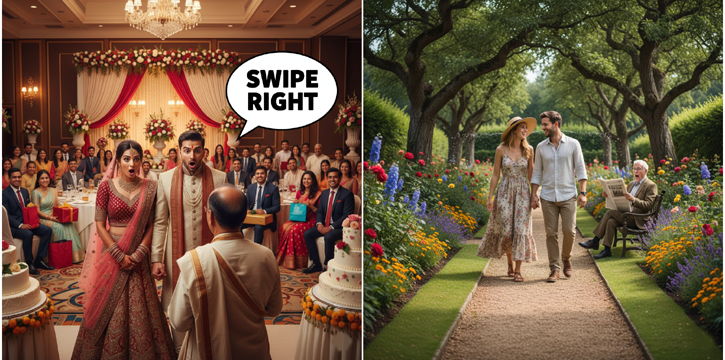
It’s a magnificent, glorious masquerade where everyone pretends to be looking for a ‘life partner’ with ‘stable family values’ and a ‘moderate social drinking habit,’ while simultaneously—and secretly—trying to figure out if their future spouse can hold a decent conversation past the third family meeting, and if they secretly own a subscription to something other than the financial newspaper.
The Indian matchmaking complex is a chrysalis of sanskaar (values, culture), desperately trying to contain the butterfly of modern desire. And the pressure on this chrysalis is immense.
Chapter 1: The Matrimonial Website: Purity’s Password-Protected Portal
Let’s begin with the community matchmaking sites. These are not mere websites; they are digital temples where profiles are treated as holy relics. The language used is a masterpiece of euphemism. The profile picture? A headshot taken in the softest possible lighting, often looking slightly away from the camera as if to suggest, “I am too modest to look directly into your worldly eyes.”
The ‘About Me’ section is where the hilarity truly begins. A 29-year-old software engineer is not a person who crushes deadlines and enjoys a Friday night binge-watch. Oh no. He is a “Meticulous professional with deep family roots, respected by elders, seeking an equally cultured partner who values tradition and a simple life.” Translation: “I have a job, and I occasionally visit my grandparents. I want a partner who won’t judge my Netflix queue.”
The irony is that these sites, designed explicitly to filter out the gently used and the too liberal, are the only available space for millions of young Indians to initiate a conversation with a stranger of the opposite gender without causing a major family incident. They are the officially sanctioned “dating app,” where instead of swiping right for a hook-up, you click “Express Interest” for a lifetime commitment, knowing full well that a six-month courtship on these platforms involves more background checks than a security clearance.
And what about the ‘Haves’ and ‘Have Nots’ of the profile? The subtle signifiers of future financial freedom are listed with meticulous precision: “Owns a 3BHK in a desirable suburb.” This is not a profile for romance; it’s a prospectus for a merger. The entire platform functions as an extremely high-stakes, hyper-vetted dating service where the first date involves bringing your mother.
Chapter 2: The Wedding Planner: The High Priest of Controlled Chaos
Once the match is made (often to the sound of great familial relief and minimal actual chemistry), the Wedding Planner steps in. This is a person who wields more power than a regional politician. They are the High Priest of Controlled Chaos, the architect of a spectacular three-day event that is less about the couple and more about the collective ego of two merging families.
The Planner’s job is a delicate balance of managing opulence while maintaining propriety. They have to design a cocktail menu that is sophisticated enough to impress the Mumbai cousins, yet discreet enough not to offend the Delhi taiji (aunt) who believes anything stronger than lemonade is an instrument of the devil.
They are essentially running an event where 500 people are trying to have a good time while simultaneously observing a strict social contract. The Planner knows that behind the meticulously arranged flower wall, the young, single attendees are using the wedding as a high-octane social mixer. The Planner is the silent accomplice, strategically placing the single cousins near the bar, ensuring the music is just loud enough to drown out awkward small talk, and timing the arrival of the bua (paternal aunt) just as the more enthusiastic dancers are getting too enthusiastic.
The wedding is the ultimate “meet market”—the one place where your parents expect you to interact with eligible strangers. It is the real-world, highly choreographed version of a dating app, complete with themed nights (Sangeet, Mehendi) and an in-built, trusted vetting system (i.e., you are already approved by the hosts). The Planner is the one who understands that the real brief is to deliver a beautiful wedding for the elders and a highly efficient flirtation environment for the next generation.
Chapter 3: The Secret Lives of the Couple: The Double-Tap Life
And finally, we have the couple themselves, the poor souls at the center of this social supernova. They are the epitome of the Indian double-tap life: one tap for sanskaar, one tap for sanity.
Before the engagement, their communication is restricted to stilted phone calls and heavily censored chats. They are forbidden from doing anything that might suggest a casual, modern courtship. No late-night dinner dates. No spontaneous weekend getaways. Their pre-marital meetings are like G20 summits: highly formal, heavily documented, and almost always involving multiple family observers.
Yet, underneath the formal clothes and the polite conversation, they are trying to figure out the important stuff: Do you chew loudly? Do you like my jokes? Will you let me control the remote? They are essentially dating in a theatrical setting, where they must perform the role of the ideal future son- and daughter-in-law while simultaneously conducting a highly private, personal assessment of their life partner.
The humor lies in this performance. They are two adults, fully capable of making their own choices, yet they must adhere to the illusion that their union is a divine arrangement facilitated by their elders and a software algorithm.
The day the couple finally gets a moment of privacy—maybe a quick drive between venues, or a moment alone on the balcony—the conversation instantly shifts from the philosophical to the pragmatic, from the celestial to the comical. They are making up for months of highly formal, monitored interaction, cramming months of casual dating into a few stolen minutes.
The great Indian matchmaking enterprise is, therefore, a hilarious exercise in collective denial. It’s a multi-billion dollar acknowledgment that young people want to choose their partners, but a social refusal to let them do it too openly or too easily. It is the cultural equivalent of a chaperone who wears earplugs and a blindfold, providing the illusion of supervision while tacitly allowing the modern world to take its course.
It is a prudish system, yes, but it is one that is slowly, hilariously, and with great expense, bursting out of its sanskaar shell. The young generation is not waiting for permission; they are simply co-opting the existing structures. They are using the matrimonial site for vetting and the wedding event for networking. The system remains, but the spirit of the swipe, the quest for genuine connection, and the pursuit of a little bit of fun—all of it is being successfully smuggled past the gatekeepers, often in the very expensive disguise of a traditional wedding invitation. And that, truly, is the biggest and most entertaining plot twist of all.