
The core expertise of the IAS is navigating the state and its processes—often called ‘deep domain knowledge’ or ‘government relations.’ This is suitably vague to mean that their only skill is being an IAS officer – something like the upper caste in the Indian caste system. I am great because I am.
This is the paradox of the pundit where we are re-examining skill, job mobility, and the IAS.
The Indian Administrative Service (IAS), the lynchpin of India’s civil machinery, is often viewed with a mixture of reverence and scrutiny. It is an institution cloaked in prestige, yet frequently subjected to critiques of its efficacy and value proposition. A particularly pungent critique circulating in public discourse posits a stark differentiation between the IAS officer and other professionals: “Did you ever hear of an IAS officer or other bureaucrat resigning to start his own independent practice? No, you never will.” This assertion, coupled with the claim that “IAS officers have no special skill. They are in essence glorified clerks,” frames a central paradox regarding the true nature of bureaucratic expertise and career mobility. This article seeks to dissect these polemical claims by cross-referencing data, academic literature, and official reports to understand the unique skillset of the IAS, the realities of post-service career transitions, and the structural factors that limit independent practice.
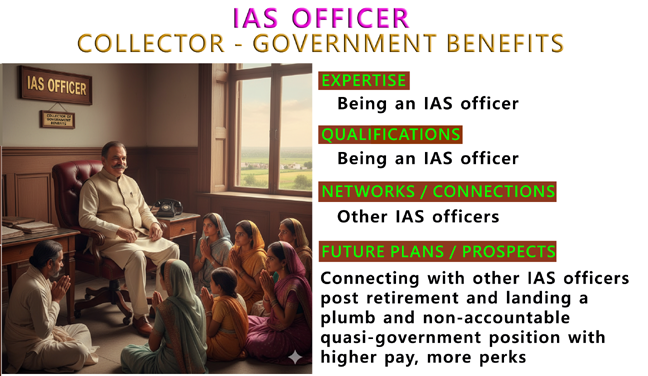
The ‘Glorified Clerk’ Thesis: Deconstructing the Skillset
The core of the critique rests on the idea that the professional skills of an IAS officer are non-transferable or, worse, non-existent, making them incapable of the independent practice seen among doctors, engineers, or military veterans. The prompt contrasts IAS officers with a panoply of skilled professionals: “physicians, surgeons, policemen or security experts, military men… air force pilots, railway motormen or electricians.” This comparison immediately highlights a fundamental disciplinary difference: the latter group possesses ‘hard skills’—clinical, technical, mechanical, or tactical expertise—that are individually certifiable, globally recognized, and directly marketable in an independent, fee-for-service setting.
However, labeling an IAS officer a “glorified clerk” overlooks the nature of ‘soft skills’ and ‘meta-governance skills’ that form the foundation of administrative work. The training and career progression of an IAS officer, detailed in reports by institutions like the Lal Bahadur Shastri National Academy of Administration (LBSNAA) and various Administrative Reforms Commissions (ARC), focus on developing a unique blend of capabilities:
- Policy Formulation and Analysis: The ability to understand complex socio-economic-political problems, design interventions, draft legislation, and forecast their impact. This requires statistical literacy, legal acumen, and political sensitivity.
- Coordination and Stakeholder Management: Unlike a surgeon or a pilot who operates within a tightly defined technical domain, a District Collector or Secretary manages a labyrinthine network of departments, political representatives, judicial bodies, and civil society groups. This is the ‘art of coordination,’ a non-linear, adaptive skill.
- Crisis Management and Resource Allocation: Handling a public health crisis, a natural disaster, or a communal disturbance requires immediate, high-stakes decision-making under extreme uncertainty, often with limited resources. This is a skill honed through repeated field postings.
As noted by development economists like Kaushik Basu, the primary function of a high-level bureaucrat is not merely to “implement” but to “mediate” and “innovate” within a fractured system. The IAS officer’s distinction is not based on a single, certifiable skill, but on the authority to command, coordinate, and allocate state resources—a distinction the prompt correctly identifies as being tied to the “glorified chair.” This chair, however, is not merely symbolic; it is the nexus of institutional power that makes the ‘skill’ effective.
The Political Economy of Mobility: Why No Independent Practice?
The central observation—that IAS officers rarely resign to start an independent practice—is largely accurate, but the causal explanation lies in structural incentives and the nature of their ‘product,’ rather than a lack of skill. - The Disincentive of Pay and Power
The most immediate disincentive is the golden handcuffs of power, prestige, and post-retirement benefits. Unlike a software engineer who may experience a significant jump in salary by moving to the private sector, the prestige and authority wielded by a senior IAS officer in India are almost impossible to replicate in the private realm. Their ‘salary’ is not just the paycheque, but the access, influence, and the sheer scale of the projects they oversee (e.g., managing a budget larger than the GDP of several small nations). Resigning prematurely means forfeiting this non-pecuniary compensation and the substantial pension. - The Non-Monetizable Nature of ‘Meta-Skill’
The core expertise of the IAS is navigating the state and its processes—often called ‘deep domain knowledge’ or ‘government relations.’
• A surgeon’s product is a successful operation.
• A pilot’s product is a safe journey.
• An IAS officer’s product is policy clearance, regulatory compliance, strategic access, and institutional reform.
For a bureaucrat to practice ‘independently,’ they would essentially have to sell their expertise in policy consulting, government liaison, or project structuring. While many do this successfully after retirement (a crucial distinction), doing it before retirement would be widely seen as ‘influence peddling’ or a direct conflict of interest, leading to career suicide and potential legal action. The skill is valuable only when deployed with the authority of the state or to those seeking to interface with the state. This structure effectively prevents the establishment of a ‘bureaucracy clinic’ analogous to a doctor’s clinic. - Data on Resignations and Post-Retirement Careers
While hard data on mid-career resignations specifically to start an independent practice is sparse, analysis of IAS career paths reveals a different trend:
• Resignations for Political/External Roles: When IAS officers do resign mid-career, it is typically for high-profile political careers (e.g., Arvind Kejriwal, Shah Faesal) or to take up senior executive positions in the corporate sector, multilateral institutions (World Bank, UN), or major NGOs/think tanks. These moves utilize their policy analysis and coordination skills on a global stage, not an independent, private practice.
• The Revolving Door Post-Retirement: The true market for the IAS skillset opens up after retirement. Numerous reports, including those by the Personnel Ministry, track the phenomenon of the ‘revolving door’ where former bureaucrats are immediately inducted into corporate boards (advisory and director roles), high-level government-appointed committees, and major consulting firms. In these roles, they are essentially practicing independently or semi-independently, selling their ‘government-facing’ expertise. The market demands their services, but only once the direct conflict of interest (holding state power) is removed.
Cross-Referencing the ‘IAS vs. Specialist’ Dynamic
The fundamental tension between the IAS and specialized professionals can be understood through the lens of institutional sociology and governance models.
The Generalist vs. Specialist Debate
The IAS officer is a Generalist by design, meant to be fungible—managing a district one day, finance the next, and education after that. This model, inherited from the British-era steel frame, prioritizes administrative continuity, political neutrality, and the ability to synthesize information over specialized depth.
In contrast, the professions cited (surgeons, pilots, motormen) are Specialists. Their value is concentrated in depth, technical certification, and adherence to universally applicable standards (e.g., medical ethics, flight safety protocols).
Academics like EAS Sarma and TK Viswanathan, former high-ranking civil servants, have often critiqued this Generalist model, arguing that modern governance demands ‘domain specialization’ and that the Generalist structure contributes to policy failures. However, the system persists because the Generalist role is essentially a ‘Chief Executive Officer of Governance’—they manage specialists, not practice their trade.
The Role of Authority
The core difference is that a doctor’s authority is epistemic (derived from knowledge and certification); a pilot’s is technical (derived from operational control). An IAS officer’s authority is jurisdictional (derived from the statute and the Constitution).
When a doctor resigns, their epistemic authority (M.D., FRCS) remains intact and is portable to their private practice. When an IAS officer resigns, their jurisdictional authority (the power to sign, sanction, and command) is instantly revoked. Their core marketable asset—institutional access and formal power—vanishes, leaving a valuable, but fundamentally different, skillset that is best monetized advisory roles, rather than ‘independent practice.’
Conclusion: The IAS and the Future of Governance
The claim that IAS officers possess “no special skill” and are merely “glorified clerks” is a reductive and polemical simplification. While their skillset is not the ‘hard skill’ of a surgeon or pilot, it is a sophisticated ‘meta-skill’ encompassing policy synthesis, complex coordination, and high-stakes resource management. The absence of mid-career resignations for ‘independent practice’ is not evidence of a lack of skill, but rather a reflection of the unique political economy of state power in India.
The IAS role is tied inextricably to the state apparatus; its authority is jurisdictional, not personal. Consequently, the value of the bureaucrat’s expertise only finds an independent market after formal retirement, when the ethical and legal conflicts of monetizing access are minimized. The debate should, therefore, shift from questioning the existence of their skill to critically examining the Generalist-Specialist divide and the ethical implications of the post-retirement revolving door. The paradox remains: the IAS officer’s distinction lies in the chair, and it is precisely that chair which prevents them from establishing an independent practice until they choose to permanently vacate it.