India has over 6.3 million kilometers of roads, making it the second-largest road network in the world after the United States. Yet, the quality of these roads remains uneven. However, the channels for finance to purchase cars in India, remains even more rocky.
For years, a persistent narrative has echoed in policy discussions, industry conferences, and public debates: India’s lagging automobile ownership and sales figures, compared to countries like China, Japan, those in Europe, or the United States, are primarily the result of poor road infrastructure and weak civic discipline. The argument is intuitive: bad roads make driving inconvenient; therefore, people are less inclined to purchase cars. However, this narrative, while not entirely without merit, misses a more fundamental economic reality — India’s car ownership gap is primarily a function of low purchasing power, not potholes.
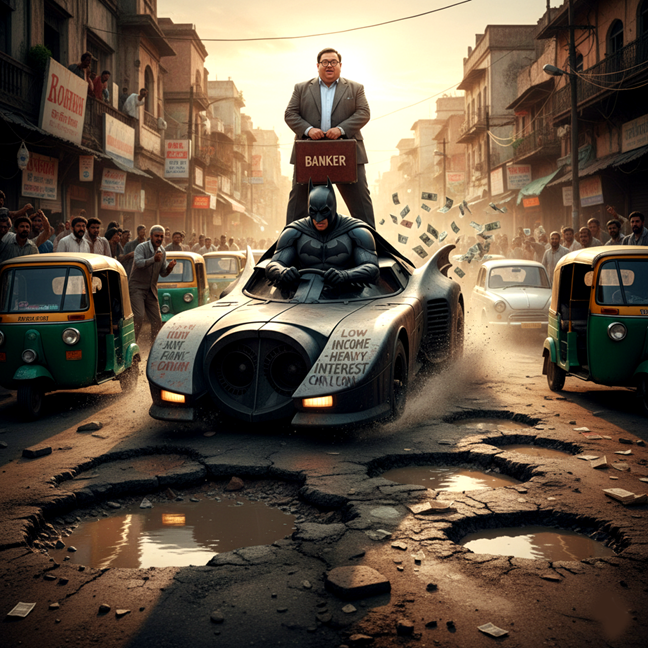
The Presumption: “Bad Roads Mean Fewer Cars”
India’s road infrastructure challenges are well-documented. According to the Ministry of Road Transport and Highways, India has over 6.3 million kilometers of roads, making it the second-largest road network in the world after the United States. Yet, the quality of these roads remains uneven. The World Economic Forum’s Global Competitiveness Report 2019 ranked India 44th out of 141 countries for road quality. Congestion, maintenance backlogs, and haphazard urban planning exacerbate the problem.
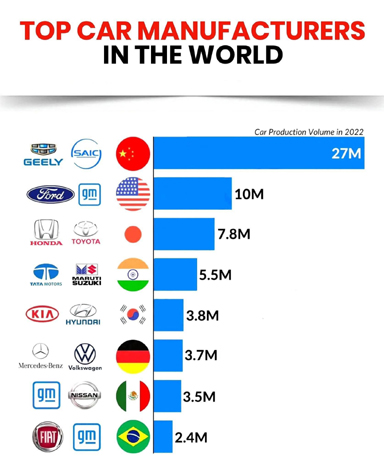
It is tempting, then, to draw a straight line from “bad roads” to “low car ownership.” But this reasoning does not hold up under comparative scrutiny. Consider China. Despite its celebrated high-speed rail network and extensive expressways, vast swathes of rural China still contend with poor or non-existent road infrastructure. Yet, China’s car market is the world’s largest. According to data from the International Organization of Motor Vehicle Manufacturers (OICA), China produced over 26 million vehicles in 2023, compared to India’s 5.5 million. More importantly, China had 231 vehicles per 1,000 people in 2022, whereas India had just 30 vehicles per 1,000 people (World Bank, 2023).
Clearly, good roads are not a precondition for mass motorization. China’s rise as an automobile superpower occurred in tandem with, not subsequent to, its infrastructure boom. Car ownership surged alongside income growth, urbanization, and policy incentives, even in areas where road infrastructure lagged.
The Economic Constraint: Low Per Capita Income
The real story lies in India’s income distribution. According to the Centre for Monitoring Indian Economy (CMIE), the median monthly household income in India hovers around ₹15,000–₹20,000. A person earning ₹20,000 per month is among the top 15% of income earners nationwide. At such income levels, household budgets are almost entirely consumed by food, housing, education, healthcare, and basic utilities. The discretionary income required for vehicle ownership — even for the most affordable cars — is simply absent.
In comparison, China’s per capita GDP in 2023 stood at around US$12,700 (IMF, 2023), while India’s was approximately US$2,730. This fivefold gap translates into radically different consumer capacities. In India, even the cheapest small cars, priced between ₹4–6 lakh (US$4,800–7,200), remain financially out of reach for the majority. Add insurance, taxes, fuel costs, and maintenance, and car ownership becomes an aspirational luxury rather than a practical necessity.
As Mahesh Vyas, CEO of CMIE, notes: “For a large section of Indian households, car ownership is not delayed because of bad roads; it is delayed because disposable income does not support such purchases. Infrastructure matters, but income matters more” (Interview, Business Standard, 2023).
Public Transport and Economic Efficiency
This income constraint leads naturally to another conclusion: India’s immediate priority should not be to push car sales through better roads, but to strengthen and modernize public transport. India’s cities are already choking under vehicular congestion. Delhi, Mumbai, Bengaluru, and Kolkata consistently rank among the world’s most congested cities (TomTom Traffic Index, 2022). A typical urban commuter in Bengaluru spends 257 hours per year in traffic jams.
Investing in metro systems, bus rapid transit, and digital ticketing infrastructure could yield much higher returns for mobility and productivity. China’s experience is instructive here as well. Its economic rise was accompanied by massive investments in urban transit. By 2023, over 50 Chinese cities had metro networks, compared to 15 in India. Public transport not only moves people efficiently but also boosts economic activity. As the World Bank has observed, “Well-functioning urban transport systems are critical for improving the ease of doing business and enabling agglomeration economies” (World Bank, Transforming Transportation, 2021).
In India, where traffic congestion routinely adds hours to daily commutes, improving public transport would enhance business efficiency far more immediately than expanding private vehicle ownership. No entrepreneur wants to spend three hours stuck in traffic to reach a meeting. China scores higher on the World Bank’s Ease of Doing Business index in part because it moves goods and people more efficiently, not because every citizen owns a car.
Climate Change and Urban Priorities
The climate dimension is equally important. Transport accounts for nearly 13% of India’s energy-related CO₂ emissions, and vehicular emissions are a leading source of urban air pollution. The International Energy Agency (IEA) has warned that “a car-centric growth path would lock India into high-emissions infrastructure for decades” (IEA, India Energy Outlook, 2021).
Rather than encouraging more private car ownership, India would do better to focus on cleaner urban mobility — electrified public transport, pedestrianization, and cycling infrastructure — alongside better waste management, air quality control, and ocean cleanup. As the IPCC’s Sixth Assessment Report emphasizes, urban planning choices made in this decade will “either lock in or avoid” massive future emissions.
Some sections of Indian society and policymakers are beginning to embrace this view. They argue that driving should be a pleasure or a luxury, not the default mode of urban transportation. This mirrors approaches in parts of Europe, where cities like Amsterdam, Copenhagen, and Paris are reducing car dependency in favor of sustainable mobility.
Roads vs. Purchasing Power: A False Binary
None of this is to suggest that road quality does not matter. Poor infrastructure has real costs — for safety, logistics, and daily life. India has one of the highest road accident rates in the world. According to the National Crime Records Bureau (NCRB), over 168,000 people died in road accidents in 2022 alone. Better roads, stricter enforcement of traffic laws, and improved driver education are all essential.
However, these factors do not explain why India has fewer cars per capita than China or the United States. Purchasing power does. Even if India were to magically upgrade every road to German Autobahn standards overnight, the majority of its population would still lack the financial capacity to buy, maintain, and operate a car. The constraint is structural and economic.
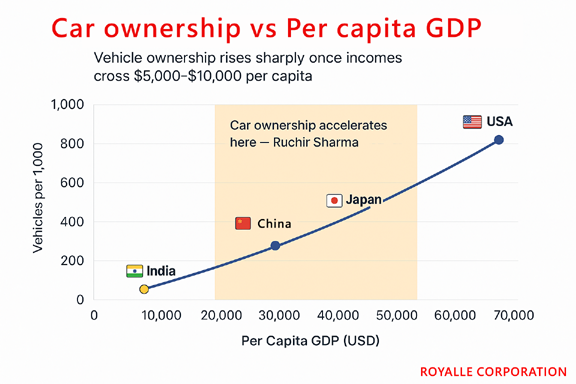
As Ruchir Sharma, global investor and author, has observed: “Car ownership follows a predictable path: when countries cross the $5,000–$10,000 per capita income threshold, car sales take off. India has not yet reached that point. Roads matter, but income is the decisive factor” (The Rise and Fall of Nations, 2016).
India’s Automobile Industry: Always “Poised”
This economic reality also explains a recurring paradox: India’s automobile industry is perpetually described as “poised for explosive growth,” but this explosion never quite arrives. The industry is indeed significant: it contributes 7.1% to India’s GDP and employs 37 million people (SIAM, 2023). Yet, vehicle penetration remains low, and growth cycles are volatile.
Industry boosters often cite the “demographic dividend” — a young, aspirational population — and the potential for job creation. But without sustained increases in household incomes, the market remains constrained. As one auto executive quipped at a recent industry conference: “We’ve been poised for takeoff for 20 years. At some point, we need fuel — and that fuel is consumer purchasing power.”
Moreover, overcrowded roads and lack of driver discipline act as secondary constraints. India’s urban roads were not designed to handle today’s volumes, let alone the traffic generated by a rapid surge in car ownership. Without massive urban redesign, the addition of millions of cars would worsen congestion and pollution, not generate smooth growth.
A Strategic Shift
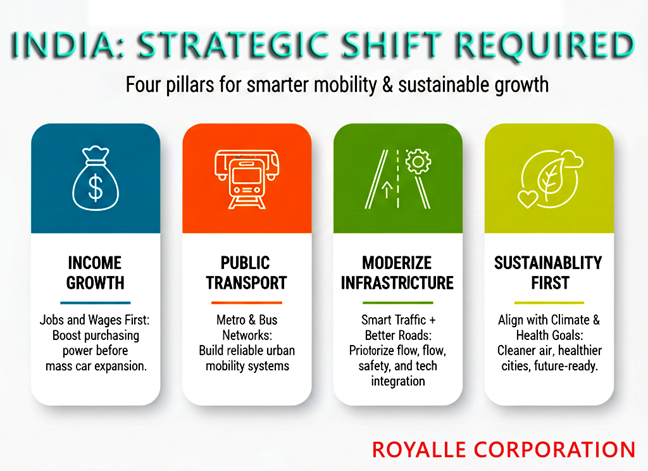
What India needs, therefore, is a strategic shift:
- Prioritize Income Growth: Broader economic development, job creation, and wage increases are the real levers for mass car ownership, not just highway construction.
- Strengthen Public Transport: Expand metro networks, buses, and last-mile connectivity to support mobility for the majority.
- Modernize Infrastructure: Improve road quality and traffic management, but as part of a balanced mobility strategy, not as a silver bullet.
- Sustainability First: Align transport policy with climate commitments and public health goals.
This is not a call to neglect roads or the automobile industry. It is a call to place them within the correct macroeconomic and environmental context.
Conclusion
Blaming India’s poor roads for its relatively low car ownership is an oversimplification. Roads matter, but they are not the decisive factor. The real constraint is the limited purchasing power of the majority of Indians, reflected in low per capita incomes and skewed income distribution. China’s example demonstrates that car ownership surges with rising incomes, even in the presence of infrastructural gaps.
India’s mobility future should not be built on an assumption that every citizen will one day own a car. Instead, it should focus on income growth, efficient public transport, sustainable urban design, and targeted infrastructure upgrades. Only then will India’s automobile industry shift from being “perpetually poised” to genuinely transformative.