The emergence of long-range, highly intelligent air-to-air missiles is forcing a rethink of how engagements are initiated and won. In this new environment, the question is no longer simply who has the better aircraft, but who can strike first from the greatest distance with the highest certainty of success
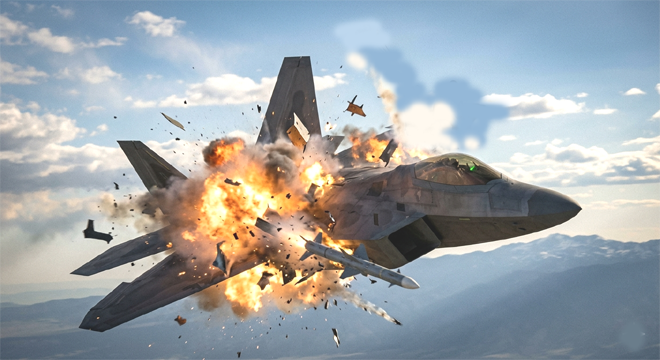
Global military air superiority, once defined by maneuverability and pilot skill, is now increasingly determined by sensors, data links, and long-range precision weapons. The United States, long accustomed to dominating the skies, is confronting a new reality in which its technological edge is being contested with growing confidence.
China’s rapid advancements in missile technology have introduced a new variable into this equation. The emergence of long-range, highly intelligent air-to-air missiles is forcing a rethink of how engagements are initiated and won. In this new environment, the question is no longer simply who has the better aircraft, but who can strike first from the greatest distance with the highest certainty of success.
For decades, American military doctrine has relied on a combination of stealth aircraft, superior training, and advanced missile systems to maintain dominance. Platforms like the F-22 Raptor and the F-35 Lightning II have symbolized this advantage, embodying the belief that invisibility and precision could neutralize any adversary before a fight truly began. Yet, recent developments suggest that this paradigm is being challenged in ways that demand urgent reassessment.
The moment that signaled a new reality
The changing dynamics of aerial warfare became particularly evident during a tense encounter in South Asia. Pilots flying the Dassault Rafale reportedly faced a situation that would have been almost unthinkable just a decade earlier. A missile launched from a Chengdu J-10C operated by Pakistan appeared to engage from an extraordinary distance, closing in from nearly 200 kilometers away.
Whether every detail of that encounter is publicly verified or not, the broader implication is unmistakable: the engagement envelope in modern air combat has expanded dramatically. Pilots are now operating in an environment where threats can emerge from beyond visual range and even beyond what was previously considered safe operational distance.
This shift fundamentally alters the psychology of air combat. Traditionally, pilots relied on a combination of radar detection, electronic warfare, and maneuverability to gain the upper hand. Now, they must contend with the possibility that an adversary can launch a weapon long before they are aware of being targeted.
The implications extend far beyond a single incident. Military planners across the world are reassessing doctrines, training methods, and procurement strategies. The idea of a “first-shot advantage” has taken on new urgency, as the side that can engage earlier effectively dictates the terms of the encounter.
For the United States, this development is particularly significant because it challenges a core assumption underlying its air power strategy—that stealth and superior situational awareness would always provide a decisive edge. If adversaries can negate or bypass these advantages, the balance of power in the skies could shift in subtle but profound ways.
The range equation and its strategic consequences
One of the most critical factors in this evolving contest is missile range. The United States has long relied on the AIM-120 AMRAAM as its primary beyond-visual-range weapon. With a maximum range of approximately 185 kilometers, it has been a cornerstone of American air combat capability for decades.
However, China’s PL-15 missile is widely believed to exceed this range, potentially reaching distances of 200 to 300 kilometers. This disparity, while seemingly incremental, carries enormous strategic weight. In aerial combat, even a small advantage in range can determine who fires first—and who survives.
The logic is straightforward but unforgiving. If one aircraft can launch a missile before the other is within firing range, it gains a decisive advantage. The opposing pilot is forced into a defensive posture, attempting to evade or counter a threat that has already been initiated.
This dynamic effectively expands what military analysts refer to as the “no-escape zone”—the area within which a target aircraft has little chance of avoiding a missile once it has been launched. By extending this zone, China is not merely improving its weapons; it is reshaping the geometry of air combat itself.
The consequences are particularly significant in the vast expanses of the Pacific Ocean, where distances between aircraft can be immense. In such environments, the ability to engage from longer ranges translates directly into operational dominance.
For American forces, this raises difficult questions about how to adapt. Should they invest in longer-range weapons, improve defensive systems, or rethink their entire approach to air superiority? The answer is likely to involve all three, but each option comes with its own set of challenges and trade-offs.
The technology behind the new generation of missiles
What gives the PL-15 its edge is not just range, but the sophistication of its design. At the heart of the missile is a dual-pulse solid rocket motor, a feature that represents a significant departure from traditional propulsion systems. Instead of burning all its fuel in a single phase, the missile can conserve energy during the midcourse of its flight and then unleash a second burst of acceleration as it closes in on its target.
This capability enhances both range and lethality. By maintaining higher energy levels during the final phase of engagement, the missile becomes more difficult to evade. Even if a target aircraft attempts to maneuver aggressively, the missile retains the speed and agility needed to adjust its trajectory.
In addition to propulsion, the missile’s guidance systems play a crucial role. Equipped with advanced radar seekers and anti-jamming capabilities, it is designed to operate effectively in contested electromagnetic environments. This is particularly important against stealth aircraft, which rely on minimizing their radar signature to avoid detection.
The PL-15 also incorporates a two-way data link, allowing it to receive updates from its launching aircraft or other platforms during flight. This transforms the missile from a simple projectile into a networked system, capable of adapting to changing conditions in real time.
Such features reflect a broader trend in military technology: the integration of sensors, communication, and computation into every aspect of weapon systems. Missiles are no longer مجرد tools; they are intelligent nodes within a larger شبكة of information.
This evolution is pushing aerial warfare into a new era, where success depends as much on data and connectivity as on raw performance. For the United States, maintaining an edge in this domain will require not only technological innovation but also a rethinking of how different systems are integrated and deployed.
America’s response and the race for parity
The United States is not standing still in the face of these developments. Recognizing the need to counter emerging threats, it has been working on a next-generation air-to-air missile known as the AIM-260 JATM. While details remain closely guarded, the missile is widely expected to match or exceed the capabilities of the PL-15.
The AIM-260 is intended to restore the range advantage that has long been a hallmark of American air power. Designed to be compatible with existing platforms such as the F-22 and the F/A-18 Super Hornet, it represents an effort to upgrade capabilities without requiring entirely new aircraft.
At the same time, the United States is exploring more innovative approaches to warfare. One such initiative is the “Golden Horde” program, which envisions networks of weapons that can communicate and coordinate with each other. In a swarm scenario, multiple missiles could share data, prioritize targets, and adjust their behavior dynamically.
This concept reflects the growing importance of artificial intelligence and autonomy in military operations. By enabling weapons to make certain decisions independently, it aims to reduce the cognitive burden on human operators and increase the speed of engagement.
However, these advancements also introduce new complexities. Ensuring reliability, preventing unintended escalation, and maintaining control over autonomous systems are significant challenges that must be addressed. The integration of AI into warfare is as much a question of ethics and governance as it is of technology.
A new balance of power in the skies
China’s deployment of advanced missiles on platforms like the Chengdu J-20 signals a broader shift in the balance of power. No longer content to follow, China is positioning itself as a peer competitor in the domain of high-end military technology.
This shift is being felt acutely within American defense circles. The assumption of uncontested air superiority, once taken for granted, is now being questioned. Analysts and strategists are grappling with scenarios in which U.S. forces must operate in environments where they are not guaranteed dominance.
The concept of distance as a form of safety is central to this new reality. In modern aerial warfare, the ability to detect and engage an enemy at long range can determine the outcome of a battle before it truly begins. If an aircraft cannot identify a threat from hundreds of kilometers away, its chances of survival diminish rapidly.
China’s advancements are effectively expanding this zone of vulnerability for its adversaries. By pushing the boundaries of detection and engagement, it is creating conditions in which traditional advantages—such as stealth—may no longer be sufficient on their own.
This does not mean that the United States is losing its edge, but it does indicate that the margin of superiority is narrowing. In such an environment, even small differences in capability can have outsized effects.
Navigating an era of technological competition
The evolving contest between the United States and China in the domain of air-to-air combat is emblematic of a broader shift in global power dynamics. It is not a simple story of one side rising and the other falling, but rather a complex interplay of innovation, adaptation, and strategic calculation.
As the United States manages tensions in multiple regions, including its ongoing challenges with Iran, it must also prepare for the possibility of high-intensity competition in the Indo-Pacific. This requires not only technological investment but also a clear understanding of how new capabilities reshape the nature of conflict.
The emergence of advanced missiles like the PL-15 and the development of systems like the AIM-260 highlight the accelerating pace of change in military technology. They underscore the importance of staying ahead in a race where the stakes are measured not just in capability, but in deterrence and stability.
Ultimately, the future of aerial warfare will be defined by those who can integrate range, intelligence, and adaptability into a coherent strategy. In this new era, the question is not simply who has the best aircraft, but who can best navigate the intricate web of technologies that now define the battlefield in the sky.