
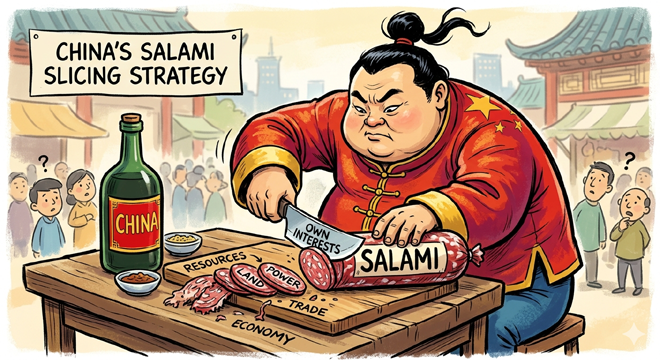
Critics often point to what is described as a “salami slicing” strategy in territorial disputes, particularly in regions like the South China Sea. This approach involves incremental moves that gradually alter the status quo without triggering outright conflict. While each individual step may appear limited, the cumulative effect can be significant
Recent developments involving China’s public messaging toward Israel have drawn attention not just because of what was said, but because of how it was said. At a time, when tensions in the Middle East remain volatile and deeply interconnected, China chose to depart from the carefully calibrated tone that most global powers adopt when addressing Israel’s military actions.
China’s intervention can be seen as part of its broader effort to position itself as a global actor willing to speak on contentious issues. Over the past decade, Beijing has increasingly projected itself as an alternative voice in international diplomacy, one that emphasizes sovereignty, non-interference, and negotiated solutions. However, this posture is not without contradictions, particularly when viewed in the context of China’s own regional behavior.
The message, reportedly delivered through official channels, suggested that military force alone cannot resolve deeply rooted conflicts and that what is required instead is political wisdom and creative diplomacy. While such sentiments are not new in international relations, the directness of the phrasing marked a departure from the norm. Most countries, particularly those with significant geopolitical stakes, tend to express similar concerns in far more measured language.
This episode unfolded against the backdrop of renewed violence involving Israel and actors linked to Iran, including Hezbollah. The situation escalated rapidly, with military operations and counter-operations creating a cycle of action and reaction. In such an environment, statements by major powers carry significant weight, not only because of their content but also because of the signals they send about shifting alignments and priorities.
The tension between principle and practice
China’s call for political solutions and restraint in military action reflects principles it frequently invokes on the global stage. The emphasis on sovereignty, territorial integrity, and civilian protection has been a consistent theme in its diplomatic rhetoric. In this instance, statements attributed to officials underscored the importance of respecting Lebanon’s sovereignty and avoiding harm to civilians.
Such positions resonate with many countries, particularly those that have experienced external intervention or conflict. The idea that military power alone cannot resolve complex political disputes is widely accepted in theory, even if not always in practice. By articulating this perspective in a direct manner, China positioned itself as a voice advocating for restraint and dialogue.
However, this stance invites scrutiny when compared with China’s own actions in its neighborhood. Critics often point to what is described as a “salami slicing” strategy in territorial disputes, particularly in regions like the South China Sea. This approach involves incremental moves that gradually alter the status quo without triggering outright conflict. While each individual step may appear limited, the cumulative effect can be significant.
The contrast between advocating restraint abroad while pursuing assertive policies at home raises questions about consistency. It is in this context that phrases like “the pot calling the kettle black” emerge in public discourse. Such critiques suggest that China’s moral positioning may be selective, shaped by strategic interests rather than universal principles.
Yet, international relations have rarely been governed by perfect consistency. All major powers navigate tensions between their stated values and their strategic objectives. The key question is not whether such contradictions exist, but how they are perceived and whether they undermine credibility.
Escalation, perception, and the power of narrative
The specific events that triggered China’s statements highlight the speed with which conflicts in the Middle East can escalate. Reports of large-scale airstrikes, significant civilian casualties, and attacks on urban areas contribute to a narrative of disproportionate force. In such situations, global reaction is shaped not only by the facts on the ground but also by how those facts are communicated and interpreted.
Israel, under the leadership of Benjamin Netanyahu, has consistently argued that its military actions are driven by the need to ensure national security and respond to threats from groups like Hezbollah. From this perspective, preemptive or retaliatory strikes are seen as necessary measures in a hostile environment.
On the other hand, critics argue that such operations often result in significant civilian harm and risk escalating conflicts rather than resolving them. The tension between these perspectives is at the heart of the international debate. China’s statements align more closely with the latter view, emphasizing the humanitarian and political dimensions of the conflict.
Narratives play a crucial role in shaping global opinion. The framing of events—whether as acts of self-defense or as disproportionate aggression—can influence how countries respond. China’s willingness to adopt a more direct tone can be seen as an attempt to shape this narrative, positioning itself as a defender of international norms and majority opinion.
At the same time, such messaging is not purely altruistic. By taking a visible stance on high-profile conflicts, China enhances its diplomatic profile and strengthens its appeal among countries that feel marginalized by existing power structures. This is particularly relevant in forums like the United Nations, where voting patterns often reflect broader geopolitical alignments.
The broader geopolitical chessboard
The dynamics of this episode cannot be understood in isolation from the broader geopolitical context. The United States remains a key ally of Israel, providing military, economic, and diplomatic support. This relationship shapes the responses of many Western countries, which often balance criticism with continued backing.
China, by contrast, has positioned itself as a more neutral or alternative actor in the Middle East. It has cultivated relationships with a range of countries in the region, including Iran, Saudi Arabia, and others. This multi-vector approach allows Beijing to engage with different parties without being tied to a single alliance structure.
Pakistan’s reaction, reportedly more forceful in its language, adds another layer to the picture. Statements by figures such as Khawaja Asif reflect a different set of political and ideological considerations. For Pakistan, criticism of Israel often resonates with domestic and regional audiences.
Israel’s response to such criticism has been equally strong, interpreting certain statements as hostile or even as questioning its right to exist. This underscores the sensitivity of the issue and the fine line that countries must navigate when expressing their views.
In this complex environment, China’s approach can be seen as both strategic and symbolic. By speaking out in a more direct manner, it differentiates itself from other major powers and reinforces its image as an independent voice in global affairs. At the same time, it avoids direct involvement in the conflict, maintaining a degree of distance that preserves its flexibility.
Silence, caution, and the limits of global consensus
One of the most striking aspects of this episode is the contrast between China’s bluntness and the relative caution of many other countries. The question of why much of the world appears reluctant to speak in similarly direct terms is not a simple one. It reflects a combination of strategic considerations, economic interests, and political calculations.
For many countries, relations with Israel are multifaceted, involving trade, technology cooperation, and security ties. At the same time, they may have strong ties with Arab countries or domestic constituencies that are sympathetic to the Palestinian cause. Navigating these competing interests often leads to carefully worded statements that avoid taking an unequivocal stance.
There is also the broader issue of power dynamics. Smaller countries may be hesitant to adopt positions that could alienate major powers or disrupt critical relationships. Even larger countries often weigh the potential consequences of their statements, considering how they might affect alliances and strategic objectives.
China’s ability to speak more freely in this context is partly a function of its growing global influence. As a major economic and political power, it has greater latitude to express positions without immediate repercussions. However, this does not mean that its statements are without risk or cost.
The perception of a lack of global consensus can also be misleading. While public statements may appear muted, diplomatic engagements behind the scenes often involve more candid discussions. The difference lies in what is said publicly versus what is conveyed privately.
Diplomacy in an age of competing narratives
The episode involving China’s direct messaging toward Israel highlights the evolving nature of global diplomacy. In an era where information flows rapidly and public opinion plays an increasingly important role, the way countries communicate is as significant as the policies they pursue.
China’s call for political wisdom and restraint reflects a broader critique of reliance on military solutions. At the same time, it raises questions about consistency and the interplay between principle and practice. Like all major powers, China operates within a framework of strategic interests that shape its actions and its rhetoric.
The reactions from other countries, including Israel and Pakistan, illustrate the diversity of perspectives that characterize international relations. Each actor brings its own history, priorities, and constraints to the table, resulting in a complex and often fragmented global conversation.
Ultimately, the challenge lies in moving beyond rhetoric to meaningful engagement. Conflicts like those in the Middle East cannot be resolved through statements alone, whether blunt or cautious. They require sustained efforts, compromises, and a willingness to address underlying grievances.
As the world continues to grapple with overlapping crises, the importance of effective diplomacy becomes ever more apparent. Whether through quiet negotiation or more outspoken intervention, the goal remains the same: to find pathways toward stability and peace in a deeply interconnected and often turbulent global landscape.

