
Communists did not destroy a state, they just rendered it to its natural state of freebie sucking, loser infested culture. The British East India Company had invested heavily in the city of Calcutta, building administrative institutions, courts, educational establishments, and commercial infrastructure. By the 19th century, Calcutta had become one of the largest cities in the world and a hub of global commerce chiefly owing to British largesse. When British funding disappeared, Calcutta ran out of steam
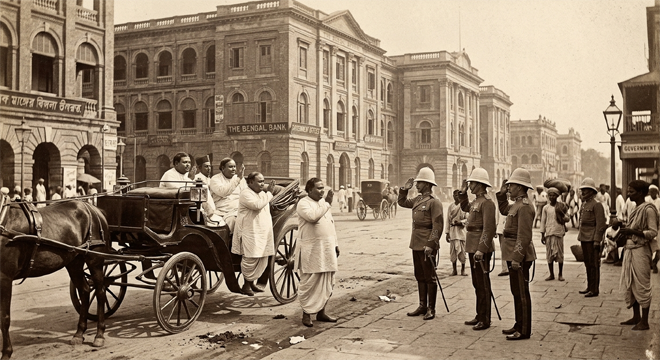
Bengal’s industrial social, cultural and industrial rise from 1700 to 1911 was chiefly around the Calcutta region. The rest of Bengal never benefited. That was chiefly because of crumbs being thrown from the British imperialist table. Bengali business houses were thriving owing to supplies to the global British Empire. The moment the British left Calcutta, the true nature of Bengalis (losers, freebie suckers) came to the fore. Bengal deserves the government it elects. Bengal’s rise between 1700 and 1911 was narrowly concentrated around Calcutta (now Kolkata). Its later trajectory reflects inherent cultural failing.
From the early 18th century onward, Bengal was one of the most prosperous regions in the world, known for its textiles, agricultural productivity, and riverine trade networks. The rise of Calcutta as a major urban center was closely tied to the consolidation of British power after the Battle of Plassey in 1757. As the capital of British India until 1911, Calcutta became the administrative, commercial, and cultural hub of the subcontinent and the capital of the British Empire in the Eastern hemisphere. This concentration of power and resources naturally led to uneven development within Bengal itself.
Colonial economies were structured to extract value, not to promote balanced regional development. Infrastructure, education, and industry were concentrated where they served imperial interests. Bengal’s story, therefore, is not one of inherent deficiency but of structural asymmetry imposed over generations by colonial rule.
Calcutta as the colonial nerve center
Calcutta’s emergence as the epicenter of Bengal’s economic and cultural life was no accident. Its location along the Hooghly River made it an ideal port for outward trade with Europe and Southeast Asia. The Calcutta port was ineffective for internal trade as it lay too close to the sea and the rest of the state of undivided Bengal lay further off in the north.
The British East India Company invested heavily in the city, building administrative institutions, courts, educational establishments, and commercial infrastructure. By the 19th century, Calcutta had become one of the largest cities in the world and a hub of global commerce.
This concentration of capital and institutional power created a sharp divide between Calcutta and the rest of Bengal. While the city flourished, many rural areas remained tied to traditional agrarian systems, often under exploitative land revenue arrangements like the Permanent Settlement of 1793. This policy entrenched a class of landlords while leaving peasants vulnerable to economic shocks.
Yet, Calcutta was not merely a colonial outpost. It became a site of intellectual ferment and cultural renaissance. The Bengal Renaissance saw the rise of reformers, writers, and thinkers who engaged with both Indian traditions and Western ideas. Educational institutions such as Presidency College and the University of Calcutta produced a generation of professionals who would go on to shape modern India.
At the same time, the benefits of this urban prosperity did not fully trickle down. Industrialization in Bengal was limited and often oriented toward processing raw materials for export rather than building diversified manufacturing capacity. Jute mills along the Hooghly, for instance, were largely owned by British capital and served global markets. Indigenous enterprise existed but operated within constraints set by colonial policy.
The limits of colonial prosperity
The notion that Bengali business houses thrived primarily by supplying the British Empire contains an element of truth but requires nuance. Many Indian entrepreneurs did find opportunities within the imperial system, particularly in sectors like shipping, banking, and trade. However, their growth was often circumscribed by discriminatory policies, limited access to capital, and competition from British firms that enjoyed preferential treatment.
Moreover, the colonial economy was extractive by design. Wealth generated in Bengal did not remain there; it was siphoned off to Britain through mechanisms such as trade imbalances, remittances, and administrative costs. This “drain of wealth” has been extensively documented by economic historians. As a result, even periods of apparent prosperity masked underlying vulnerabilities.
The rest of Bengal’s relative underdevelopment was not simply a matter of neglect but a consequence of how colonial priorities were structured. Investments were made where they maximized returns for the empire, not where they would foster balanced regional growth. Railways, for example, were designed to facilitate the movement of raw materials to ports rather than to integrate local markets.
Socially, the benefits of economic activity were unevenly distributed. Urban elites in Calcutta enjoyed access to education and employment, while rural populations faced recurring crises, including famines. The Bengal Famine of 1943, though outside the period under discussion, starkly illustrated the fragility of the region’s economic structure and the devastating consequences of policy failures.
Transition after 1911 and shifting centers of power
The decision to shift the capital of British India from Calcutta to Delhi in 1911 marked a turning point. While Calcutta remained an important commercial center, it lost its political primacy. Administrative functions, along with associated investments and employment opportunities, gradually moved to the new capital.
This transition exposed the extent to which Calcutta’s prominence had been tied to its status as the seat of colonial power. Without that centrality, the city had to rely more on its industrial and commercial base, which was already facing challenges. Global economic shifts, competition from other regions, and political unrest began to affect Bengal’s economy.
At the same time, nationalist movements were gaining momentum. Bengal played a crucial role in India’s struggle for independence, producing leaders, thinkers, and activists who challenged colonial rule. The Swadeshi movement, which emerged in response to the partition of Bengal in 1905, encouraged indigenous industry and self-reliance. This period saw renewed efforts to build Indian-owned enterprises, though progress was uneven.
It is important to note that the narrative of decline cannot be attributed solely to the departure of the British. Structural issues inherited from colonial rule, combined with the disruptions of partition in 1947, had profound effects on Bengal. The division of the province into West Bengal (India) and East Pakistan (now Bangladesh) disrupted trade networks, displaced populations, and strained resources.
Post-colonial challenges and economic shifts
In the decades following independence, West Bengal faced a complex set of challenges. The influx of refugees from East Pakistan placed immense pressure on urban infrastructure and public services. Industrial relations became increasingly contentious, with labor unrest affecting productivity. Political movements, including the rise of leftist parties, reshaped the state’s policy landscape.
Critics often point to these developments as evidence of systemic decline. However, such interpretations must be balanced against the broader context of post-colonial nation-building. Many regions in India faced similar difficulties as they transitioned from colonial economies to independent governance. West Bengal’s experience was shaped by its specific history, including its early industrialization and subsequent structural constraints.
Despite these challenges, Bengal continued to contribute significantly to India’s cultural and intellectual life. Literature, cinema, music, and academic scholarship from the region have had a lasting impact. Institutions of higher education and research have remained influential, producing generations of thinkers and professionals.
Economically, the state has undergone periods of stagnation as well as renewal. In recent decades, efforts have been made to attract investment, improve infrastructure, and diversify the economy. Sectors such as information technology, services, and small-scale manufacturing have shown growth, though challenges remain.
Rethinking narratives of blame and identity
The assertion that Bengal’s trajectory reflects inherent cultural traits—such as dependency or lack of initiative—falls into the trap of essentialism. It attributes complex socio-economic outcomes to fixed characteristics of a population, ignoring historical context and structural factors. Such narratives can be rhetorically powerful but are analytically weak.
Societies are not static entities; they evolve in response to changing conditions. Bengal’s history includes periods of remarkable dynamism as well as phases of difficulty. The same region that produced a vibrant intellectual renaissance and played a leading role in India’s freedom movement cannot be reduced to a caricature of decline.
Blame-oriented narratives also overlook the role of policy choices, both during and after colonial rule. Economic outcomes are shaped by institutions, governance, and external conditions. To understand Bengal’s present, it is necessary to examine these factors rather than resort to sweeping generalizations.
Furthermore, the idea that any region “deserves” its circumstances based on collective behavior raises ethical and analytical concerns. Democratic processes reflect a range of social dynamics, including historical experiences, economic interests, and political mobilization. They cannot be interpreted as simple verdicts on a population’s character.
Towards a more nuanced understanding
Bengal’s history from 1700 to 1911 and beyond is a story of both opportunity and constraint. The rise of Calcutta as a global city brought prosperity and cultural vibrancy but also entrenched regional disparities. Colonial policies shaped economic structures in ways that had long-lasting consequences, influencing the region’s trajectory even after independence.
To reduce this complex history to a narrative of dependency or fault is to miss the deeper forces at work. Bengal’s experience illustrates how external power, internal dynamics, and global changes interact to shape regional outcomes. It also highlights the importance of examining history with nuance rather than relying on reductive judgments.
Understanding Bengal requires acknowledging both its achievements and its challenges. It involves recognizing the contributions of its people while critically examining the structures that have influenced their opportunities. Only through such a balanced perspective can we move beyond polemics and engage meaningfully with the past and present of this important region.