Operating 24 hours a day, 365 days a year, the system is designed to function in snowstorms, hail, and low-visibility conditions. Unlike traditional supply chains that depend heavily on manual labor or animal transport, the monorail reduces human exposure to danger. Soldiers no longer need to traverse precarious ridgelines carrying heavy loads, nor do they have to depend entirely on aerial drops that may miss their targets or be delayed
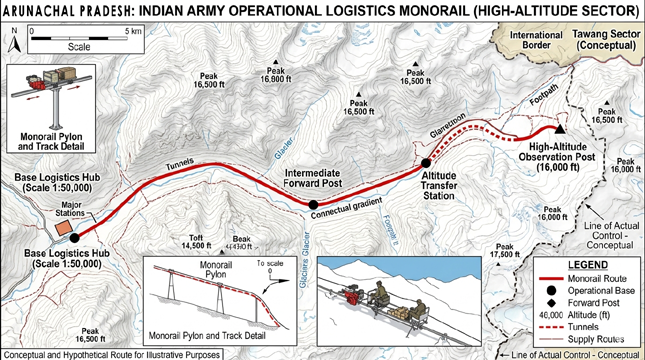
The deployment of an indigenous high-altitude monorail system by the Indian Army in the remote Kameng sector of Arunachal Pradesh represents far more than a logistical innovation. It is a statement of intent, a manifestation of technological adaptation, and a clear indication of how modern militaries are rethinking supply chains in extreme terrains. At an altitude of approximately 16,000 feet, where oxygen levels are thin, temperatures plunge unpredictably, and terrain defies conventional mobility, sustaining troops is not merely a matter of efficiency, it is a matter of survival and strategic continuity.
The system, developed by the Gajraj Corps and executed by the 10 Engineer Regiment, stands as a testament to indigenous ingenuity. Completed in November 2025 and recognized by the India Book of Records, this monorail is not a symbolic installation but a fully operational, round-the-clock logistics backbone. It is capable of carrying over 300 kilograms of supplies in a single run, ranging from ammunition and rations to fuel and engineering equipment, across terrain that would otherwise require human porters risking life and limb.
Reinventing logistics at extreme altitude
The Himalayan frontier has always posed unique logistical challenges. Roads are often seasonal, vulnerable to landslides, avalanches, and enemy observation. Helicopter operations, though effective, are limited by weather conditions, visibility, and high operational costs. In such an environment, a ground-based, all-weather, mechanically reliable system becomes invaluable. The monorail fulfills precisely this role.
Operating 24 hours a day, 365 days a year, the system is designed to function in snowstorms, hail, and low-visibility conditions. Unlike traditional supply chains that depend heavily on manual labor or animal transport, the monorail reduces human exposure to danger. Soldiers no longer need to traverse precarious ridgelines carrying heavy loads, nor do they have to depend entirely on aerial drops that may miss their targets or be delayed.
The ability to transport 300 kilograms per trip may seem modest when compared to heavy-duty logistics vehicles, but in the context of high-altitude warfare, it is transformative. Each successful run replaces multiple porter trips, significantly reducing time, effort, and risk. Over the course of a day, the cumulative effect is substantial, enabling sustained supply flows to forward posts that were once intermittently serviced.
Enhancing operational readiness through innovation
Beyond logistics, the monorail enhances operational readiness. In high-altitude conflict scenarios, the difference between a well-supplied post and an undersupplied one can determine tactical outcomes. Ammunition resupply, timely delivery of winter gear, and consistent food supply are not luxuries, they are operational imperatives.
Moreover, the system’s ability to support casualty evacuation (CASEVAC) adds a critical humanitarian and tactical dimension. Injured personnel can be transported swiftly and safely across steep gradients and deep valleys, reducing evacuation time and increasing survival rates. In areas where helicopter evacuation is impossible due to weather or enemy threat, this capability becomes indispensable.
The birth of a self-reliant solution
The development of this monorail system aligns closely with India’s broader push toward self-reliance, often referred to as Atmanirbharta. Rather than relying on imported technologies or expensive foreign solutions, the Indian Army has leveraged its in-house engineering capabilities to create a system tailored specifically to its operational environment.
This approach has several advantages. First, it ensures adaptability. Engineers working within the system understand the terrain, climate, and operational requirements intimately, allowing for continuous improvements and modifications. Second, it reduces dependency on external suppliers, which is crucial in times of geopolitical tension. Third, it fosters a culture of innovation within the military, encouraging personnel to think beyond conventional solutions.
The recognition by the India Book of Records is not merely ceremonial. It highlights the uniqueness and scale of the achievement, drawing attention to the Army’s capability to innovate under constraints. It also sets a precedent for similar projects in other high-altitude sectors, including Ladakh and Sikkim, where logistical challenges are equally severe.
The strategic context of Arunachal Pradesh
Arunachal Pradesh, particularly the Kameng sector, holds significant strategic importance due to its proximity to the India-China border. The region is characterized by rugged mountains, dense forests, and limited infrastructure. Maintaining a robust logistical network here is essential for deterrence and defense.
The deployment of the monorail system enhances India’s ability to sustain forward deployments in this sensitive region. It ensures that troops stationed in remote posts remain well-supplied regardless of weather conditions or infrastructural limitations. This, in turn, strengthens the overall defensive posture and reduces vulnerabilities.
Lessons from history and global experimentation
While the Arunachal monorail is a modern innovation, the idea of using monorail and elevated systems for military purposes is not new. Historical experiments, such as the Brennan Monorail in the United Kingdom, provide valuable context.
Developed by Louis Brennan in the early 20th century, the Brennan Monorail was a gyroscopically balanced system designed for high-speed transport on a single rail. Demonstrated in 1909, it showcased remarkable stability and efficiency. However, despite its technical success, it was never adopted for military use, largely due to the complexities of deployment and the rapid evolution of alternative transport technologies.
Similarly, in the 1930s, Soviet engineers explored suspension rail systems capable of traversing vast distances and even crossing water bodies. These concepts, though innovative, were ultimately abandoned in favor of conventional rail systems, which offered greater scalability and reliability at the time.
Modern parallels in urban and military infrastructure
In contemporary settings, elevated rail systems are widely used in urban environments, often in regions with significant military presence. Systems like the Okinawa Urban Monorail in Japan and the Chongqing Rail Transit in China serve civilian populations but also provide strategic mobility in densely populated or contested areas.
These systems enable rapid movement of personnel, including military units, within urban landscapes. While not designed specifically for combat logistics, they demonstrate the versatility and efficiency of elevated transport systems in complex environments.
The Indian Army’s high-altitude monorail differs fundamentally from these urban systems. It is not designed for passenger comfort or high-speed transit but for reliability, durability, and functionality in extreme conditions. Its success underscores the adaptability of monorail technology across diverse contexts.
Transforming the human dimension of logistics
One of the most profound impacts of the monorail system is on the human dimension of military logistics. Traditionally, high-altitude supply chains have relied heavily on porters and soldiers carrying loads across treacherous terrain. This not only exposes them to physical danger but also leads to fatigue and reduced operational efficiency.
By mechanizing the transport of heavy loads, the monorail frees up manpower for other critical tasks. Soldiers can focus on surveillance, defense, and training rather than spending hours or days transporting supplies. This shift enhances overall combat readiness and morale.
Furthermore, reducing the reliance on human porters minimizes the risk of accidents and injuries. In high-altitude environments, even a minor slip can have fatal consequences. The monorail system mitigates these risks by providing a stable and controlled transport mechanism.
Engineering challenges and solutions
Constructing a monorail system at 16,000 feet is no small feat. The engineering challenges are immense. Extreme temperatures can affect materials and machinery, causing brittleness and mechanical failures. Snow accumulation and ice formation can obstruct tracks and disrupt operations. The terrain itself, steep, uneven, and unstable, complicates construction and maintenance.
To address these challenges, the engineers of the Gajraj Corps employed innovative design and materials. The system is built to withstand extreme cold, with components designed to function reliably in sub-zero temperatures. The track layout is optimized to navigate steep gradients and sharp turns, ensuring stability and efficiency.
Maintenance protocols are also critical. Regular inspections and timely repairs are essential to keep the system operational. Given the remote location, maintenance teams must be self-sufficient, equipped with the tools and expertise needed to address issues on-site.
A model for future deployments
The success of the Arunachal monorail sets a precedent for future deployments in similar environments. Other high-altitude regions, both within India and globally, can benefit from such systems. Whether in the Himalayas, the Andes, or other mountainous regions, the principles demonstrated here are widely applicable.
For the Indian Army, the next step could involve scaling up the technology, increasing load capacity, and integrating it with other logistical systems. Advances in automation and remote monitoring could further enhance efficiency and reliability.
Beyond its immediate logistical benefits, the monorail system has broader strategic implications. It signals to adversaries that India is capable of sustaining long-term deployments in challenging terrains. This enhances deterrence by reducing the likelihood that logistical vulnerabilities can be exploited.
In modern warfare, logistics often determines the outcome as much as combat capability. A well-supplied force can maintain pressure, respond to threats, and adapt to changing situations. By strengthening its logistical backbone, the Indian Army enhances its overall combat effectiveness.
The future of military logistics
The high-altitude monorail in Arunachal Pradesh represents a glimpse into the future of military logistics. As technology advances, we can expect to see more such innovations, combining mechanical engineering, automation, and possibly even artificial intelligence to create resilient and efficient supply chains.
Drones, autonomous vehicles, and advanced rail systems may work in tandem to ensure seamless logistics across diverse terrains. The key will be adaptability, designing systems that can be tailored to specific environments and operational requirements.
In the grand narrative of military innovation, not all breakthroughs come in the form of advanced weaponry or cutting-edge combat systems. Sometimes, the most impactful innovations are those that quietly transform the fundamentals of how armies operate.
The high-altitude monorail system in Arunachal Pradesh is one such innovation. It does not capture headlines in the way that fighter jets or missile systems do, but its impact is profound. By redefining logistics in one of the most challenging environments on Earth, it strengthens the foundation upon which all military operations depend.
It is a story of ingenuity, resilience, and forward thinking, a reminder that in the harshest conditions, human creativity continues to find ways to overcome even the most formidable obstacles.