
The rescue operation was a layered mission involving air, ground, and intelligence assets working in coordination. It unfolded under the constant threat of engagement with Iranian forces, including units of the Islamic Revolutionary Guard Corps. Despite the risks, the outcome remained clear and decisive: both crew members were brought home alive. Iran losing ground everyday
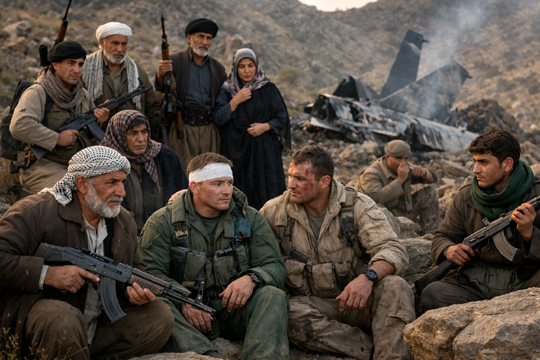
The events of early April 2026 have already begun to take their place among the most dramatic combat rescue narratives of the modern era. At the center of this episode is the downing of a F-15E Strike Eagle over southwestern Iran and the subsequent recovery of both crew members under extreme conditions. While the pilot was rescued relatively quickly, the survival and extraction of the Weapons Systems Officer over a period of nearly 48 hours transformed the incident into a complex story of endurance, precision, and human intervention under pressure.
According to reports, both airmen are now safe and have been extracted from Iranian territory. The WSO, a colonel, survived on the ground despite injuries, evading capture while hostile forces actively searched for him. His ability to remain undetected was attributed to rigorous training in survival, evasion, resistance, and escape procedures, which are designed specifically for such high-risk scenarios. These methods include concealment, controlled movement, use of terrain, and signaling techniques that allow recovery teams to locate personnel without exposing them prematurely.
The rescue operation itself was not a single event but a layered mission involving air, ground, and intelligence assets working in coordination. It unfolded under the constant threat of engagement with Iranian forces, including units of the Islamic Revolutionary Guard Corps. Despite the risks, the outcome remained clear and decisive: both crew members were brought home alive.
What elevates this story beyond a conventional military operation is the reported involvement of Iranian civilians. In a remote region and later in the town of Dehdasht, locals are said to have taken significant risks to prevent the capture of the American airman. Whether by providing shelter, withholding information, or physically obstructing security forces, their actions introduced a human dimension that complicates conventional narratives of conflict.
The incident and the first phase of response
The incident began on April 3, 2026, when the aircraft, assigned to the 494th Fighter Squadron and operating from RAF Lakenheath, was shot down during a deep strike mission. It was a rare occurrence in recent decades, marking the loss of a United States manned fighter over hostile territory. Iranian authorities claimed responsibility, citing advanced air defense capabilities that may have included systems such as the Bavar-373 or the S-300.
Initial confusion surrounded the type of aircraft involved, with early reports incorrectly identifying it as a stealth platform. However, debris later confirmed the aircraft as an F-15E Strike Eagle. Both crew members ejected successfully, but the nature of their landing created immediate complications. They were separated by distance and terrain, forcing independent survival efforts.
The first phase of the response focused on the pilot. United States forces quickly mobilized combat search and rescue units, deploying helicopters including the HH sixty W Jolly Green II. These aircraft are specifically designed for recovery missions in contested environments, equipped with defensive systems and capable of operating under fire.
The extraction was not without cost. The rescue helicopter came under attack, sustaining damage and causing injuries among its crew. Despite this, it successfully exited Iranian airspace with the pilot onboard. At the same time, an A-10 Warthog providing support was struck and later forced to crash after its pilot ejected safely. These parallel developments highlighted the intensity and scale of the operation within its first few hours.
The survival and evasion of the WSO
While the pilot’s recovery was achieved relatively quickly, the situation for the WSO became significantly more complex. Injured and alone, he moved away from the crash site and sought concealment in mountainous terrain. His actions reflected the principles of survival training: avoid detection, conserve energy, and maintain communication discipline.
Iranian forces intensified their search, deploying military units and coordinating with local groups. Reports indicate that a monetary reward was offered for information leading to his capture. This added another layer of danger, as the presence of financial incentives could have encouraged civilians to assist in the search.
However, accounts suggest a different outcome. In several instances, local civilians reportedly refused to cooperate or actively interfered with search efforts. In Dehdasht, crowds are said to have blocked roads, delaying convoys and preventing rapid movement of security forces. Such actions, if accurate, indicate a level of civil resistance that is rarely visible in official accounts of conflict zones.
During this period, the WSO remained hidden for more than 24 hours, relying on terrain and timing to avoid detection. His ability to survive under these conditions underscores the importance of training but also highlights the unpredictable role of local populations in shaping outcomes.
Intelligence operations and tactical deception
As the search continued, United States intelligence agencies-initiated measures to alter the operational environment. A deception effort was reportedly launched to mislead Iranian forces regarding the WSO’s location. By suggesting that he had already been found and moved, the operation aimed to redirect search efforts away from his actual position.
Deception has long been a central element of military strategy. In this case, it appears to have fragmented the response of pursuing units, forcing them to act on incomplete or inaccurate information. While these units pursued false leads, intelligence assets worked to confirm the WSO’s real location with greater precision.
This phase of the operation illustrates the integration of information warfare with physical operations. The ability to shape perception and influence decision making can be as critical as firepower, particularly in time sensitive missions where delay can determine success or failure.
The final rescue under pressure
The final phase of the mission began late on April 4, when United States special operations forces were inserted into Iranian territory. These teams, which may have included elements associated with elite units such as SEAL Team Six, were tasked with locating and extracting the WSO. The operation unfolded under intense pressure. Air support was rapidly deployed, with aircraft conducting strikes to block access routes and delay approaching forces. Roads leading to the extraction zone were targeted to create obstacles, slowing reinforcements and buying critical time.
During the extraction, complications arose when two C-130 Hercules aircraft became immobilized. Commanders made the decision to destroy these aircraft rather than risk their capture. This action reflects a consistent principle in modern warfare: sensitive technology must not fall into adversary hands, even at significant cost. A firefight reportedly occurred as the extraction proceeded. While details remain limited, the outcome was clear. The WSO was successfully recovered, and all personnel involved in the mission were evacuated. Despite the intensity of the engagement, no American lives were lost.
Coordination, support, and political response
The operation benefited from coordination with allied partners. Reports suggest that Israel provided intelligence that assisted in locating the WSO. This cooperation highlights the interconnected nature of modern military operations, where information sharing can significantly enhance effectiveness.
At the political level, the situation was closely monitored by leadership in Washington. Donald Trump later acknowledged the success of the mission with a brief statement, emphasizing the safe recovery of the airman. Public communication was managed carefully, with initial details withheld to protect operational security.
The cost of the mission was substantial in material terms. One F-15E was lost, an A ten was damaged and crashed, a helicopter was hit, and two transport aircraft were destroyed. Additional aircraft were deployed under fire to complete the mission. However, the primary objective was achieved: all personnel were recovered alive.
Narrative, perception, and historical comparison
Beyond the operational details, the incident carries broader implications for how conflicts are perceived and understood. The potential capture of a senior airman could have provided a significant narrative advantage to Iranian authorities. Its prevention altered the information landscape, removing a key element that could have been used for political messaging.
This dynamic can be compared to earlier conflicts, such as the 2003 Iraq War. During that period, the Iraqi Republican Guard was widely portrayed as an elite and formidable force. In reality, years of sanctions and limited modernization had weakened its capabilities. Many units were unable to withstand sustained air attacks and lacked the cohesion necessary for effective resistance.
Several common assumptions about the Republican Guard did not hold under operational conditions. It was not an invincible force, nor did it provide a consistent, coordinated defense. Command structures were fragmented, and parallel groups operated independently, reducing overall effectiveness. In many cases, irregular units posed a more persistent challenge than the formal guard formations.
The contrast between perception and reality in that conflict serves as a reminder that narratives are often shaped by expectation rather than evidence. The events of April 2026 similarly highlight how outcomes on the ground can diverge from anticipated scenarios.
The enduring role of the human element
Despite the advanced technology and complex coordination involved in the rescue operation, the outcome ultimately depended on human factors. The resilience of the WSO, the discipline of rescue forces, and the reported actions of civilians all contributed to the final result.
Modern warfare often emphasizes precision systems, networked operations, and technological superiority. While these elements are critical, they do not eliminate the importance of individual decisions and actions. The ability to endure, adapt, and act under pressure remains central to success.
The reported involvement of civilians adds a dimension that is often overlooked. In environments where state authority is strong, acts of defiance carry significant risk. Whether motivated by empathy, principle, or circumstance, such actions can influence outcomes in ways that formal strategies cannot fully anticipate.
A new chapter in the rescue operations textbook
The rescue of both crew members from the downed aircraft stands as a significant event in recent military history. It demonstrates the effectiveness of coordinated operations across multiple domains, the importance of training and preparation, and the value of decisive leadership under pressure.
Aircraft were lost, and equipment was destroyed, but the mission achieved its primary objective. Every individual involved returned safely. This outcome reflects a clear prioritization of personnel and a willingness to accept material losses to achieve that goal.
At the same time, the story highlights the complexity of modern conflict. It is not defined solely by opposing forces but also by the actions of individuals and communities caught within it. The reported support of civilians, the use of deception, and the intensity of the rescue all contribute to a narrative that extends beyond conventional definitions of military success.
In the final assessment, the events of April 2026 illustrate how preparation, coordination, and human resolve can converge to produce outcomes that might otherwise seem unlikely. It is a story of survival, recovery, and the enduring capacity of individuals to shape events even in the most challenging circumstances.