
A central server with a unified database where all Indian medical records are stored against an Aadhaar number sounds elegant, almost obvious. It mirrors the success of digital identity systems and financial infrastructure. Healthcare data is deeply personal, highly sensitive, and clinically complex. A CT scan is a large imaging dataset that requires specialized formats, storage standards, and viewing software. Ensuring that such data can be securely stored, accessed, and interpreted across thousands of institutions is a systemic transformation
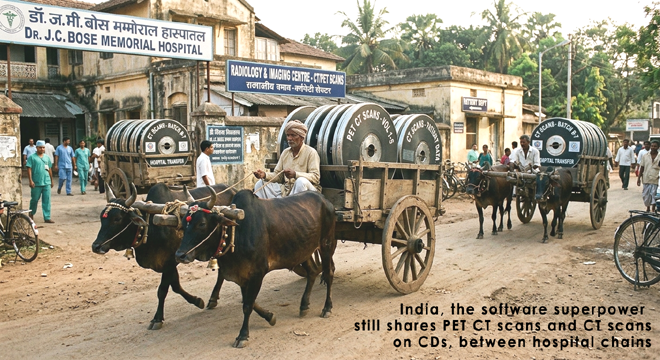
Every Indian family that has navigated a serious illness knows this ritual intimately. A diagnosis is made at one hospital. A second opinion is sought at another. A specialist recommends a third. And through this journey, a relative becomes the courier of medical truth—carefully carrying CT scan films, PET scan CDs, discharge summaries, handwritten prescriptions, and printed lab reports from one hospital to another. In an age where banking happens in seconds, food arrives at your doorstep with a swipe, and identities are verified digitally through Aadhaar, this process feels almost archaic. Why does such a primitive system persist in a country celebrated globally as a software powerhouse?
The answer lies not in technological incapacity but in structural complexity. India’s healthcare system is not a single unified organism but a sprawling, fragmented ecosystem. It consists of tens of thousands of independent units—small clinics, nursing homes, diagnostic centers, charitable hospitals, and large corporate chains—each operating with its own processes, incentives, and technological maturity. Unlike industries that have undergone centralized digital transformation, Indian healthcare evolved in a decentralized manner, driven by necessity rather than design. As a result, interoperability—the ability of systems to communicate seamlessly—remains elusive.
The idea of a central server or a unified database where all medical records are stored against an Aadhaar number sounds elegant, almost obvious. It mirrors the success of digital identity systems and financial infrastructure. However, healthcare data is not just another dataset. It is deeply personal, highly sensitive, and clinically complex. A CT scan is not merely a file; it is a large imaging dataset that requires specialized formats, storage standards, and viewing software. A PET scan involves even more intricate layers of interpretation. Ensuring that such data can be securely stored, accessed, and interpreted across thousands of institutions is not a trivial engineering challenge—it is a systemic transformation.
At the same time, the problem is not just technological. It is economic, regulatory, and behavioral. Many small hospitals operate on thin margins. Investing in advanced digital infrastructure, maintaining secure servers, training staff, and ensuring compliance with data standards are costs they may not be able to bear. Even when digital systems are installed, they often remain siloed—optimized for internal efficiency but not designed for external sharing. Thus, the burden of integration falls not on the system but on the patient.
This paradox—of digital excellence coexisting with analog healthcare workflows—reveals a deeper truth. India’s challenge is not to build more technology but to weave technology into a highly fragmented, uneven landscape. The question, therefore, is not why the system is primitive, but why it has remained so despite the tools to modernize it.
India’s fragmented healthcare backbone and its implications
To understand why seamless digital record sharing has not taken root, one must examine the structure of India’s healthcare system. Unlike countries where healthcare delivery is dominated by large, integrated hospital networks, India’s system is overwhelmingly decentralized. Nearly 70 percent of hospitals in the country have fewer than 25 beds. These are not large institutions with dedicated IT departments; they are small, often family-run establishments that cater to local communities.
India has over 70,000 hospitals, but a significant portion of these are small nursing homes and clinics. This distribution fundamentally shapes how healthcare operates. In a system dominated by large hospital chains, standardization becomes easier. A network can mandate uniform software, centralized databases, and shared protocols. In contrast, India’s landscape resembles a patchwork quilt—each piece distinct, loosely connected, and governed by its own logic.
The implications of this fragmentation are profound. When a patient moves from one hospital to another, they are effectively transitioning between entirely different systems that may not recognize each other’s data formats, diagnostic protocols, or reporting styles. Even something as basic as a lab report can vary in format and units. Imaging data, which is far more complex, faces even greater challenges.
Bed density further complicates the picture. India has approximately 1.5 beds per 1,000 people, significantly lower than countries like the United States, which has around 2.8. This scarcity means that patients often have to move across facilities to access different levels of care. A small clinic may diagnose a condition but lack the infrastructure for advanced imaging. A district hospital may provide imaging but not specialized treatment. A corporate hospital may offer advanced care but at higher costs. This constant movement amplifies the need for portable medical records.
Public and private sector dynamics add another layer of complexity. India’s healthcare system is a hybrid, with roughly 26,000 public institutions and around 44,000 private ones. Public healthcare facilities, including primary health centers, community health centers, and district hospitals, operate under government schemes and often face resource constraints. Private hospitals, particularly in urban areas, dominate service delivery but vary widely in scale and capability. While some corporate hospitals have advanced electronic health record systems, many smaller private facilities rely on basic or semi-digital processes.
This diversity creates a fundamental challenge: there is no single authority or incentive structure that can enforce universal data standards. Each entity optimizes for its own operational efficiency rather than system-wide interoperability. As a result, the patient becomes the bridge between disconnected nodes—carrying data physically because the system cannot transmit it digitally.
The myth of easy digitization in healthcare
At first glance, the solution seems straightforward: digitize everything and link it to a unique identifier like Aadhaar. However, healthcare data is fundamentally different from other forms of digital information. Unlike financial transactions, which are standardized and relatively simple, medical data is heterogeneous, voluminous, and context-dependent.
Consider imaging data such as CT and PET scans. These are stored in specialized formats that require compatible software for viewing and interpretation. A scan performed on one machine may have parameters and calibration settings that differ from another. Ensuring that such data can be seamlessly accessed and accurately interpreted across institutions requires adherence to strict standards, robust infrastructure, and continuous quality control.
Moreover, healthcare data is not static. It evolves with every consultation, test, and treatment. Maintaining a centralized database that is always up to date, accessible in real time, and secure against breaches is a monumental task. Unlike banking systems, where errors can often be reversed, mistakes in medical data can have life-threatening consequences.
Privacy and security concerns further complicate the picture. Medical records contain sensitive information that must be protected against unauthorized access. Linking such data to a universal identifier raises legitimate concerns about surveillance, misuse, and data breaches. Any centralized system would need to balance accessibility with stringent privacy safeguards—a challenge that even technologically advanced countries continue to grapple with.
There is also the issue of consent and control. Patients may want to decide who can access their medical records and under what circumstances. Designing systems that allow granular control while remaining user-friendly is not trivial. For a country as diverse as India, with varying levels of digital literacy, this becomes even more challenging.
Finally, there is the human factor. Technology adoption in healthcare is not just about installing software; it requires changes in workflows, training of staff, and cultural shifts. Doctors, nurses, and administrative personnel must adapt to new systems, which can initially slow down processes. In high-pressure environments where time is critical, resistance to change is natural.
Economic realities and the cost of connectivity
The persistence of physical record transfer is also deeply rooted in economic realities. Many healthcare providers, especially smaller ones, operate on tight budgets. Investing in advanced digital infrastructure is not just a one-time cost; it involves ongoing expenses for maintenance, upgrades, cybersecurity, and training.
For a small nursing home with fewer than 25 beds, the priority is often to provide immediate care rather than invest in long-term digital systems. The return on investment for such technology may not be immediately visible, especially when patients are accustomed to carrying their own records. In such scenarios, the incentive to digitize remains weak.
Even when digital systems are implemented, they are often designed for internal use. A hospital may have an electronic health record system that works well within its own network but does not communicate with external systems. This creates digital silos—pockets of efficiency that do not translate into system-wide integration.
Insurance and reimbursement mechanisms also play a role. In countries where insurance providers mandate standardized data formats and electronic submissions, hospitals are compelled to adopt interoperable systems. In India, where a significant portion of healthcare expenditure is out-of-pocket, such pressures are less pronounced. Although schemes like Ayushman Bharat are pushing towards standardization, the transition is gradual.
Infrastructure disparities between urban and rural areas further exacerbate the issue. While metropolitan hospitals may have access to high-speed internet and advanced IT systems, rural facilities often struggle with basic connectivity. Building a unified digital network requires bridging these gaps, which involves significant investment and coordination.
The role of policy and emerging digital frameworks
Despite these challenges, India is not standing still. There are ongoing efforts to create a more integrated digital health ecosystem. Government initiatives aim to establish frameworks for electronic health records, standardize data formats, and enable secure sharing of medical information.
The concept of a “medical digilocker” is gaining traction—a system where patients can store and access their health records digitally. Such platforms aim to give individuals control over their data while enabling healthcare providers to access relevant information with consent. If implemented effectively, this could reduce the need for physical record transfer and improve continuity of care.
Schemes like Ayushman Bharat are also driving infrastructure development and encouraging the adoption of digital systems. By linking healthcare delivery with digital platforms, these initiatives aim to create a more cohesive network. However, the success of such efforts depends on widespread adoption across both public and private sectors.
Standardization is a critical component of this transformation. Without common protocols for data storage, transmission, and interpretation, interoperability will remain a challenge. Efforts are underway to define such standards, but their implementation requires coordination across thousands of independent entities.
Another promising area is distributed diagnostics. Instead of concentrating advanced diagnostic capabilities in a few large hospitals, the idea is to create networks where smaller facilities can access these services remotely. Telemedicine, cloud-based imaging, and AI-driven diagnostics can play a significant role in this model. By enabling data to flow seamlessly between nodes, such systems can reduce the need for physical movement of patients and records.
Towards smarter healthcare systems, not just bigger hospitals
India’s healthcare future may not lie in building more large hospitals but in creating smarter, more connected systems. The country’s unique structure—characterized by a large number of small facilities—can be an advantage if leveraged correctly. Instead of trying to replicate the centralized models of developed countries, India can pioneer a distributed, technology-enabled approach.
Strong referral pathways are essential in this model. Patients should be able to move seamlessly between different levels of care, with their medical data following them digitally. This requires not just technology but also coordination and trust between institutions.
Technology-enabled care networks can bridge the gaps between fragmented providers. Cloud-based platforms, interoperable software, and secure data-sharing protocols can create virtual networks that function as integrated systems. In such a scenario, a patient’s CT scan performed in a small town could be instantly accessible to a specialist in a metropolitan hospital.
The shift from physical to digital records is not just about convenience; it has significant clinical implications. Access to complete and accurate medical histories can improve diagnosis, reduce duplication of tests, and enhance treatment outcomes. It can also reduce costs for patients, who often have to pay for repeated investigations due to lack of accessible records.
Ultimately, the persistence of CDs and pen drives in Indian healthcare is a symptom of a larger structural issue. It reflects the challenges of integrating a highly fragmented system rather than a failure of technology. As India continues to invest in digital infrastructure and healthcare reforms, the transition to a more connected system is inevitable—but it will take time, coordination, and sustained effort.
The vision of a seamless, Aadhaar-linked medical database is compelling, but the path to achieving it is complex. It requires not just technological innovation but also policy alignment, economic incentives, and cultural change. When these elements come together, the ritual of carrying medical records may finally become a relic of the past—replaced by a system where information flows as seamlessly as care itself.