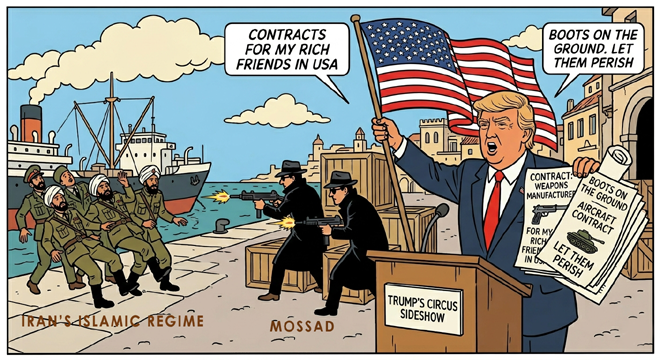
Iran is fighting Israel. Israel is demolishing Iran’s Islamic authoritarian regime’s dictatorial nexus with terrorist groups in West Asia. That is the real picture of the Iran war. The United States and its aircraft carriers, Donald Trump’s circus are just an irrelevant side show. Breaking myths curated by arm chair commentators. Read on:
Myth: Iran is shooting cheap drones and cheap missiles at US aircraft carriers while the US is using expensive missiles to shoot them down. This supposedly means that Iran is winning the war.
Reality: The USA enters wars to bankroll its armament industry. This is the only and primary reason that USA has been entering a war every few years for the last 200 years. Petroleum supremacy is an added benefit and restoring democracy is an excuse. So, the USA wants its soldiers and sailors to die in these wars so that the caucus of gun factory and fighter plane factory owners who support the US president for funding election campaigns get more orders from the federal US government to build more rifles, landing crafts, tanks, war aircraft and warships. Therefore, the USA is winning in its objective. Therefore, the USA is deliberately keeping the war alive. The USA can win this war in very little time. The USA just chooses not to and lingers on the battlefield at all fronts.
Myth: Israel is in a deep crisis as Iran is shooting missiles at Israel.
Reality: In Israel, the war against Iran has always been covert. Israel has never fought a war which is completely Mahabharat style face to face akraman (attack). Israel relies on surgical strikes by Sayeret Matkal and long term espionage and swift assasinations by Mossad. Israel is currently slowly and gradually wiping out the IRGC command at all levels. Israel is slowly winning the war, which looks dramatic from the outside.
Myth: Iran still has a nuclear weapon or can develop one fast
Reality: Iran nuclear weapon ecosystem has been broken long back by Mossad with individual assasinations all over Iran. The USA did a lot of grandstanding by bombing the hills, which contained Iran’s nuclear facility but that was just 10% of the ecosystem. Israel had already put paid to the whole picture and rendered it with holes. The action by USA had more psychological effect than military destruction.
Mossad’s role in this war
At the heart of this Iran Israel shadow war lies Mossad, Israel’s foreign intelligence agency, whose role in countering Iran’s nuclear ambitions has become both pivotal and deeply controversial.
The struggle between these two nations is not merely territorial or political; it is existential in tone and strategic in execution. Iran’s steady pursuit of nuclear capability, framed domestically as a sovereign right and internationally as a matter of suspicion, has been perceived by Israel as an unacceptable threat. In response, Mossad has emerged as a key instrument in shaping a covert response—one that seeks not open confrontation, but precise, deniable, and often disruptive interventions deep within Iranian territory.
Mossad’s operations against Iran are built on a foundation of intelligence penetration. Unlike conventional warfare, where visibility and force define success, intelligence warfare thrives on invisibility. Reports and investigations over the years suggest that Mossad has managed to infiltrate multiple layers of Iran’s security and scientific infrastructure. This includes not only the recruitment of informants but also the cultivation of assets capable of operating within highly restricted environments. These networks form the backbone of Israel’s ability to act with specificity, targeting facilities, individuals, and systems critical to Iran’s nuclear progress.
One of the most striking demonstrations of this capability came in 2018, when Israeli operatives reportedly executed a daring mission in Tehran, extracting a vast archive of nuclear documents from a secured warehouse. The operation, conducted in the heart of Iran’s capital, underscored a level of operational audacity and precision that few intelligence agencies can claim. The stolen documents, later publicized, were intended to demonstrate the extent and intent of Iran’s nuclear program, shaping international perception and reinforcing Israel’s long-standing warnings.
Yet intelligence gathering is only one dimension of Mossad’s role. Equally significant is its involvement in sabotage operations aimed at delaying or derailing Iran’s nuclear progress. Facilities such as Fordo, a heavily fortified uranium enrichment site buried deep within a mountain, represent both the ambition and the resilience of Iran’s program. Targeting such sites requires not only technical sophistication but also an intimate understanding of their vulnerabilities. Sabotage efforts—whether through cyber means, physical disruption, or supply chain manipulation—are designed to create setbacks without triggering full-scale retaliation.
Cyber warfare, in particular, has become a defining feature of this shadow conflict. The digital domain offers a battlefield where attribution is murky and consequences can be calibrated. Operations attributed to Israeli intelligence, sometimes in collaboration with allied entities, have targeted Iranian infrastructure in ways that disrupt functionality while maintaining plausible deniability. These actions blur the line between espionage and warfare, raising complex questions about the evolving nature of conflict in the 21st century.
Another controversial aspect of Mossad’s operations is the alleged targeting of individuals—specifically, scientists and key figures associated with Iran’s nuclear program. The assassination of Mohsen Fakhrizadeh in 2020 stands out as a particularly dramatic episode. Widely regarded as a central figure in Iran’s nuclear efforts, Fakhrizadeh was killed in an operation reportedly involving advanced technology, including a remote-controlled weapon system. The precision and sophistication of the attack suggested a level of planning and intelligence integration that goes far beyond conventional tactics.
Such actions, while tactically effective in removing key personnel, carry significant ethical and strategic implications. Targeted killings risk escalating tensions and can provoke retaliatory measures, potentially drawing the region closer to open conflict. They also raise questions about international norms and the boundaries of acceptable state behavior in pursuing security objectives. For Israel, however, these operations are often framed as necessary preemptive measures in the face of an existential threat.
Beyond physical and cyber operations, Mossad’s role extends into the realm of psychological warfare. Modern conflicts are as much about perception as they are about capability, and influencing internal dynamics within Iran has become a strategic objective. Reports suggest efforts to exploit economic dissatisfaction, political divisions, and social unrest within the country. By leveraging communication platforms and covert messaging, these operations aim to amplify dissent and weaken the cohesion of the Iranian regime from within.
This dimension of the conflict reflects a broader shift in how power is exercised. Rather than relying solely on external pressure, states increasingly seek to shape the internal environment of their adversaries. In Iran’s case, a country with a complex political structure and periodic episodes of public unrest, such strategies carry both potential and risk. While they may create pressure points, they can also reinforce narratives of foreign interference, strengthening hardline positions within the regime.
Coordination between intelligence operations and military strategy further underscores the integrated nature of this shadow war. Mossad’s intelligence is often believed to play a crucial role in enabling Israeli military actions, whether in Syria, Iraq, or other theaters where Iranian influence is present. By providing real-time data on targets such as missile depots, airbases, and logistical networks, intelligence operations enhance the precision and effectiveness of military strikes. This synergy between covert and overt capabilities represents a sophisticated approach to modern conflict management.
However, the effectiveness of these operations must be assessed within a broader strategic context. While sabotage, assassinations, and cyberattacks can delay Iran’s nuclear progress, they are unlikely to eliminate the underlying motivations driving the program. Iran’s pursuit of nuclear capability is shaped by a combination of security concerns, regional dynamics, and domestic politics. As such, external pressure—even when highly effective—may reinforce rather than diminish the perceived necessity of the program.
Moreover, the shadow war carries inherent risks of escalation. Each covert action, while designed to remain below the threshold of open conflict, contributes to a cycle of retaliation and counter-retaliation. Iran has responded to perceived Israeli actions through its own network of proxies and asymmetric strategies, targeting Israeli interests and allies in the region. This ongoing exchange creates a volatile environment where miscalculation or unintended consequences could rapidly escalate into broader confrontation.
The international dimension adds another layer of complexity. Global powers, including the United States, European nations, and others, are deeply invested in the question of Iran’s nuclear program. Diplomatic efforts, such as the Joint Comprehensive Plan of Action (JCPOA), represent attempts to address the issue through negotiation rather than confrontation. Mossad’s operations, while aligned with Israel’s security concerns, can sometimes complicate these diplomatic efforts by altering the strategic calculus or undermining trust between negotiating parties.
At the same time, these covert actions serve a signaling function. They demonstrate capability, resolve, and a willingness to act unilaterally if necessary. For Israel, this signaling is an essential component of deterrence, aimed not only at Iran but also at other regional actors. The message is clear: perceived existential threats will be met with decisive and often unconventional responses.
In examining Mossad’s role in the Iran conflict, it becomes evident that this is not a story of simple opposition, but of layered strategies and evolving tactics. The agency operates at the intersection of intelligence, technology, and geopolitics, navigating a landscape where success is often measured in delays rather than decisive victories. Its actions reflect a broader transformation in how states engage with one another in an era defined by ambiguity and asymmetry.
Ultimately, the shadow war between Iran and Israel is likely to persist as long as its underlying drivers remain unresolved. Mossad will continue to play a central role, adapting its methods to new challenges and opportunities. Whether through infiltration, sabotage, cyber operations, or psychological strategies, its objective remains consistent: to neutralize threats before they fully materialize.
Yet the question that lingers is not only about effectiveness, but about consequence. In a world where the lines between war and peace are increasingly blurred, the actions taken in the shadows can have profound implications in the light. The story of Mossad and Iran is, in many ways, a reflection of this new reality—a conflict defined not by declarations, but by deniability; not by battles, but by operations; and not by endings, but by continuity.