
Pakistan is born out of the seed of jealousy that Turkish horsemen felt when they first came to India in the middle ages and saw India the land of plenty. That caucus of horsemen nomad soldier mentality still persists and they want to wreck the beautiful fabric of India and make it a beggar nation like their own. However, the Hindu Democratic fabric of India keeps holding strong. Any rivalry only exists in the minds of India haters. Indians only compete against the world’s best nations
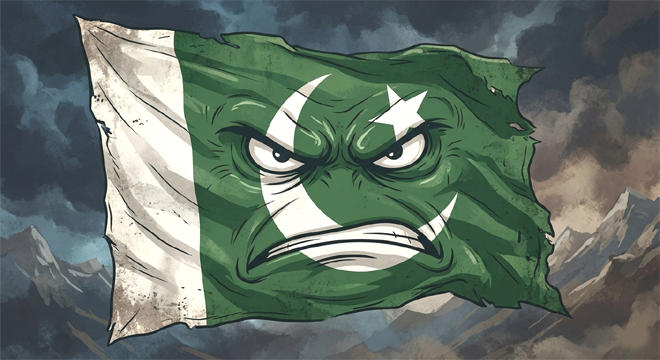
It is not just the political entity of Paaksthan but the idea of wrecking India as a fount of Hindu democratic beauty that exists within Pak, India and few other Islamic nations of West Asia. The relationship between India and Pakistan is not merely a matter of borders, armies, or diplomacy. It is something far deeper, more persistent, and far more difficult to resolve. At its core lies a clash of ideas—about identity, nationhood, history, and legitimacy. These ideas are not confined to government institutions or political rhetoric. They live within textbooks, media narratives, diaspora conversations, and the inherited memories of generations.
To understand this rivalry, one must move beyond simplistic binaries of “good versus bad” or “aggressor versus victim.” Instead, it requires a recognition that both nations emerged from a shared civilizational space but chose sharply divergent political and ideological paths. The friction between these paths continues to shape not only bilateral relations but also internal politics within each country.
India defines itself, at least constitutionally, as a pluralistic democracy rooted in civilizational continuity. Pakistan, on the other hand, was conceived as a homeland for Muslims of the subcontinent, born out of the trauma and urgency of Partition. These foundational differences created a structural tension that has never fully dissipated.
Over time, this tension has evolved into a powerful narrative engine. In Pakistan, India often appears as the “other” against which national identity is consolidated. In India, Pakistan is frequently portrayed as both a security challenge and a cautionary example of what ideological rigidity can produce. These mutually reinforcing perceptions ensure that the rivalry remains alive even during periods of relative peace.
The weight of history and the persistence of memory
The roots of this rivalry are often traced back to the Partition of 1947, one of the most traumatic events in modern history. Millions were displaced, and hundreds of thousands lost their lives in communal violence. The scars of that moment were not just physical; they were psychological and civilizational.
Partition did not simply divide land—it divided memory. Each side constructed its own narrative of victimhood and justification. In Pakistan, the creation of the state is often framed as a necessary safeguard for Muslim identity in the face of perceived majoritarian dominance. In India, Partition is frequently remembered as a tragic rupture imposed upon a historically interconnected society.
These competing narratives have hardened over time. Educational systems, political speeches, and media representations have often reinforced selective interpretations of history. As a result, generations have grown up with deeply embedded perceptions of the “other,” often without meaningful exposure to alternative viewpoints.
The invocation of medieval history—whether it involves invasions, empires, or cultural exchanges—further complicates the discourse. Historical episodes are frequently reinterpreted through modern political lenses, transforming complex past realities into simplified symbols of pride or grievance.
What emerges is a layered memory structure in which the past is never truly past. It is constantly being reactivated, reshaped, and redeployed to serve present-day agendas. This makes reconciliation difficult because the conflict is not just about current policies but about deeply internalized identities.
National identity and the politics of contrast
Nations often define themselves not only by what they are but also by what they are not. In the case of India and Pakistan, this dynamic is particularly pronounced. Each country has, at various times, used the other as a reference point to clarify its own identity.
For Pakistan, the emphasis on religious identity has historically been central. This does not mean that Pakistan is monolithic—far from it. It contains diverse ethnic, linguistic, and cultural groups. However, the overarching narrative of being a Muslim-majority state distinct from India has played a significant role in its political discourse.
India, by contrast, has emphasized diversity as a foundational principle. Its democratic framework accommodates multiple religions, languages, and cultural traditions. This pluralism is often presented as a point of contrast with Pakistan’s more religion-centric identity.
However, these distinctions are not static. Both countries have experienced internal debates and transformations regarding their identities. In India, discussions around secularism, nationalism, and cultural heritage continue to evolve. In Pakistan, there have been ongoing conversations about the balance between religious identity and civic governance.
The interplay between these internal debates and the external rivalry adds another layer of complexity. Domestic political narratives sometimes draw upon the India–Pakistan dynamic to mobilize support or reinforce legitimacy. This can lead to cycles in which external tensions are amplified by internal considerations.
The role of institutions and power structures
Another important dimension of the relationship lies in the differing roles of institutions within each country. In Pakistan, the military has historically played a significant role in shaping national policy, particularly in relation to India. Security considerations often dominate the strategic outlook, and this has influenced both domestic and foreign policy decisions.
In India, civilian political institutions have maintained primary control, although security concerns remain a key factor in policymaking. The contrast between these institutional structures affects how each country approaches dialogue, conflict, and long-term strategy.
The persistence of mistrust has also limited the effectiveness of diplomatic engagement. Even when formal talks occur, they are often overshadowed by skepticism about intentions. Confidence-building measures, though occasionally successful, have struggled to produce lasting change.
International actors further complicate the picture. Global powers have, at different times, aligned with one country or the other based on broader strategic interests. This external involvement can sometimes reinforce existing tensions rather than resolve them.
Media narratives and the amplification of conflict
In the modern era, media plays a crucial role in shaping public perception. Both traditional and digital platforms have the power to amplify certain narratives while marginalizing others. In the context of India and Pakistan, media coverage often emphasizes conflict, controversy, and confrontation.
This is not entirely surprising. Conflict-driven stories tend to attract attention and engagement. However, the cumulative effect can be a distorted understanding of reality. Nuanced perspectives and efforts at cooperation receive far less visibility than incidents of tension or hostility.
Social media has intensified this dynamic. Algorithms that prioritize engagement can inadvertently promote polarizing content. As a result, extreme viewpoints may gain disproportionate traction, further entrenching divisions.
At the same time, there are also voices—journalists, scholars, and civil society groups—who advocate for dialogue and mutual understanding. Their work, though less sensational, provides an important counterbalance to dominant narratives.
The human dimension beyond politics
Amid all the geopolitical analysis, it is easy to overlook the human dimension of the India–Pakistan relationship. Families divided by borders, shared cultural traditions, and common linguistic roots all point to a deeper connection that transcends political boundaries.
Music, literature, and cinema often reveal these shared sensibilities. Artists from both countries have found audiences across the border, despite political restrictions. These cultural exchanges suggest that the divide is not as absolute as it sometimes appears.
People-to-people interactions, when they occur, frequently challenge preconceived notions. Personal experiences can disrupt stereotypes and open up new avenues of understanding. However, such interactions remain limited due to visa restrictions and security concerns.
The diaspora also plays a role in shaping perceptions. Communities living outside the subcontinent often engage with these issues in unique ways, influenced by both their heritage and their current environments.
Rethinking the future beyond binary narratives
If the India–Pakistan relationship is to evolve, it will require a shift away from rigid, binary narratives. This does not mean ignoring legitimate concerns or historical grievances. Rather, it involves acknowledging complexity and resisting the temptation to reduce everything to a single storyline.
Constructive engagement could take many forms—economic cooperation, cultural exchange, or incremental confidence-building measures. While large-scale breakthroughs may be difficult, smaller steps can still make a meaningful difference.
Education also has a critical role to play. Encouraging critical thinking and exposure to multiple perspectives can help future generations move beyond inherited biases. This is a long-term process, but it is essential for any sustainable change.
Ultimately, the idea that one nation must define itself through the diminishment or destruction of another is neither constructive nor sustainable. History shows that such approaches tend to perpetuate cycles of conflict rather than resolve them.
Between rivalry and possibility
The India–Pakistan dynamic is one of the most complex and enduring rivalries in the modern world. It is shaped by history, identity, politics, and perception. While conflict has often dominated the narrative, it is not the only possible outcome.
There remains, beneath the layers of mistrust, a shared heritage and a set of human connections that cannot be entirely erased. Recognizing this does not solve the problem overnight, but it does open the door to alternative ways of thinking.
Moving forward requires not only political will but also a broader cultural shift. It involves questioning entrenched assumptions, engaging with complexity, and imagining a future that is not bound by the limitations of the past.
Such a future may seem distant, but it is not impossible.