
Both states, Kerala and Bengal, are cursed with a communist mindset which allows lethargy and politics to rule supreme over the population intrinsically. Bengal is more sullied with illegal immigration. Kerala has at least preserved its own culture from moorish and Arab history
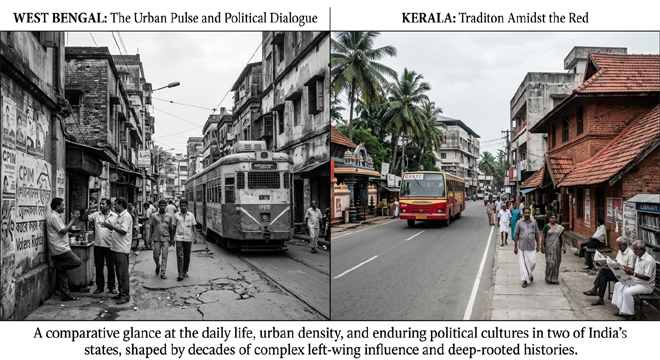
The political histories of Kerala and West Bengal are often invoked as examples of ideological commitment, mass mobilization, and deeply entrenched democratic participation. Yet beneath the surface of high literacy rates, political awareness, and vibrant electoral culture lies a more complex and, at times, troubling story—one of delayed decisions, missed opportunities, bureaucratic inertia, and competing visions of development. The tale of the Vizhinjam port in Kerala, juxtaposed with the broader electoral and governance patterns in both Kerala and West Bengal, offers a compelling lens through which to examine how political structures can either accelerate or obstruct long-term progress.
At the heart of this narrative is the idea that governance is not merely about ideological consistency or electoral victories, but about execution. For decades, both Kerala and West Bengal have been shaped by leftist politics, which brought with it a focus on social welfare, labor rights, and grassroots mobilization. However, as global economic dynamics shifted and infrastructure became the backbone of competitiveness, the ability—or inability—to implement large-scale projects began to define the success of governments.
Kerala’s Vizhinjam port project stands as a striking example. Conceived in 1991 during the tenure of a Congress-led government, the project was envisioned as a deep-water transshipment hub that could transform India’s maritime trade. Strategically located near international shipping routes, Vizhinjam had the potential to reduce India’s dependence on foreign ports such as Colombo, Singapore, and Dubai. Yet for over three decades, this vision remained largely unrealized, trapped in a cycle of political hesitation, environmental concerns, and administrative delays.
The long gestation of a maritime dream
The early years of the Vizhinjam project were marked by optimism but little action. Successive governments, both from the United Democratic Front (UDF) and the Left Democratic Front (LDF), revisited the project repeatedly. Committees were formed, feasibility studies commissioned, and proposals drafted, but tangible progress remained elusive. The project became emblematic of a broader governance challenge—an ability to conceptualize but a reluctance or incapacity to execute.
When Oommen Chandy secured environmental clearances in 2014, it was widely seen as a breakthrough. Yet even this milestone failed to attract bidders. The project had, by then, acquired a reputation for being politically risky and administratively cumbersome. Private players were wary of entering a space where delays seemed inevitable and returns uncertain.
It was in this context that the Adani Group emerged as the sole bidder, a development that underscored both the urgency and the fragility of the project. The lack of competitive bidding was not a sign of confidence but rather a reflection of how deeply the project had been mired in uncertainty.
Meanwhile, India continued to incur significant economic losses. Without a deep-water port capable of handling the world’s largest container ships, a substantial portion of Indian cargo was transshipped through foreign ports. This not only increased costs but also limited India’s strategic autonomy in maritime trade.
Intervention and acceleration at the national level
The turning point came with the intervention of the central government under Narendra Modi. Through initiatives such as Sagarmala and PM GatiShakti, the project was integrated into a broader national infrastructure strategy. Funding support, expedited clearances, and a clear articulation of national priority transformed the project’s trajectory.
Construction began in December 2015, marking the first time in over two decades that the project moved beyond the planning stage. The journey from that point onward was far from smooth. The project faced multiple challenges, including natural disasters like Cyclone Ockhi and severe floods, as well as disruptions caused by the COVID-19 pandemic. In addition, a prolonged protest led by sections of the local community created further obstacles, highlighting the complex interplay between development and local concerns.
Despite these challenges, the project persisted. The central government’s consistent backing ensured that momentum was maintained, even in the face of adversity. By May 2, 2025, the port was ready for inauguration—a milestone that symbolized not just the completion of an infrastructure project but the culmination of decades of effort, delay, and eventual resolve.
Early outcomes and economic implications
The initial months of Vizhinjam’s operation offered a glimpse into its transformative potential. Within eight months, the port handled hundreds of ships and close to a million containers, generating substantial revenue. More importantly, it began to reduce India’s reliance on foreign transshipment hubs, thereby retaining economic value within the country.
This shift has broader implications for India’s trade ecosystem. By providing a domestic alternative to ports like Colombo, Vizhinjam enhances India’s competitiveness in global shipping. It also strengthens the country’s strategic position in the Indian Ocean region, an area of increasing geopolitical significance.
However, the story of Vizhinjam is not merely about economic gains. It is also a reflection of how alignment between state and central governments can influence outcomes. The concept of an “alignment dividend” becomes particularly relevant here—when different levels of government work in sync, projects can move from conception to completion with greater efficiency.
Kerala’s political structure and developmental paradox
Kerala’s political landscape is characterized by a stable bipolar system, with power alternating between the LDF and the UDF. This structure has ensured a high degree of accountability, as each coalition seeks to outperform the other. At the same time, it has also led to a certain degree of policy discontinuity, with projects often being revisited or re-evaluated when governments change.
The state’s achievements in social indicators—education, healthcare, and human development—are widely acknowledged. Yet these successes coexist with challenges in industrial growth and infrastructure development. The Vizhinjam project encapsulates this paradox: a state capable of high social progress but struggling with large-scale economic execution.
The emphasis on welfare policies, while essential, has sometimes overshadowed the need for long-term investments in infrastructure. This has led to debates about the balance between immediate social benefits and future economic growth—a debate that continues to shape Kerala’s political discourse.
West Bengal’s contrasting trajectory
While Kerala presents a case of alternating power, West Bengal offers a different narrative. For 34 years, the state was governed by the Left Front, led by the Communist Party of India (Marxist). This period was marked by significant land reforms and a strong focus on rural empowerment. However, over time, the centralized nature of governance and resistance to industrialization began to impact the state’s economic trajectory.
The political landscape underwent a dramatic shift in 2011, when the Mamata Banerjee-led Trinamool Congress came to power, ending decades of Left rule. Since then, West Bengal has seen a more dominant, single-party structure, with the Bharatiya Janata Party emerging as the primary opposition force.
Political mobilization and electoral dynamics
Both Kerala and West Bengal are known for their highly engaged electorates. Voter turnout is consistently high, and political awareness extends deep into rural areas. Party structures are robust, with local committees playing a crucial role in mobilization and outreach.
The presence of significant minority populations adds another layer of complexity to electoral strategies. In Kerala, the relatively balanced distribution of religious communities necessitates coalition-building and inclusive policies. In West Bengal, the demographic composition influences campaign narratives and political alignments in distinct ways.
The rise of the Bharatiya Janata Party as a major political player in both states has introduced new dynamics. In Kerala, the BJP is working to establish a foothold in a traditionally bipolar system. In West Bengal, it has positioned itself as the primary challenger to the ruling party, leading to intense electoral contests.
Development versus distribution: a continuing debate
A central theme that emerges from the comparison of these two states is the tension between development and distribution. Welfare policies have played a crucial role in improving living standards, but they must be complemented by investments in infrastructure and industry to ensure sustainable growth.
The Vizhinjam port serves as a case study in this regard. It demonstrates how delays in decision-making can have long-term economic costs, and how decisive action can unlock potential that has remained dormant for years. At the same time, it also highlights the importance of addressing local concerns and ensuring that development is inclusive.
Looking ahead: choices and consequences
As Kerala and West Bengal move forward, the choices made by their electorates will shape their trajectories for decades to come. The question is not merely about which party comes to power, but about the priorities that guide governance. Will the focus be on short-term benefits or long-term investments? On maintaining the status quo or embracing change?
The answers to these questions will determine whether these states can leverage their strengths—high literacy, political awareness, and social capital—to achieve sustained economic growth. The experience of Vizhinjam suggests that when vision is matched with execution, the results can be transformative.
In the end, governance is about outcomes. Ideologies, alliances, and electoral strategies are important, but they must translate into tangible improvements in people’s lives. Whether it is a port that reduces dependence on foreign infrastructure or policies that create jobs and opportunities, the true measure of success lies in delivery.
Kerala and West Bengal stand at critical junctures in their political journeys. Their histories offer valuable lessons, their present poses significant challenges, and their futures hold immense possibilities. The path they choose will not only define their own destinies but also contribute to the broader narrative of India’s development.