
Packaged foods frequently carry statements such as “high in sugar,” “high in sodium,” or “may contain allergens.” Pharmaceutical drugs come with extensive warnings and disclaimers. Alcohol bottles warn that drinking during pregnancy can cause birth defects. The idea is simple: inform the consumer and the market will self-correct. This has never worked

Modern consumer law assumes a simple principle: if citizens are informed of the dangers of a product, they will make rational decisions. Governments across the world have therefore mandated warning labels on a wide range of items, tobacco products, sugary beverages, alcohol, ultra-processed food, pain killers and other medicines. The logic behind these warnings is rooted in consumer protection law: disclosure of risk should shift responsibility from the state to the buyer. In theory, if the product clearly says “this can kill you,” the consumer cannot later claim ignorance.
This philosophy has influenced legislation in almost every major jurisdiction. The international tobacco treaty, the Framework Convention on Tobacco Control, promoted by the World Health Organization, requires countries to place large health warnings on cigarette packs. Article 11 of the treaty specifically calls for pictorial warnings covering significant portions of tobacco packaging. Research summarized by the organization shows that graphic warnings increase awareness of smoking risks and can encourage quit attempts.
Governments have extended similar logic to food products. Packaged foods frequently carry statements such as “high in sugar,” “high in sodium,” or “may contain allergens.” Pharmaceutical drugs come with extensive warnings and disclaimers. Alcohol bottles warn that drinking during pregnancy can cause birth defects. The idea is simple: inform the consumer and the market will self-correct.
Yet reality has repeatedly shown that warning labels alone rarely prevent harm. People continue to smoke despite grotesque images of diseased lungs. They drink sugary beverages despite warnings about obesity. In many cases the warnings exist primarily as legal shields for governments and corporations rather than as meaningful protections for public health.
The psychology of ignoring warnings
Behavioral science has long demonstrated that people do not behave like rational actors when it comes to risk. Humans discount long-term dangers in favor of immediate gratification. Nicotine addiction, sugar cravings, and the appeal of cheap processed food overpower abstract warnings printed on packaging.
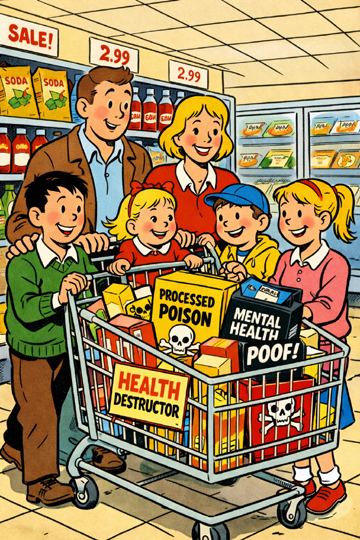
Studies of tobacco labels illustrate this paradox. Graphic warnings covering more than half of cigarette packages have been shown to increase awareness of health risks and sometimes raise the intention to quit smoking. However, other research suggests that such warnings do not necessarily alter the deep-seated attitudes of smokers. One study found that graphic labels did not significantly change implicit evaluations of smoking behavior.
Over time, consumers become desensitized to warnings. Psychologists call this the “wear-out effect.” After repeated exposure, the shock value fades. A smoker who initially reacts with disgust to a picture of cancerous lungs eventually stops noticing it entirely. The warning becomes part of the packaging aesthetic rather than a deterrent.
Governments recognize this phenomenon, which is why they periodically redesign warning labels. In 2025, for example, Australia went so far as to require health warnings printed directly on individual cigarettes themselves, ensuring that smokers see the message with every puff. Even such drastic measures may only marginally reduce consumption.
The uncomfortable conclusion is that information alone rarely overrides addiction, habit, or social pressure. When products are engineered to exploit human vulnerabilities—nicotine addiction, sugar cravings, caffeine dependence—warnings become little more than symbolic gestures.
Tobacco: the original experiment in warning labels
The modern regulatory regime of warning labels began with tobacco. For decades cigarette companies aggressively marketed smoking as glamorous and healthy. Historical advertising campaigns even featured physicians endorsing particular brands. When scientific evidence linking smoking to cancer became overwhelming in the mid-twentieth century, governments responded by mandating warnings.
The first major warning label appeared in the United States in 1965 with the message: “Caution: Cigarette Smoking May Be Hazardous to Your Health.” Over time the warnings became larger and more graphic. Many countries now require images of diseased organs or dying patients.
Legal battles followed these regulations. Tobacco companies repeatedly challenged warning mandates in courts, arguing that forced messages violated their commercial speech rights. In the United States, several cigarette manufacturers contested rules issued by the U.S. Food and Drug Administration requiring large pictorial warnings covering half of cigarette packages. Courts eventually allowed the regulations to proceed after years of litigation.
Despite these measures, smoking remains widespread worldwide. While warning labels have contributed to gradual declines in smoking rates in some countries, the decline has been far slower than public health advocates hoped. The persistence of tobacco consumption despite overwhelming warnings illustrates the limits of informational regulation.
Sugar, salt and the silent epidemic
If tobacco is the most visible example of warning labels, food is the most insidious. Excessive consumption of sugar, salt, and ultra-processed ingredients is now linked to obesity, diabetes, and cardiovascular disease across the world. Governments have begun placing nutritional warnings on packaged foods in an attempt to curb these health crises.
Several countries in Latin America pioneered aggressive labeling systems. Chile, for example, introduced black stop-sign labels on foods high in sugar, salt, calories, or saturated fat. Similar policies were adopted in Mexico and Peru. The European Union and India have debated front-of-pack warning systems as well.
Yet the food industry has fought these regulations with enormous lobbying power. Food corporations often argue that warnings stigmatize their products or oversimplify complex nutritional science. Lobbyists pressure governments to dilute regulations or replace strong warnings with weaker “guideline daily allowance” charts that are harder for consumers to interpret.
The result is a regulatory compromise. Warnings exist, but they are often watered down enough that consumption patterns remain largely unchanged. Meanwhile, corporations continue to design products with optimal combinations of sugar, fat, and salt that trigger powerful reward mechanisms in the brain.
In this sense, the warning label becomes a fig leaf. The state can claim that consumers were informed, while corporations can continue selling products engineered for addiction.
When warnings fail catastrophically
Sometimes the failure of regulation goes far beyond ineffective warnings and becomes a public health disaster. History offers many examples where corporations knowingly or negligently sold poisonous products while governments failed to intervene.
The most infamous industrial disaster in modern history occurred in 1984 in India during the Bhopal disaster. A pesticide plant owned by Union Carbide leaked toxic methyl isocyanate gas into the surrounding city. Thousands died immediately and many more suffered long-term illnesses. Estimates suggest that more than 3,000 people died in the initial disaster and over 100,000 were injured.
Legal proceedings followed the tragedy. The Indian government enacted the Bhopal Gas Leak Act of 1985, allowing it to represent victims in court. After prolonged litigation, the company agreed to a settlement of $470 million in 1989, a figure many critics considered inadequate given the scale of the disaster.
Even decades later, legal battles continue over environmental contamination around the site. The tragedy illustrated how corporations, regulatory failures, and political considerations can combine to produce mass poisoning.
Another landmark legal case arising from industrial hazards was M. C. Mehta v. Union of India, often called the Oleum Gas Leak case. In this case the Supreme Court of India established the doctrine of “absolute liability,” holding hazardous industries strictly responsible for harm caused by their activities. The judgment became a cornerstone of environmental jurisprudence, recognizing that corporations engaged in dangerous industries must bear the full cost of accidents.
These cases demonstrate that warnings alone are insufficient when industries themselves create systemic risks.
Food adulteration and corporate fraud
Food safety scandals reveal another dimension of the problem: corporations deliberately adulterating products to increase profits. In such cases warning labels are meaningless because the product itself is misrepresented.
A notorious example occurred in Taiwan in 2013 when the company Tatung Chang Chi Foods Co., Ltd. was caught selling olive oil that contained less than half actual olive oil. Investigators discovered that cheaper oils and coloring agents had been added while the product was marketed as premium extra-virgin olive oil. Authorities charged company executives with violating food safety laws and imposed heavy fines.
Similar scandals have occurred worldwide: melamine contamination in Chinese milk powder, horse meat disguised as beef in European food products, and widespread adulteration of spices and cooking oils in developing countries. In each case, consumers believed they were buying one thing but were actually ingesting something potentially harmful.
The problem is not ignorance but deception.
No warning label can protect consumers from fraudulent labeling.
Poisoned food and the role of corruption
Corruption often magnifies the dangers of unsafe products. When regulators accept bribes or ignore violations, dangerous goods remain on the market.
A striking example emerged in China in 2025 during the Tianshui kindergarten lead poisoning scandal. Investigators discovered that meals served at a kindergarten contained pigments with lead levels thousands of times above safety limits. More than two hundred children suffered lead poisoning as a result.
Reports later revealed attempts to conceal the scandal. Officials allegedly falsified medical data and suppressed early warnings about the contamination. Some individuals were accused of bribing authorities to hide the problem.
This case illustrates the fatal intersection of corporate negligence and bureaucratic corruption. When regulators become complicit, even the most detailed safety laws fail to protect the public.
When governments themselves fail
In some cases the problem is not corporate wrongdoing alone but systemic failures in governance. The 2010 “Pudreval” scandal in Venezuela revealed that more than 130,000 tons of imported food had rotted in government warehouses while shortages plagued the population.
The food had been imported through state programs intended to subsidize staples for ordinary citizens. Instead, mismanagement and corruption allowed massive quantities of food to spoil before distribution. The scandal exposed the weaknesses of centralized food procurement systems when transparency and accountability are absent.
Similarly, the global pharmaceutical industry has faced repeated accusations of influencing regulators through lobbying or revolving-door employment. Companies often fund studies that minimize risks while suppressing negative findings. The resulting regulatory approvals can leave consumers exposed to drugs whose dangers become evident only after widespread use.
Legal doctrines and the limits of liability
Courts have struggled to balance corporate accountability with economic realities. Legal doctrines such as strict liability and consumer protection laws were developed to address industrial hazards, but enforcement remains uneven.
The Oleum Gas Leak case established the principle that companies engaged in hazardous industries bear absolute liability for accidents. This means they cannot escape responsibility by claiming lack of negligence. Yet even this powerful doctrine depends on effective enforcement and the political will to challenge powerful corporations.
In many countries regulatory agencies suffer from limited resources, political pressure, or regulatory capture. When regulators become too close to the industries they oversee, enforcement weakens. Warning labels then become substitutes for stronger regulation.
From a legal perspective, warning labels also serve a strategic function. By informing consumers of risks, corporations can argue that the consumer assumed those risks voluntarily. The doctrine of “informed consent” shifts liability from the manufacturer to the buyer.
Thus a packet of cigarettes bearing a large warning about cancer may protect the manufacturer from lawsuits even if the product itself remains deadly.
The economics of poisonous products
The persistence of harmful products despite warnings is also driven by powerful economic incentives. Industries built around addictive or unhealthy goods generate enormous profits. Tobacco companies, processed food manufacturers, and chemical producers all operate in markets worth billions of dollars annually.
These industries invest heavily in marketing, research, and lobbying to maintain their market share. Warning labels represent only a small obstacle compared to the financial resources behind product promotion.
For example, tobacco companies historically responded to warning regulations by designing packaging that minimized the visual impact of warnings. They also shifted marketing toward developing markets where regulations were weaker.
Food companies similarly reformulate products just enough to avoid specific warning thresholds while maintaining high levels of sugar or sodium. Such strategies demonstrate how corporations adapt quickly to regulatory frameworks that rely primarily on labeling rather than structural change.
Cultural and social factors
Another reason warning labels often fail is the cultural context in which products are consumed. Smoking, alcohol consumption, and sugary foods are deeply embedded in social rituals and traditions.
In many societies cigarettes are associated with social bonding or stress relief. Sugary foods are linked to celebration and comfort. Alcohol is intertwined with hospitality and recreation. These cultural associations can override rational assessments of risk.
Public health campaigns therefore face the challenge of changing social norms rather than simply providing information. Warning labels alone cannot dismantle cultural habits formed over generations.
Lessons from global experiences
The global record suggests that warning labels can contribute to harm reduction but rarely succeed on their own. Effective public health strategies typically combine multiple approaches: taxation, advertising restrictions, product reformulation, and public education.
Tobacco control offers a clear example. Countries that achieved significant reductions in smoking rates combined warning labels with high taxes, advertising bans, smoke-free public spaces, and cessation programs. Labeling was only one component of a broader strategy.
Similarly, efforts to reduce sugar consumption increasingly rely on taxes on sugary beverages, restrictions on marketing to children, and reformulation requirements for food manufacturers. Warning labels serve as reminders but cannot substitute for structural regulation.
The uncomfortable truth about consumer responsibility
At the heart of the debate lies a philosophical question: how much responsibility should individuals bear for the risks they choose to take?
Libertarian arguments emphasize personal freedom. Adults should be free to consume tobacco, alcohol, or sugary foods as long as they are informed of the risks. Warning labels fulfill the state’s duty by providing that information.
Public health advocates counter that corporations deliberately engineer products to exploit human psychology and addiction. In such circumstances the concept of free choice becomes questionable. If a product is designed to be addictive and aggressively marketed, can consumers truly exercise informed consent?
The tension between these perspectives shapes modern regulatory policy. Governments often compromise by allowing harmful products to remain legal while requiring warnings. This approach avoids accusations of paternalism but leaves public health outcomes uncertain.
When the buyer is “an idiot”
Laws can mandate warnings, enforce labeling, and punish fraud, but they cannot eliminate human folly. People continue to smoke despite knowing the risks. They consume excessive sugar despite warnings about diabetes. They purchase miracle cures advertised on late-night television. Human behavior frequently defies rational calculation.
Yet blaming consumers alone ignores the broader structural forces shaping those choices. Advertising, cultural norms, addiction, and economic inequality all influence behavior. When unhealthy products are cheap and widely promoted, individual willpower becomes an unreliable defense. The challenge for policymakers is therefore not merely to inform consumers but to reshape the environments in which decisions are made.
Toward stronger protection
If warning labels alone are insufficient, what alternatives exist? Several policy approaches have shown promise. First, taxation can reduce consumption of harmful products by increasing their cost. High tobacco taxes, for example, have proven effective in lowering smoking rates in many countries. Second, advertising restrictions can limit the influence of marketing. Bans on tobacco advertising and sponsorship have been linked to significant reductions in smoking uptake.
Third, product reformulation can directly reduce harmful ingredients. Governments can mandate limits on trans fats, sodium, or sugar content in processed foods. Fourth, strong enforcement mechanisms are essential. Regulatory agencies must have the authority and independence to investigate corporate misconduct and impose meaningful penalties.
Finally, transparency and whistleblower protections can help expose corruption and fraud before they escalate into public health disasters.
Warning label for a carb, tobacco addict? Ha!
Warning labels are one of the simplest and most visible tools of consumer protection. They represent the state’s attempt to balance individual freedom with public health. Yet decades of experience show that warnings alone rarely prevent harm.
Addiction, corporate marketing, regulatory capture, and human psychology all undermine the effectiveness of labels. From tobacco packs to processed foods, warnings often become background noise in a marketplace designed to encourage consumption.
The tragedies of industrial disasters, food adulteration scandals, and poisoned communities demonstrate the limits of relying on consumer awareness. In many cases the victims knew the risks but lacked meaningful alternatives or protection.
Ultimately the question is not whether warnings are useful—they are—but whether they are sufficient. History suggests they are not. Without strong regulation, enforcement, and accountability, warning labels risk becoming little more than legal disclaimers attached to products that continue to harm the public.