
The reported Pakistani offensive in May 2025 combined multiple vectors of aerial threat. Among them were 300–400 Asisguard Songar Turkish drones, small armed unmanned systems capable of precision targeting and adaptable flight paths. Nothing happened owing to India’s S-400 shield
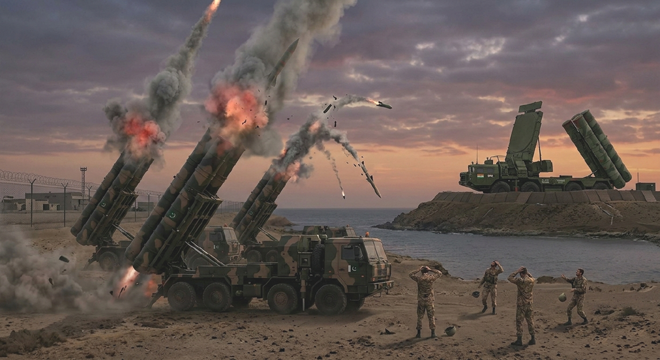
When Iranian missiles were reportedly fired at United States military facilities and allied positions across the Middle East—in Dubai in the United Arab Emirates, in Bahrain, Kuwait, Oman, Saudi Arabia, Israel, and Qatar—the world was reminded how swiftly regional rivalries can spill into multinational confrontation. Missile arcs do not respect diplomatic nuance; they redraw risk maps overnight. The spectacle of projectiles streaking across desert skies carried not just tactical significance but psychological weight. It was a message of reach, retaliation, and regional defiance. Yet for observers in India, the episode evoked a powerful parallel closer to home. Months earlier, Pakistan had attempted a coordinated aerial assault across Indian territory using drones, loitering munitions, and missiles in what analysts described as one of the largest hybrid air campaigns in South Asian history. The intention, as alleged by Indian defence assessments, was to overwhelm air defence grids, paralyse airfields, and terrorise civilian centres along a vast swathe of territory near the Indo-Pak border. The scale—over a thousand aerial threats launched toward 36 locations—suggested not mere provocation but a test of national resilience. And yet, according to Indian claims, the assault largely failed. Missiles and drones were intercepted in remarkable numbers, civilian casualties were minimal, and critical infrastructure remained intact. The contrast between intended devastation and actual outcome forms the core of a larger story about modern air defence, technological integration, and strategic deterrence in the 21st century.
The anatomy of a saturation attack
The reported Pakistani offensive in May 2025 combined multiple vectors of aerial threat. Among them were 300–400 Asisguard Songar Turkish drones, small armed unmanned systems capable of precision targeting and adaptable flight paths. Complementing these were approximately 600 additional systems, including Yiha-III class loitering munitions designed to hover over targets before striking, swarming drones intended to confuse radar and overwhelm defences, and commercial quadcopters modified for military use. The campaign allegedly incorporated Fatah-II long-range missiles and Fatah-I ballistic missiles, weapons intended to strike deeper targets with greater payload. Further complexity was added by the potential deployment of Chinese PL-15 long-range air-to-air missiles fired from J-10C fighter jets, extending engagement ranges and complicating interception timelines. The sheer diversity of platforms mirrored evolving doctrines worldwide: saturate the defender’s sensors, fragment response capacity, and exploit gaps in layered defence. The targeted zone—over 1,500 square kilometres adjacent to the Indo-Pak border—was large enough to encompass urban settlements, forward air bases, logistics depots, and civilian infrastructure. In theory, such a coordinated barrage could have inflicted catastrophic damage. In practice, the outcome was starkly different.
The spectre of civilian vulnerability
Modern warfare blurs the line between military and civilian domains. Drones launched toward airfields can drift into populated neighbourhoods. Ballistic missiles aimed at runways can overshoot into residential districts. In a densely populated country like India, even a handful of successful penetrations could translate into mass casualties. The psychological impact alone—sirens, blackouts, televised intercepts—can induce panic. The prospect that thousands of civilians might perish under a drone-and-missile swarm was not hyperbole; it reflected the destructive potential of contemporary precision-guided munitions. India’s major northern cities lie within operational reach of cross-border missile systems. Industrial corridors, oil depots, and railway junctions form dense clusters of economic activity. The risk calculus, therefore, extends beyond immediate fatalities to long-term economic paralysis. That such devastation did not materialise, according to official accounts, became a point of strategic emphasis for New Delhi.
Layered defence and the logic of interception
India’s response hinged on a layered air defence architecture combining long-range missile systems, medium-range interceptors, radar networks, and satellite inputs. Central to this narrative is the deployment of the S-400 Triumf, acquired from Russia and inducted into the Indian Air Force beginning in the early 2020s. Designed to detect and engage multiple targets at varying altitudes and ranges, the S-400 can intercept aircraft, cruise missiles, and ballistic missiles within a broad envelope. Its phased-array radars and command posts integrate data across sectors, enabling simultaneous tracking of dozens of threats. Complementing it is India’s indigenous Akash system, integrated through a digital command-and-control framework often referred to as Akashteer. This networked approach allows ground-based radars, airborne early warning platforms, and satellite feeds to share targeting data in near real time. The result is a defensive mesh rather than isolated batteries. In a saturation scenario, such integration is critical. Each intercepted drone represents not merely a saved asset but a preserved layer of deterrence credibility.
Satellites and intelligence fusion
No modern air defence functions in isolation from space-based assets. India’s space agency, Indian Space Research Organisation, operates satellites capable of surveillance, communication, and navigation support. High-resolution imagery and infrared sensors can detect launch signatures or unusual activity near borders. Combined with ground-based radar and signals intelligence, satellite input enhances situational awareness before missiles even cross into national airspace. The narrative also references intelligence inputs from Mossad, Israel’s external intelligence service, reflecting the growing defence cooperation between India and Israel. Intelligence fusion—melding domestic and foreign data streams—shortens reaction time. In a drone swarm scenario, seconds matter. Early cueing can mean the difference between intercepting a projectile at high altitude and scrambling to neutralise debris over populated zones.
Technology as deterrent messaging
Publicly emphasising the success of interception serves strategic communication goals. By asserting that almost every missile and drone was neutralised, India sends a deterrent message to adversaries: saturation will not guarantee success. Deterrence in the missile age is no longer solely about retaliatory capability; it is about denial—the ability to deny an attacker the benefits of aggression. If the cost of launching a thousand drones yields negligible strategic gain, the calculus shifts. This mirrors global trends. Israel’s Iron Dome system altered expectations in conflicts with non-state actors. Saudi Arabia’s Patriot and THAAD deployments respond to Houthi missile threats. The United States maintains layered missile defence for its bases worldwide. In each case, visible interception footage reinforces domestic morale and signals capability externally.
Parallel theatres, shared anxieties
The Iranian missile launches toward U.S. bases in Gulf states underscored similar vulnerabilities. American installations in Bahrain or Qatar, though fortified, are geographically exposed. The U.S. Fifth Fleet headquarters in Bahrain sits within reach of Iranian missile batteries. Al Udeid Air Base in Qatar hosts thousands of personnel. A successful strike could escalate rapidly into broader confrontation. Thus, both the Middle East and South Asia confront a shared strategic dilemma: how to protect fixed assets in an era when missiles are cheaper and more numerous than ever. The Indian example, as presented by its officials, suggests that layered defence and intelligence integration can blunt even large-scale attempts.
The evolution of drone warfare
Drones have democratized airpower. From commercial quadcopters modified for surveillance to loitering munitions capable of autonomous target acquisition, unmanned systems complicate traditional air defence. They fly low, evade radar, and can be launched in swarms. Turkey’s defence industry has become a major exporter of armed drones, while China supplies advanced missile technology to several countries. Pakistan’s reported use of diverse drone classes reflects a global shift: rather than rely solely on manned aircraft, states experiment with attritable, expendable systems. Defenders must adapt with electronic warfare, jamming, directed-energy weapons, and rapid-fire interceptors. India’s claim of near-total interception implies not only kinetic missile defence but also electronic countermeasures disrupting navigation and command links.
Civil defence and societal resilience
Beyond hardware, societal preparedness plays a role. Air raid protocols, coordination between military and civil authorities, and rapid dissemination of verified information can prevent panic. During the alleged May 2025 assault, Indian authorities reportedly maintained continuity of services in most affected regions. Airports resumed operations quickly. Schools and hospitals remained functional. Such continuity reinforces the perception of resilience. In the Middle East, similar drills are routine; Gulf states conduct periodic missile defence exercises in coordination with U.S. forces. The psychological dimension of defence is as crucial as the physical.
Strategic partnerships and multi-vector diplomacy
India’s defence posture reflects diversified partnerships. The S-400 acquisition from Russia occurred despite Western sanctions frameworks, underscoring New Delhi’s strategic autonomy. Simultaneously, intelligence cooperation with Israel deepened, and indigenous systems continued to mature. This multi-vector diplomacy mirrors India’s broader foreign policy—engaging the United States, Russia, Europe, and regional partners without formal alliance entanglements. In contrast, Gulf states rely heavily on U.S. security guarantees, though they increasingly diversify suppliers. The Iranian missile episode could accelerate discussions on integrated regional air defence architectures linking Gulf Cooperation Council states with external partners.
The cost calculus of interception
Interception is expensive. Advanced surface-to-air missiles cost millions of dollars per unit, while commercial drones may cost a fraction. This asymmetry raises sustainability questions. If an adversary can launch hundreds of low-cost drones, can the defender afford to intercept each with high-end missiles? India’s experience suggests a mix of solutions—using high-end systems against ballistic threats while employing cheaper interceptors or electronic warfare against smaller drones. The future likely lies in layered cost-effective defence, including laser-based systems that reduce per-shot expense. The Gulf states, flush with energy revenues, may pursue similar diversification.
Escalation control and red lines
One striking aspect of both theatres is escalation management. Despite missile launches, neither region spiralled immediately into full-scale war. Interceptions, diplomatic backchannels, and calibrated messaging contained fallout. Missile defence thus serves not only protective but stabilising functions. By reducing casualties, it lowers pressure for immediate massive retaliation. However, it can also embolden actors who believe their own defences make them invulnerable. The balance between deterrence and overconfidence is delicate.
The domestic political narrative
For India, projecting an image of impregnable defence strengthens domestic political confidence. Citizens who witness successful interceptions perceive state competence. Defence modernization becomes politically validated. Similarly, Gulf leaders emphasise missile defence success to reassure expatriate populations and investors. Markets react not just to attacks but to perceived control over them. In both contexts, transparency about capabilities is selective—enough to reassure, not enough to reveal vulnerabilities.
Toward an integrated future shield
Looking ahead, the convergence of satellite surveillance, artificial intelligence, and network-centric warfare will define air defence. India’s integration of ISRO data, ground radars, and interceptor batteries foreshadows a future in which decision cycles shrink to milliseconds. Autonomous threat classification could allocate interceptors optimally. Swarm-on-swarm engagements—defensive drones countering offensive swarms—may become routine. The Gulf region, too, may adopt AI-driven regional command centres linking multiple states. Shared threat perception could overcome historical rivalries.
India stands protected—yet vigilance endures
The assertion that India stands protected reflects confidence born of recent experience. Yet protection is never absolute. Technology evolves, adversaries adapt, and complacency invites risk. The May 2025 episode, as portrayed, demonstrated the potency of layered defence and strategic partnerships. The Iranian missile strikes in the Middle East highlighted parallel vulnerabilities and the universal relevance of air defence modernization. Together, these episodes underscore a central truth of contemporary security: in an age of drones and missiles, survival depends not merely on firepower but on integration—of sensors, systems, intelligence, and alliances. India’s claimed success offers a case study in denial-based deterrence. Whether in the deserts of the Gulf or the plains of Punjab, the message is consistent: the shield matters as much as the sword.