
Widening a marine strait is not without precedent in concept. Humans have dug canals such as the Suez Canal and the Panama Canal, reshaping global trade routes. More recently, Egypt expanded sections of the Suez to allow two-way traffic in certain stretches. China has built entire artificial islands in the South China Sea. The Netherlands has reclaimed land from the ocean for centuries
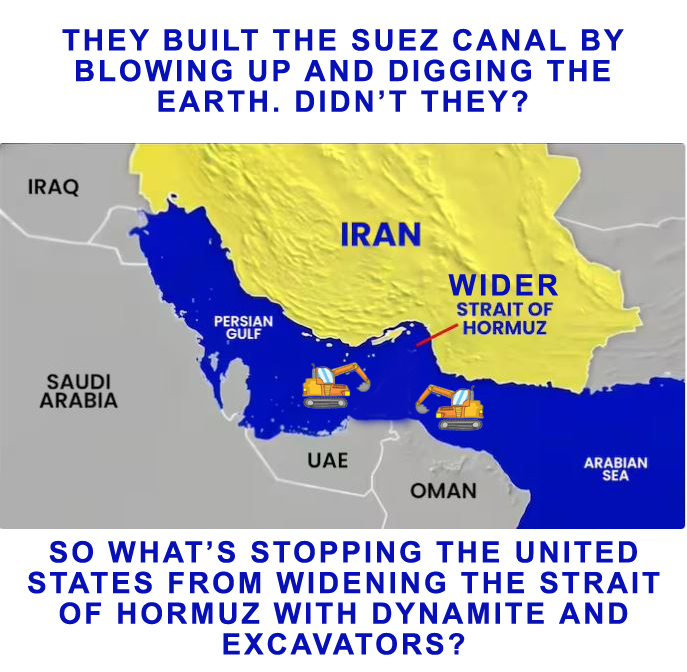
When Iran blocked the Strait of Hormuz, the world was reminded of how geography can still overpower globalization. The Strait is just 33 kilometers wide at its narrowest navigable channel, a span shorter than the daily commute of millions of urban workers. Yet through this thin maritime artery flows roughly a fifth of the world’s petroleum liquids, much of it destined for Asia’s energy-hungry economies. Tankers from Saudi Arabia, Iraq, Kuwait, the United Arab Emirates, and Qatar must funnel through this corridor between Iran to the north and Oman and the United Arab Emirates to the south. The closure or even the threat of closure instantly rattles markets from Mumbai to Tokyo. The chokepoint has long been a strategic obsession for naval planners, energy economists, and policymakers, and it has featured prominently in the strategic doctrines of both Tehran and Washington. The question now posed in frustration, why not simply widen the Strait with dynamite and excavators, submerge donated land from the UAE and Oman, and permanently defang the chokehold, invites a bold thought experiment. If the Strait were widened significantly, what would the future look like? Would a broader channel neutralize coercion, stabilize oil markets, and transform Gulf geopolitics? Or would it create new fault lines, environmental upheavals, and security dilemmas? The idea sounds deceptively simple, but its implications are vast and multi-layered.
The geography and the legal architecture of the strait
The Strait of Hormuz connects the Persian Gulf to the Gulf of Oman and onward to the Arabian Sea. It is bordered by Iran on one side and Oman’s Musandam Peninsula and the United Arab Emirates on the other. The navigable shipping lanes are in fact far narrower than the total 33-kilometer width; traffic separation schemes designate inbound and outbound lanes only a few kilometers wide, separated by buffer zones. International maritime law, especially the regime of transit passage under the United Nations Convention on the Law of the Sea, guarantees ships the right of passage through such straits used for international navigation. Yet law depends on compliance and deterrence. Iran has periodically threatened to close the Strait during times of heightened tension, particularly in response to sanctions. The United States Fifth Fleet, headquartered in Bahrain, has maintained a persistent presence to deter such action. Widening the Strait would not merely be a matter of blasting rock; it would require redrawing maritime boundaries, renegotiating sovereign rights, and re-engineering shipping lanes that are already embedded in international law and naval doctrine. Any submergence of territory donated by the UAE or Oman would alter baselines, exclusive economic zones, and possibly continental shelf claims. In short, it would trigger a cascade of legal recalculations extending far beyond the Gulf.
Engineering the impossible or merely the expensive
From an engineering perspective, widening a marine strait is not without precedent in concept. Humans have dug canals such as the Suez Canal and the Panama Canal, reshaping global trade routes. More recently, Egypt expanded sections of the Suez to allow two-way traffic in certain stretches. China has built entire artificial islands in the South China Sea. The Netherlands has reclaimed land from the ocean for centuries. The Gulf itself is no stranger to ambitious reclamation projects; Dubai’s palm-shaped islands stand as monuments to marine engineering bravado. In theory, excavators and dredgers could deepen and widen channels, and land could be deliberately submerged to create a broader maritime corridor. Yet the Strait of Hormuz is not a shallow lagoon; it is a dynamic marine environment with complex currents, deep channels, and ecological sensitivity. Massive dredging would disturb seabeds, alter tidal flows, and potentially affect salinity gradients in the Persian Gulf, which is already one of the most saline bodies of water on Earth. The cost would likely run into hundreds of billions of dollars, with ongoing maintenance dredging required to prevent sedimentation. Moreover, any such project would unfold under the watchful eyes of regional powers, global navies, and environmental watchdogs.
Environmental consequences in a fragile marine ecosystem
The Persian Gulf is semi-enclosed and shallow, with limited water exchange through the Strait of Hormuz. Altering the Strait’s width and depth could change the hydrodynamics of the entire Gulf basin. Increased water exchange might lower salinity levels, affecting marine species adapted to high-salinity conditions. Coral reefs, seagrass beds, and fisheries could be disrupted. The Gulf’s coastal economies depend not only on oil but also on desalination plants that draw seawater for fresh water production. Changes in currents and sediment loads could impair desalination infrastructure. Oil spills, already a risk in such a heavily trafficked corridor, could spread differently under altered flow regimes. Climate change adds another layer of uncertainty, with rising sea levels and warming waters stressing marine life. Environmental impact assessments for a project of this magnitude would be unprecedented in scope. They would require cooperation among states that often distrust one another. The environmental dimension alone could delay or derail any plan to widen the Strait.
Geopolitical recalibration and the Iranian response
If the Strait were widened significantly, Iran would face a strategic dilemma. Its leverage over global energy markets stems partly from the chokepoint’s narrowness. A broader corridor might dilute that leverage, making it harder to interdict or threaten shipping effectively. Yet Iran could respond asymmetrically. It has invested heavily in anti-ship missiles, naval mines, and fast attack craft. A wider Strait would require more extensive patrols by foreign navies, potentially increasing the footprint of the United States and its allies. Tehran might perceive the project as a hostile act designed to neutralize its strategic card, prompting escalation. Conversely, if Iran were included in the planning and benefited economically from construction contracts and transit fees, it might see the widened Strait as an opportunity for regional integration. The outcome would depend on whether the project emerged from confrontation or cooperation.
The economics of energy security
The immediate market reaction to a blockade of the Strait of Hormuz is a spike in oil prices. Traders price in risk premiums, insurers raise rates, and shipping companies reroute vessels where possible. A permanently widened and perhaps deepened Strait could reduce perceived risk and thus lower the structural risk premium embedded in oil prices. Over time, this might stabilize energy markets and benefit import-dependent economies such as India, Japan, and South Korea. However, energy markets are complex and influenced by far more than physical chokepoints. The rise of U.S. shale production, diversification of supply routes, and the gradual shift toward renewable energy all shape long-term trends. A widened Strait might marginally reduce volatility, but it would not eliminate geopolitical risk. Moreover, lower risk premiums could reduce revenues for Gulf producers accustomed to price spikes during crises. The economic calculus is therefore mixed.
The role of alternative pipelines and redundancy
Gulf states have already sought to bypass the Strait through pipelines. Saudi Arabia’s East-West Pipeline runs from its oil fields to the Red Sea. The United Arab Emirates operates a pipeline from Abu Dhabi to the port of Fujairah on the Gulf of Oman, outside the Strait. These infrastructures provide partial redundancy but cannot fully replace maritime exports. A widened Strait might reduce the urgency of further bypass projects. Alternatively, it could complement them, creating a multi-layered resilience architecture. Energy security in the future may hinge less on any single corridor and more on redundancy across pipelines, shipping lanes, and storage facilities. In that sense, widening the Strait could be one component of a broader strategy rather than a silver bullet.
Naval strategy in a broader corridor
For naval planners, a wider Strait would change operational geometry. Currently, the narrow lanes concentrate traffic, making surveillance and escort missions more manageable but also increasing vulnerability to mines and missile attacks. A broader corridor would disperse traffic, complicating surveillance but reducing the effectiveness of certain denial tactics. The United States Navy and allied forces might need more assets to patrol a larger area. Iran’s anti-access/area-denial strategy would have to adapt. The Gulf could see an arms race in unmanned systems, with drones and autonomous vessels monitoring expanded waters. Maritime domain awareness would become even more critical. The strategic chessboard would not disappear; it would simply expand.
Legal disputes and maritime boundaries
Submerging land donated by the UAE and Oman would alter coastlines, potentially affecting baselines from which territorial seas are measured. Under international law, changes to coastlines can influence maritime entitlements. Iran might challenge any redrawing of boundaries, especially if it perceives a loss of relative control. Negotiations would likely involve not only the immediate littoral states but also major maritime powers concerned with freedom of navigation. The project could become a test case for how international law adapts to deliberate geographic alteration. Would submerged land still count toward baselines? Would artificial modifications carry the same legal weight as natural coastlines? These questions could reverberate beyond the Gulf, influencing disputes in other strategic waterways.
The environmental technology revolution
If such a project were undertaken in the 2030s or 2040s, it would likely leverage advanced environmental technologies. AI-driven modeling could simulate hydrodynamic changes before excavation begins. Autonomous dredgers could minimize ecological disruption. Carbon-neutral construction methods might mitigate climate impact. The Gulf states, flush with sovereign wealth funds, could position the project as a showcase of sustainable mega-engineering. This could align with their broader diversification strategies under national visions aimed at reducing dependence on oil. The irony would be palpable: widening a strait to secure oil flows while proclaiming a commitment to a post-oil future. Yet such contradictions often define transitional eras.
Regional cooperation or fragmentation
A widened Strait could either foster unprecedented regional cooperation or deepen fragmentation. If conceived as a multilateral project involving Iran, Oman, the UAE, Saudi Arabia, and external stakeholders, it might serve as a confidence-building measure. Joint management authorities could oversee navigation, environmental monitoring, and security. Shared economic benefits might incentivize stability. Alternatively, if pursued by a subset of states without Iran’s consent, it could entrench rival blocs. The Gulf has oscillated between cooperation and rivalry for decades. The future scenario hinges on whether widening the Strait is framed as a collective insurance policy or a strategic gambit.
Impact on global trade patterns
Beyond petroleum, the Strait of Hormuz also carries liquefied natural gas, particularly from Qatar, one of the world’s largest LNG exporters. A wider Strait could reassure long-term LNG buyers and encourage further investment in gas infrastructure. It might also influence shipping insurance markets and freight rates. Over decades, such incremental changes could subtly reshape global trade patterns. Asian economies, heavily dependent on Gulf energy, might deepen their economic ties to the region. China’s Belt and Road Initiative could integrate a widened Strait into its maritime silk road narrative. The European Union, seeking diversified energy supplies, might view the project as enhancing resilience.
Climate transition and the paradox of permanence
Yet the energy transition looms large. By mid-century, global oil demand may plateau or decline under aggressive decarbonization scenarios. Investing colossal sums to widen a strait primarily for oil shipments could appear shortsighted if demand wanes. On the other hand, petrochemicals and aviation may sustain oil flows longer than anticipated. Moreover, LNG could serve as a transition fuel. The paradox is that infrastructure built for permanence may outlast the era it was designed to secure. Policymakers would have to weigh long-term demand forecasts against immediate security imperatives.
Societal perceptions and symbolism
The Strait of Hormuz is more than a shipping lane; it is a symbol of vulnerability. Widening it would carry psychological weight. Markets might interpret the project as a declaration that chokepoint coercion is obsolete. Populations in energy-importing countries might feel more secure. Conversely, nationalist voices in Iran might portray it as an attempt to erase a natural advantage bestowed by geography. Symbols matter in geopolitics. The narrative surrounding the project could shape its success as much as its engineering.
Technological disruption and autonomous shipping
Looking further ahead, autonomous shipping and digital maritime corridors could transform how traffic moves through the Strait. A wider corridor might facilitate segregated lanes for human-operated and autonomous vessels. Smart buoys and satellite monitoring could optimize routing in real time. The Gulf could become a laboratory for next-generation maritime logistics. If so, widening the Strait would not merely be about adding physical space but about reimagining maritime governance in a digital age.
Risk displacement rather than elimination
One must also consider the possibility that widening the Strait merely displaces risk rather than eliminating it. Adversaries might target ports, pipelines, or offshore platforms instead. Cyberattacks on shipping management systems could disrupt flows without firing a shot. Energy security is multifaceted; geography is only one dimension. A broader Strait might reduce the probability of a classic blockade but not the spectrum of hybrid threats.
The financial architecture of a mega-project
Financing such an undertaking would require unprecedented collaboration among sovereign wealth funds, multilateral development banks, and private investors. The Gulf states possess significant capital reserves. They could frame the project as an investment in global stability, attracting co-financing from major energy consumers. Construction contracts would be lucrative, drawing global engineering firms. Yet cost overruns, corruption risks, and political disputes could plague the process. The governance model would be as important as the bulldozers.
A wider strait, a wider world
If the Strait of Hormuz were widened through deliberate engineering and territorial concessions, the future would not be a simple story of liberation from a chokepoint. It would be a complex reconfiguration of law, ecology, strategy, and economics. Oil markets might stabilize somewhat, but geopolitical rivalry would adapt. Environmental systems would shift in unpredictable ways. Legal doctrines would be tested. The Gulf could either become a model of cooperative mega-engineering or a theater of intensified competition. Geography would be reshaped, but power politics would endure. The fantasy of dynamite and excavators solving a strategic dilemma underestimates the intricate web of consequences that follow any alteration of nature at such scale. A wider Strait might reduce one form of vulnerability, yet it would open a broader arena in which states contest influence. In the end, the question is not only whether humans can widen a 33-kilometer passage, but whether they can widen the political imagination required to manage the world that would follow.

