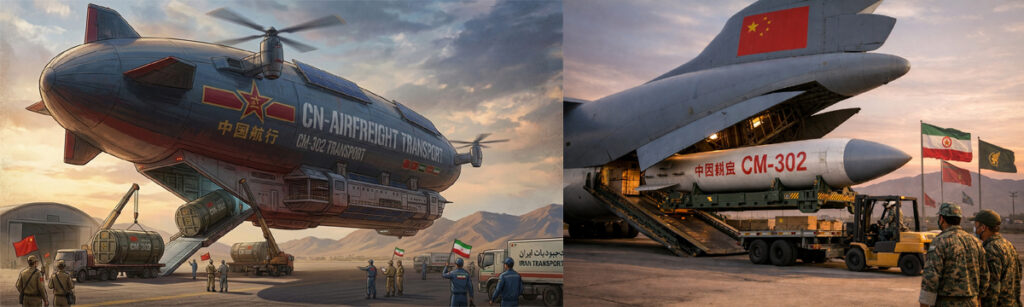
The CM-302 missile, marketed by China Aerospace Science and Industry Corporation as a high-performance anti-ship weapon, reportedly has a range of roughly 290 kilometres and travels at supersonic speeds while skimming low over the sea to evade radar detection. Such characteristics make it particularly challenging for naval air-defence systems to intercept
China’s accelerating military embrace of Iran is rapidly reshaping the strategic geometry of West Asia, hardening blocs and paradoxically pushing America’s Arab partners into closer security coordination with Washington at a moment of extraordinary volatility. Reports that Beijing is supplying Tehran with attack drones, advanced air defence systems, and is nearing agreement on the sale of supersonic and even hypersonic anti-ship missiles come as the United States masses formidable naval power off Iran’s coastline. The convergence of these developments has injected a new intensity into an already combustible regional confrontation, with implications stretching from the Persian Gulf to global energy markets and the wider contest among great powers.
A new phase in China–Iran military ties
The reported near-completion of a deal for the Chinese-made CM-302 anti-ship cruise missile marks a significant milestone in the evolving defence relationship between China and Iran. Negotiations, said to have begun at least two years ago, appear to have accelerated sharply after the 12-day conflict between Israel and Iran in June. That brief but intense war, which saw significant degradation of Iranian military assets, exposed vulnerabilities in Tehran’s deterrent posture and underscored the need for replenishment and technological upgrades.
The CM-302, marketed by China Aerospace Science and Industry Corporation as a high-performance anti-ship weapon, reportedly has a range of roughly 290 kilometres and travels at supersonic speeds while skimming low over the sea to evade radar detection. Such characteristics make it particularly challenging for naval air-defence systems to intercept. If deployed along Iran’s southern coastline or mounted on mobile launchers, aircraft, or ships, the missile would extend Tehran’s ability to threaten surface vessels operating in the Strait of Hormuz, the Gulf of Oman, and even the northern Arabian Sea.
The reported talks have also included discussions over more sophisticated systems, including the DF-17 hypersonic glide missile. The DF-17, developed by China, combines a ballistic booster with a manoeuvrable glide vehicle capable of travelling at hypersonic speeds—well above Mach 5—while performing evasive manoeuvres during its terminal phase. Unlike traditional ballistic missiles that follow a predictable arc, hypersonic glide vehicles can alter course, compressing reaction times for defenders and complicating interception by systems such as the Aegis combat system deployed aboard American destroyers and cruisers.
Although it remains unclear whether a DF-17 sale will materialise, even serious negotiations represent a qualitative shift. China has historically been cautious in transferring complete advanced missile systems to Iran, particularly after international scrutiny intensified in the 1990s and early 2000s. But the current environment—characterised by deteriorating U.S.–China relations, renewed sanctions on Iran, and deepening Sino-Russian strategic coordination—appears to be loosening those restraints.
Drones, air defence and the layered approach
Alongside the missile discussions, officials familiar with the matter have described deliveries of loitering munitions—often called “kamikaze drones”—as well as additional surface-to-air missile systems. Systems such as the HQ-16 and HQ-17AE reportedly form part of Iran’s growing inventory of Chinese-supplied air defence assets. These platforms, designed to intercept aircraft, cruise missiles, and in some configurations precision-guided munitions, could bolster Iran’s ability to defend key facilities against air strikes.
The significance of loitering munitions should not be underestimated. They provide a relatively low-cost but flexible offensive capability, capable of hovering over a battlefield before diving onto a target. Their proliferation across multiple conflict zones—from Eastern Europe to Africa—has demonstrated their disruptive potential against conventional forces. For Iran, which has developed its own drone industry and supplied unmanned systems to partners across the region, the acquisition of additional or more advanced Chinese variants could augment its swarm tactics and saturate enemy defences.
Iran is also believed to be exploring the acquisition of man-portable air defence systems (MANPADS), anti-ballistic missile technology, and possibly anti-satellite capabilities. Such a layered approach—combining offensive anti-ship missiles, hypersonic systems, drones, and enhanced air defence—suggests a comprehensive effort to rebuild and modernise capabilities eroded during last year’s conflict.
The American armada and the shadow of escalation
These developments unfold as the United States assembles a formidable naval presence near Iran. The aircraft carrier USS Abraham Lincoln and its strike group have been deployed within striking distance, while the USS Gerald R. Ford and its escorts are heading to the region. Together, the two carrier strike groups represent more than 5,000 personnel and roughly 150 aircraft, a concentration of maritime airpower that signals both deterrence and readiness for sustained operations.
The presence of these carriers serves multiple purposes. It reassures regional partners, underscores American resolve, and provides a flexible platform for air strikes should diplomacy fail. Yet it also creates a high-value target set. Supersonic or hypersonic anti-ship missiles in Iranian hands would be explicitly designed to challenge the survivability of such capital ships.
President Donald Trump has publicly warned that Iran faces a stark choice: negotiate over its nuclear programme or confront severe consequences. Deadlines and rhetoric have heightened the sense that military action is not merely theoretical. Reports that the United States is preparing for the possibility of sustained, weeks-long operations against Iran amplify the stakes.
In this context, Chinese military support to Iran is not a marginal factor but a central variable. Even the perception that Tehran’s anti-ship and air-defence capabilities are improving could influence American operational planning, rules of engagement, and escalation thresholds.
Energy chokepoints and market tremors
The strategic significance of the Gulf region lies not only in military geometry but also in energy flows. The Strait of Hormuz remains one of the world’s most critical chokepoints, through which a substantial share of global oil and liquefied natural gas transits. Any credible threat to shipping—whether from mines, drones, or advanced anti-ship missiles—immediately reverberates through energy markets.
Recent disruptions, including shutdowns of major refining and LNG facilities in the broader region, have already heightened anxiety. If Iran were to field supersonic or hypersonic missiles capable of targeting tankers or naval escorts, insurers would raise premiums, shipping routes could be altered, and prices would spike. Even absent actual strikes, the mere risk environment can generate volatility.
China’s own economic calculus is complex. Beijing is a major importer of Iranian crude, with estimates suggesting that a vast majority of Iran’s oil exports flow to Chinese buyers, often through intermediaries. By strengthening Iran’s defensive and offensive capacities, China may be seeking to stabilise a key energy partner against regime-threatening external pressure. At the same time, China has little interest in a full-scale war that would choke off energy supplies and destabilise global markets on which its export-driven economy depends.
The unintended unification of America’s Arab allies
Ironically, China’s stepped-up support for Iran may be reinforcing cohesion among America’s Arab partners. Gulf monarchies have long harboured deep mistrust of Tehran’s regional ambitions, missile programme, and network of allied militias. Missile and drone strikes attributed to Iran or its partners in recent years have directly targeted energy infrastructure in countries such as Saudi Arabia and the United Arab Emirates.
As Iran’s arsenal becomes more sophisticated—with potential supersonic and hypersonic capabilities—the threat perception intensifies. This has the effect of tightening security coordination with Washington, even among states that have in recent years sought to diversify their partnerships and hedge between great powers.
Joint air-defence integration, intelligence sharing, and maritime patrols are likely to deepen. The spectre of Iranian missiles capable of reaching across the Gulf or targeting shipping lanes reinforces the rationale for closer operational ties with the United States. In this sense, China’s attempt to bolster Iran may inadvertently consolidate a pro-American security architecture among Arab states wary of Tehran’s enhanced reach.
The Russia factor and the great power overlay
China’s moves cannot be viewed in isolation from Russia’s posture. Moscow, itself under extensive Western sanctions, has cultivated closer ties with Tehran, including reported drone acquisitions for use in other theatres. Annual joint naval exercises among China, Iran, and Russia signal an emerging alignment that challenges U.S. primacy.
This triangular cooperation transforms regional disputes into nodes within a broader great power contest. If American carriers were directly targeted by advanced Chinese-origin missiles operated by Iran, the political ramifications would extend far beyond the Gulf. Questions would arise regarding Beijing’s responsibility, escalation management, and the risk of horizontal widening into other theatres, including the Indo-Pacific.
European powers, too, are drawn into the equation. The United Kingdom, France, and Germany have strategic interests in maintaining secure energy transit routes and upholding non-proliferation norms. Their deliberations over potential involvement in securing sea lanes reflect concern that a regional conflict could metastasise into a wider confrontation affecting global trade and security.
Sanctions, legality and diplomatic fallout
The reported missile transfers would defy the spirit, if not the letter, of United Nations arms restrictions first imposed on Iran in 2006, suspended in 2015 under the nuclear agreement, and later reimposed. China, along with Russia, has criticised the reimposition of sanctions, arguing that the legal basis is flawed. This legal dispute provides Beijing with diplomatic cover to maintain or expand military ties with Tehran.
Washington, for its part, has sanctioned Chinese entities in the past for supplying missile-related materials and chemical precursors to Iranian programmes. Should complete missile systems be transferred, pressure for additional sanctions would intensify. Such measures could further strain already fraught U.S.–China relations, adding a Middle Eastern layer to disputes over trade, technology, Taiwan, and the South China Sea.
Diplomatically, China frames its relationship with Iran as support for sovereignty and resistance to external coercion. President Xi Jinping has publicly expressed backing for Iran’s territorial integrity and national dignity. For Tehran, Chinese support provides not only matériel but also political symbolism: evidence that it is not isolated and that major powers contest American pressure.
Hypersonic reality or psychological warfare?
One of the most consequential yet uncertain elements of the reports concerns hypersonic systems. Hypersonic missiles have acquired near-mythic status in strategic discourse, often portrayed as “game-changers” that render existing defences obsolete. In reality, while they pose significant challenges, their operational effectiveness depends on integration, targeting data, command and control resilience, and training.
If Iran were to acquire a system akin to the DF-17, questions would arise regarding technology transfer depth. Would China provide only hardware, or also training, maintenance support, and integration assistance? Would Iran adapt the system to its own doctrinal preferences? And how would regional missile defence architectures respond?
There is also the possibility that discussion of hypersonic transfers serves a signalling function. By amplifying uncertainty about its capabilities, Iran may seek to deter adversaries and complicate their planning without necessarily fielding large numbers of such weapons. In high-stakes confrontations, perception management can be nearly as important as physical inventory.
Yemen, the Red Sea and the widening arc
Warnings from actors in Yemen about targeting coalition vessels in the Red Sea underscore the risk of horizontal escalation. If Iranian-aligned groups were to receive more advanced drones or missile technologies, the maritime threat environment could expand beyond the Persian Gulf. The Bab el-Mandeb strait, another crucial chokepoint linking the Red Sea to the Gulf of Aden, would become even more sensitive.
Such developments would stretch American and allied naval resources, requiring persistent patrols across multiple theatres. They would also heighten insurance costs and disrupt commercial shipping routes, with cascading economic effects.
A battlefield between systems
One official reportedly described Iran as becoming a battlefield between the United States on one side and Russia and China on the other. This characterisation captures the structural reality: local conflicts are increasingly embedded within systemic rivalry. Military hardware transfers, sanctions regimes, energy flows, and diplomatic alignments intersect in complex ways.
For the United States, the challenge lies in deterring Iran while avoiding a direct clash with China. For China, the calculus involves supporting a partner and countering U.S. influence without triggering a confrontation that could damage its broader strategic interests. For Iran, the objective is regime survival, deterrence credibility, and leverage in negotiations over its nuclear programme.
The road ahead
As deadlines loom and naval forces manoeuvre, the margin for miscalculation narrows. A single missile launch—whether intentional, accidental, or misattributed—could ignite rapid escalation. Advanced systems such as supersonic and hypersonic anti-ship missiles compress decision times, increasing the risk that commanders act on incomplete information.
Yet there remains space for diplomacy. Military buildups often serve coercive bargaining strategies, signalling resolve while leaving room for negotiated outcomes. China’s involvement could, paradoxically, create leverage for de-escalation if Beijing judges that stability better serves its interests than confrontation.
What is clear is that the reported transfers of drones, air defences, and advanced missiles mark a turning point. They deepen China–Iran military ties, intensify great power competition in West Asia, and solidify threat perceptions among America’s Arab allies. In attempting to fortify Iran against American pressure, Beijing may be accelerating the very alignment it seeks to counter: a more unified, tightly coordinated U.S.–Arab security bloc determined to preserve maritime dominance and deter Iranian expansion.
The Gulf thus stands at a precarious juncture. Supersonic trajectories and hypersonic glide paths are no longer abstract technological concepts but tangible factors in strategic calculations. Whether they culminate in confrontation or catalyse renewed negotiation will depend on decisions taken in Washington, Beijing, Tehran, and regional capitals in the weeks and months ahead.