
According to government data from UDISE (Unified District Information System for Education), in the last ten years, 93,000 schools have shut down, school enrolment has fallen by 2.41 crore students. In 2015, 20.7% of India’s population was enrolled in schools. In 2025, it is at 16.8%
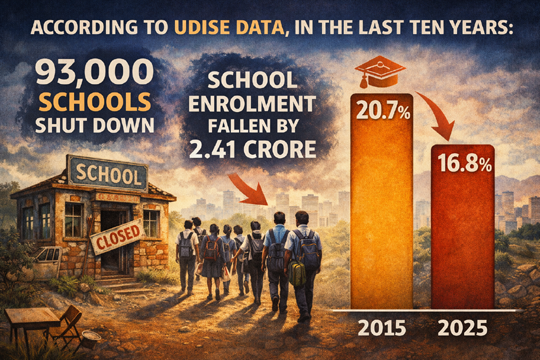
The great illusion of the demographic dividend: For over two decades, India has celebrated the idea of a “demographic dividend.” The argument has been simple and optimistic: a young population means a productive workforce; a productive workforce means accelerated economic growth; and accelerated growth means prosperity. But what if the dividend was misunderstood? What if the numbers tell a different story — one not of opportunity but of erosion? According to government data from UDISE (Unified District Information System for Education), the foundation of India’s demographic promise — its schooling system — is weakening. In the last ten years:
- 93,000 schools have shut down.
- School enrolment has fallen by 2.41 crore students.
- India’s population has increased by 15.4 crore people.
In 2015, 20.7% of India’s population was enrolled in schools. In 2025, that number has dropped to 16.8%. That is a 19% decline in school enrolment as a proportion of population in just one decade. These are not opposition claims. These are not private estimates.
These are government figures. If a demographic dividend depends on educated, skilled youth — what happens when fewer children are in school despite a rapidly rising population? That is not a dividend. That is a warning.
When the base weakens, the pyramid collapses
Demographic dividend theory assumes three critical conditions:
- A large working-age population.
- Rising educational attainment.
- Expanding employment opportunities.
India may still have the first condition — a large working-age population — but the second condition is visibly eroding. When school enrolment declines in absolute numbers while population rises sharply, the structural base of future productivity weakens. The arithmetic is sobering. If population rises by 15.4 crore but enrolment drops by 2.41 crore, then millions of additional children are either:
- Never entering school,
- Dropping out early,
- Or disappearing from formal education systems.
Each child outside school represents:
- Lower future income,
- Lower productivity,
- Lower tax contribution,
- Higher risk of unemployment or informal labour,
- Greater social instability.
A demographic dividend without education becomes a demographic burden.
The closure of 93,000 schools: Silent systemic collapse
The closure of 93,000 schools in ten years is not administrative housekeeping. It signals structural distress. Schools close for several reasons:
- Falling enrolment,
- Budget consolidation,
- Teacher shortages,
- Migration patterns,
- Rural depopulation,
- Urban informal expansion without adequate schooling infrastructure.
But 93,000 closures nationwide indicate something deeper. Education infrastructure is shrinking while population is expanding. The contradiction is stark. If India truly expected to capitalise on its youth bulge, it would be expanding classrooms, not shutting them down. Compare this to East Asian nations during their demographic transitions:
- South Korea massively expanded schooling before industrial takeoff.
- China invested heavily in basic literacy before becoming a manufacturing powerhouse.
- Vietnam ensured high literacy rates before entering global supply chains.
India risks entering peak working-age years without universal educational preparedness.
The drop from 20.7% to 16.8%: A 19% proportional collapse
The decline from 20.7% to 16.8% enrolment as a share of total population may appear abstract, but the implications are profound. A 19% drop in schooling proportion over a decade means:
- The education system is not keeping pace with population growth.
- Birth rates among poorer segments may be outstripping institutional capacity.
- Dropout rates may be rising after primary stages.
- Migration patterns may be disrupting schooling continuity.
- Economic pressures may be pushing children into work.
Demographic dividend theory depends on a rising skill base. Instead, this data suggests a thinning educational pipeline. If fewer children are in school relative to population, then future labour quality declines relative to labour quantity. Quantity without quality does not generate prosperity.
Population growth without human capital growth
India’s population increase of 15.4 crore in ten years is equivalent to adding a country the size of Japan. Population growth is not inherently negative. It becomes problematic when:
- Educational infrastructure stagnates.
- Employment generation lags.
- Skill development remains inadequate.
- Public health systems are strained.
Without proportional expansion in human capital investment, rapid population growth magnifies inequality.
The demographic dividend narrative assumed:
- More workers.
- Better skills.
- More productivity.
The emerging numbers suggest:
- More people.
- Fewer in formal education.
- Greater risk of informalisation.
That trajectory leads to underemployment, not innovation.
The global lesson: Demography is a window, not a guarantee
Countries that benefited from demographic dividends did three things simultaneously:
- Universalised schooling.
- Rapidly expanded manufacturing and industry.
- Integrated into global value chains.
China’s demographic dividend was accompanied by near-universal primary and secondary education. South Korea’s dividend followed decades of educational expansion. Ireland’s economic transformation was supported by aggressive higher education reform. Demography alone never created prosperity. Education converted demography into productivity. If schooling proportion falls while population rises, the dividend window narrows — or even reverses.
The employment time bomb
India already faces youth unemployment concerns. If enrolment falls today, the labour market will face consequences in 5–15 years:
- Larger cohorts with incomplete schooling.
- Higher dropout-driven informal labour.
- Lower employability in technology-intensive sectors.
- Greater vulnerability to automation.
The global economy is becoming skill-intensive. Artificial intelligence, automation, robotics, biotech, and green energy demand higher education levels. If the schooling base shrinks proportionally, India risks being trapped in low-value economic segments. A young population without adequate education does not become an innovation engine. It becomes a pressure point.
Rural India: The invisible epicenter
School closures disproportionately affect rural areas. When a rural school shuts down:
- Children must travel longer distances.
- Dropout rates increase.
- Girls’ education suffers more severely.
- Poor families disengage.
Rural schooling collapse translates into rural stagnation. Urban India cannot absorb an uneducated rural youth surge. Migration without skill becomes precarious survival, not upward mobility. The demographic nightmare, if it unfolds, will likely begin in rural districts.
The informalisation risk
India already has a high informal employment share. Lower schooling enrolment may increase:
- Child labour,
- Early workforce entry,
- Informal sector dependency,
- Low wage traps.
Informality limits tax revenue, social security coverage, and productivity growth. Without educational strengthening, demographic expansion feeds informalisation and informalisation suppresses per capita income growth.
Gendered consequences
Declining enrolment ratios can have gendered impacts. Girls are often the first withdrawn from school when:
- Schools close nearby,
- Household income drops,
- Distance increases,
- Safety concerns rise.
Female labour force participation in India is already low. Reduced schooling may further weaken women’s economic empowerment. Demographic dividend narratives often ignore gender dynamics.
Demographic nightmares amplify them.
Fiscal strain and social tension
A large, undereducated youth population increases:
- Welfare demands,
- Subsidy pressures,
- Public spending burdens,
- Crime vulnerability risks.
Demographic stress historically correlates with social unrest when:
- Employment opportunities are scarce,
- Aspirations exceed reality,
- Educational attainment is inadequate.
If educational participation declines while aspirations rise through digital exposure, frustration may intensify. The mismatch between ambition and opportunity becomes combustible.
The UDISE numbers: Why they matter
UDISE is not a private survey. It is government-compiled educational data. If the official database shows:
- 93,000 schools closed,
- 2.41 crore enrolment decline,
- 19% proportional drop,
then the issue is systemic, not anecdotal. Data-driven governance requires acknowledging uncomfortable trends. Demographic dividend rhetoric must confront demographic arithmetic.
The risk of complacency
India’s demographic narrative has been repeated so often that it has become an assumption. But dividends are conditional. They require:
- Policy discipline,
- Infrastructure expansion,
- Skill alignment with industry,
- Economic dynamism.
Without those, demographic bulges can become demographic burdens. Several Latin American countries experienced this phenomenon — population growth without commensurate productivity expansion. The result: middle-income stagnation. India cannot afford that trap.
Urgent steps required
If the data indicates structural decline, urgent course correction is necessary:
1. Halt School Closures: Consolidation must not become silent abandonment.
2. Expand Secondary Education: Primary enrolment gains mean little without secondary completion.
3. Strengthen Rural Education Infrastructure: Transport, digital access, teacher recruitment.
4. Incentivise Attendance: Conditional cash transfers tied to school attendance.
5. Invest Beyond 6% of GDP in Education: Global benchmarks demand sustained investment.
6. Integrate Skill Training with Schooling: Align curriculum with future labour demands.
Demographic windows close quickly. Once cohorts age out without education, recovery becomes exponentially harder.
From dividend to discipline
India’s demographic advantage is real in theory but theory collapses without discipline. If enrolment ratios decline for another decade:
- The working-age bulge will not be skilled.
- Innovation capacity will weaken.
- Per capita growth will slow.
- Inequality will widen.
Demography magnifies whatever system it enters. In a strong education system, it multiplies growth. In a weak education system, it multiplies fragility.
The moment of reckoning
India stands at a crossroads. The numbers are not abstract. They are directional signals. A population increase of 15.4 crore alongside a fall of 2.41 crore in school enrolment is not a temporary fluctuation. It is structural drift. A 19% proportional drop in schooling within a decade is not a rounding error. It is a systemic red flag. Demographic dividend is not destiny. It is conditional. Without urgent reinforcement of education infrastructure and enrolment, India risks entering peak working-age years with inadequate human capital. The demographic dividend narrative was built on hope. The UDISE data demands realism. The choice now is between complacency and correction. If action is delayed, the dividend window may close — and the demographic nightmare may define the next generation. India still has time. But not much.