
To understand the drama of Valencia versus Real Madrid is to understand two culinary identities as distinct as their footballing philosophies. One celebrates rice, olive oil, and proximity to the sea; the other embraces global sophistication, premium dining, and a city that sees itself as Spain’s capital of everything
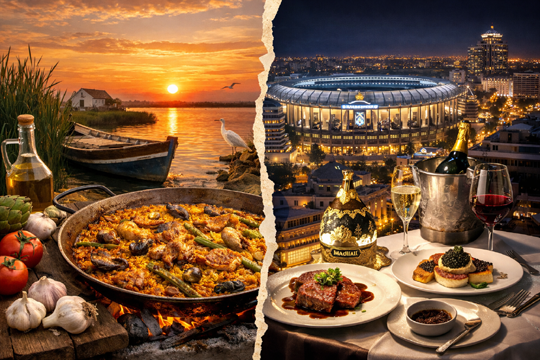
Spain has always been a country where food and football move in parallel rhythms. The same passion that animates the terraces also simmers in the kitchen. When Valencia and Real Madrid meet on the pitch, the contest is not merely athletic; it is cultural. It is Mediterranean rice fields against Castilian boulevards, rustic tradition against cosmopolitan polish. And on a recent dramatic evening, as Kylian Mbappé struck his 38th goal of the season to seal a late Real Madrid victory, those contrasts felt sharper than ever.
To understand the drama of Valencia versus Real Madrid is to understand two culinary identities as distinct as their footballing philosophies. One is rooted in the sun-drenched Albufera wetlands, the other in the grand avenues surrounding the Santiago Bernabéu. One celebrates rice, olive oil, and proximity to the sea; the other embraces global sophistication, premium dining, and a city that sees itself as Spain’s capital of everything.
This is a story of paella and prestige, of seafood and sushi, of disciplined defending and last-minute goals.
Valencia: Where Rice Is Religion
Valencia’s cuisine is not merely regional; it is elemental. It is defined by land and sea, by rice paddies that stretch toward the horizon and by fishing boats that glide into Mediterranean ports at dawn. At the heart of it all lies paella valenciana—the original, authentic version that locals guard with near-religious fervor.
The classic paella valenciana is not seafood-laden excess. It is built on chicken and rabbit, slow-cooked over fire, infused with saffron, rosemary, green beans, and garrofón (a large local lima bean). It is earthy and balanced, rustic and precise. Every ingredient has a purpose; nothing is decorative.
Rice in Valencia is not an accompaniment. It is the protagonist. The region’s short-grain varieties absorb flavor like a sponge, creating dishes that are layered yet restrained. Beyond paella valenciana, there are seafood rice dishes—arroz a banda, arroz negro infused with squid ink, and brothy arroz meloso variations that blur the line between soup and stew.
Seafood, too, carries the unmistakable stamp of the Mediterranean. Fresh prawns, mussels, red shrimp, sea bass, and octopus appear not as luxury tokens but as natural extensions of geography. Vegetables are seasonal, vibrant, and often locally grown. Tomatoes taste like sunshine. Artichokes are sweet and nutty. Citrus—particularly oranges—adds brightness to desserts and salads alike.
Olive oil binds it all together. High-quality extra virgin olive oil is not an indulgence in Valencia; it is a baseline expectation. Almonds and other nuts find their way into sauces and sweets, adding texture and healthy fats. The cuisine, taken as a whole, is deeply Mediterranean in the truest sense: ingredient-driven, heart-healthy, balanced.
There is little pretension here. Valencia’s culinary identity is grounded in tradition. Recipes pass through generations, guarded but shared within families. The flavors are honest. The technique is disciplined. The experience is communal.
In Valencia, food is not spectacle. It is belonging.
Madrid: Cosmopolitan Power Around the Bernabéu
Travel north to Madrid and the culinary atmosphere changes immediately. The capital has always absorbed influences from across Spain and beyond. Around the Santiago Bernabéu, home of Real Madrid, this cosmopolitan energy is particularly evident.
Here, dining is varied, sophisticated, and often high-end. The neighborhood caters to an international clientele—players, executives, tourists, and lifelong fans. The culinary landscape reflects that diversity.
You can find traditional Castilian roasts: cochinillo (suckling pig) with crackling skin, slow-roasted lamb carved tableside, hearty stews that speak of colder winters and inland landscapes. These dishes are rich, meat-focused, and unapologetically indulgent.
But step a few doors down and you might encounter Kabuki, a refined sushi destination known for blending Japanese technique with Spanish ingredients. Real Madrid players have been known to frequent such establishments, embracing a global palate that mirrors the club’s international roster.
Elsewhere near the Bernabéu, restaurants like Los Arroces de Segis offer premium rice dishes. Madrid may not be the birthplace of paella, but it has mastered the art of reinterpretation. Rice here is elevated, curated, and sometimes reinvented for a metropolitan audience.
Mesón Txistu, another favorite among players and executives, represents rustic elegance—meat-centric yet refined. The dining rooms feel both traditional and exclusive, designed for conversations about transfers, tactics, and titles.
The culinary environment around Real Madrid is extensive and sophisticated. It caters to high traffic and luxury expectations. The experience is often as important as the plate. Presentation, service, and ambiance are meticulously crafted.
If Valencia’s cuisine is rooted in geography, Madrid’s is rooted in ambition.
Tradition Versus Modernity
The culinary divide between Valencia and Madrid reflects a broader philosophical contrast.
Valencia embodies continuity. Its food tells a story of soil, sea, and inheritance. Even innovation there feels tethered to authenticity.
Madrid, by contrast, thrives on reinvention. It absorbs, refines, and reinterprets. It is as comfortable serving traditional Castilian dishes as it is presenting avant-garde tasting menus or pristine sashimi.
This distinction mirrors their footballing identities.
Valencia, historically, has relied on discipline, structure, and collective effort. The club’s identity is forged in resilience, often punching above its weight.
Real Madrid, meanwhile, represents glamour and global star power. The club’s brand extends far beyond Spain. Its footballing philosophy frequently blends technical brilliance with ruthless efficiency.
On a recent La Liga evening, these contrasts were on full display.
A Tense Night at the Bernabéu
Real Madrid entered the match chasing Barcelona at the top of the table. The gap was narrow—just a point—but every fixture felt decisive. A seventh straight La Liga victory would keep the pressure firmly on their Catalan rivals.
Valencia arrived in a very different situation. Seventeenth in the table, hovering just one point above the relegation zone, they were fighting for survival. Worse still, they had played a game more than the teams below them. Every point mattered. Every defensive stand was precious.
Madrid were without two key figures: the suspended Vinicius Junior and the injured Jude Bellingham. Their absence altered the rhythm of the side. There would be no explosive wing runs from Vinicius, no late-arriving midfield dominance from Bellingham.
Instead, the responsibility fell even more heavily on Kylian Mbappé.
Early Control, Limited Threat
From the outset, Real Madrid dominated possession. The ball circulated confidently across the midfield. Valencia, disciplined and compact, formed tight defensive lines.
Despite their territorial advantage, Madrid struggled to create clear chances. Stole Dimitrievski, the Valencia goalkeeper, was not immediately troubled. The home side’s build-up was methodical but lacked incision.
Arda Güler offered a flicker of creativity. His low shot was deflected wide, a reminder that Madrid’s young talents were eager to step forward. Mbappé soon tested Dimitrievski with a powerful drive, forcing the keeper into a sharp parry.
David Jimenez nearly broke the deadlock with a first-time strike, but Dimitrievski produced an even better save, tipping the ball wide of the far post.
Valencia, meanwhile, were not passive. Arnaut Danjuma, lively and direct, posed a threat on the counter. His left-footed drive was deflected wide by Raul Asencio. Lucas Beltrán flicked a Danjuma delivery just past the far post early in the second half.
The game simmered like a Valencian arroz—heat building beneath a calm surface.
Carreras Strikes
Twenty minutes into the second half, the tension broke.
Álvaro Carreras bundled his way past two defenders in a determined run that epitomized Valencia’s grit. Steering a low, right-footed effort into the net, he silenced the Bernabéu.
For Valencia, the goal was both tactical reward and psychological lifeline. For Madrid, it was a jolt.
Suddenly, possession meant little. The home crowd grew restless. Barcelona’s earlier victory over Mallorca loomed large in the background. Dropped points would widen the gap.
Beltrán almost doubled Valencia’s lead five minutes later. His first-time, left-footed effort struck the outside of the post. For a split second, Madrid hovered on the brink of crisis.
Mbappé’s Relentless Season
Great teams often lean on great individuals. This season, Real Madrid have leaned heavily on Kylian Mbappé.
Already on 37 goals before this match, the French forward has delivered with remarkable consistency. His pace, intelligence, and composure have made him the focal point of Madrid’s attack, particularly in the absence of other stars.
As the match ticked into stoppage time, Madrid poured forward with urgency. Crosses were delivered with increasing desperation. Valencia’s defenders threw themselves into blocks and clearances.
Then the decisive moment arrived.
A low cross zipped into the box. Mbappé timed his movement perfectly and converted, driving the ball home to secure his 38th goal of the season.
The Bernabéu erupted. The comeback was complete.
One Point Apart
The victory ensured that Real Madrid matched Barcelona’s result from the previous day. The title race remained razor-thin—just one point separating the two giants.
For Madrid, the significance extended beyond the three points. It was a statement of resilience. Without Vinicius and Bellingham, they had found a way.
For Valencia, the defeat was painful. They remained 17th, only one point above the bottom three. With an extra game played, their margin for error shrank further.
The contrast in fortunes could not have been starker. One club chased glory; the other fought to survive.
Culinary Echoes of the Match
The narrative of this game mirrors the culinary identities of both cities.
Valencia approached the match like a traditional paella—carefully structured, ingredient-driven, patient. They relied on organization and authenticity. Carreras’ goal felt like the perfect socarrat—the crisp, caramelized layer at the bottom of the pan—earned through disciplined cooking.
Madrid, on the other hand, embodied their cosmopolitan dining scene. When the standard recipe faltered, they reached into a global pantry of talent. Mbappé’s late strike was akin to a chef adding a luxurious finishing touch—unexpected yet decisive.
Even the rhythm of the game felt culinary. Slow build-up, bursts of heat, a dramatic finale.
The Health of a League
Spanish football thrives on such contrasts. Just as Spain’s culinary diversity strengthens its global reputation, its footballing variety enriches La Liga.
Valencia’s Mediterranean identity is as essential to the league’s character as Real Madrid’s glamour. The rustic and the refined coexist, each sharpening the other.
The same can be said of food culture. A country that offers both authentic paella by the sea and Michelin-starred innovation in the capital is stronger for it.
Survival and Supremacy
As the season progresses, the stakes for both clubs remain immense.
Real Madrid’s pursuit of Barcelona demands consistency. Every late goal, every narrow victory, builds psychological momentum. Mbappé’s scoring streak has become a narrative thread tying the campaign together.
Valencia, meanwhile, must transform narrow defeats into points. Defensive solidity alone may not suffice. Like a recipe missing a final seasoning, their performances require a touch more sharpness in decisive moments.
The relegation battle is unforgiving. Unlike a culinary rivalry, it offers no aesthetic consolation.
A Shared Passion
Despite their differences, Valencia and Madrid share something fundamental: passion.
In Valencia, families gather around paella pans on Sundays, debating line-ups as saffron threads bloom in broth. In Madrid, supporters dine near the Bernabéu before marching into the stadium, anticipation thick in the air.
Food and football intertwine in both cities. Victories taste sweeter. Defeats linger like overcooked rice.
Two Tables, One Drama
Valencia offers a deeply traditional Mediterranean experience—rooted, authentic, and heart-healthy. Real Madrid’s culinary scene reflects diversity, luxury, and modernity.
On the pitch, those identities find new expression. Valencia defend with structure and resilience. Real Madrid attack with global flair and individual brilliance.
In the end, it was Mbappé’s late goal that separated them—just as a final garnish can transform a dish. The gap at the top of La Liga remains one point. The gap at the bottom is just as narrow.
Spain’s culinary and footballing landscapes continue to evolve, shaped by history, ambition, and passion. Whether savoring paella by the Mediterranean or dining in the shadow of the Bernabéu, one truth endures: in Spain, flavor and football are inseparable. And sometimes, both are decided in the final minute.