
Employees do not own IP. This structural divide is visible in Silicon Valley, Shenzhen, Munich, Tokyo. It is also visible in the migration of engineers and scientists from Karnataka, Andhra Pradesh, Telangana, Tamil Nadu, Delhi-NCR, and Kerala to the United States and Europe. They contribute immensely to technological breakthroughs abroad. Yet the patents they generate typically belong to corporations headquartered elsewhere
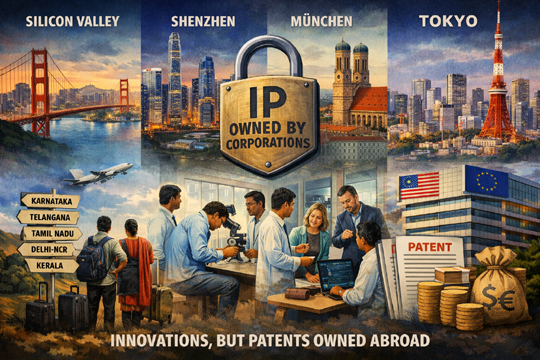
The ownership divide: Talent creates, capital accumulates. Across the world, laboratories hum with the ideas of brilliant engineers and scientists who experience “Eureka” moments — flashes of insight that reshape industries. Yet in the modern corporate system, those moments rarely belong to the individuals who conceive them. They belong to the employer. More precisely, they belong to the shareholders of the employer.
In a globalised economy structured around intellectual property (IP), ownership determines destiny. The engineer receives a salary, a bonus, perhaps stock options. The shareholder receives compounding returns as patents are monetised over decades. The inventor’s brilliance fuels innovation; the IP owner captures the geometric growth.
This structural divide is visible everywhere — in Silicon Valley, in Shenzhen, in Munich, in Tokyo. It is also visible in the migration of engineers and scientists from Karnataka, Andhra Pradesh, Telangana, Tamil Nadu, Delhi-NCR, and Kerala to the United States and Europe. They contribute immensely to technological breakthroughs abroad. Yet the patents they generate typically belong to corporations headquartered elsewhere.
In the 21st century, wealth creation flows not from labour alone, but from IP ownership. Nations that understand this rule prosper disproportionately. Those that export talent but not ownership risk remaining suppliers of intellectual labour rather than beneficiaries of intellectual capital.
The global IP economy: Why patents matter more than ever
The 20th century was dominated by industrial capital — steel mills, oil wells, assembly lines. The 21st century is dominated by intangible capital — patents, software, algorithms, drug formulas, semiconductor designs, and brand equity.
Consider the composition of corporate value. In the 1970s, tangible assets — factories, machinery, inventory — accounted for the majority of the market value of large corporations. Today, intangible assets dominate. For technology companies like Apple, Microsoft, Alphabet, or Nvidia, a large portion of enterprise value is tied to intellectual property, software ecosystems, and proprietary designs.
Patents provide:
- Monopoly rights for a defined period.
- Licensing income streams.
- Defensive leverage in cross-licensing battles.
- Increased market valuation.
- Strategic deterrence against competitors.
Qualcomm is a classic example. Its business model depends heavily on patent licensing. The company collects royalties from virtually every smartphone manufacturer worldwide. Engineers invent; shareholders collect recurring royalty flows.
Similarly, pharmaceutical giants like Pfizer, Novartis, and Roche rely on patents that protect drug molecules. A single patented drug can generate billions annually during its exclusivity window. The scientists who worked on it receive compensation; shareholders receive dividend streams and capital gains.
The IP owner captures exponential gains because IP can be replicated at near-zero marginal cost. Software, once written, can be sold millions of times. A patented chip design can power billions of devices. The scaling effect multiplies returns in geometric progression.
The corporate invention model: Employees sign away IP
Most global corporations require employees to sign intellectual property agreements as a condition of employment. These agreements stipulate that any invention created within the scope of employment belongs to the company.
This is standard practice in the United States, Europe, Japan, South Korea, and China.
For example:
- Engineers at Google who develop AI algorithms do not personally own those patents. Alphabet does.
- Scientists at IBM who file patents do so on behalf of IBM.
- Researchers at Samsung transfer IP ownership to the corporation.
IBM has historically topped global patent filing charts. Yet those patents were created by salaried employees. The company owns the rights, monetises them, and increases shareholder value.
This model is not inherently unjust. Employees trade ownership for stability, salary, infrastructure, and risk absorption. Corporations fund R&D, absorb failure risk, and scale production globally. In exchange, they own the outcome.
The issue is not exploitation. The issue is strategic positioning at the national level.
When Indian engineers working in California invent breakthrough semiconductor designs, the patent is filed by a US corporation. That IP becomes part of America’s economic arsenal. The inventor earns well — but the nation of origin does not own the compounding asset.
Case studies from around the world
Silicon Valley: Talent from everywhere, IP in America
Silicon Valley thrives on immigrant talent. A significant percentage of engineers in US tech firms were born outside the United States, including a large share from India and China.
Yet the patents they generate are filed under US corporations:
- Apple’s chip design breakthroughs (M-series processors) are corporate assets.
- Nvidia’s GPU architectures are Nvidia’s intellectual property.
- OpenAI’s models are controlled by corporate entities.
The result? American market capitalisation dominance. The US controls a disproportionate share of global technology valuation because it owns the IP infrastructure.
Israel: A nation that owns its ideas
Israel offers a contrasting example. With a small population, it consistently ranks high in per capita patent filings and startup formation.
Rather than exporting all talent permanently, Israel built domestic startup ecosystems. Companies like Mobileye (acquired by Intel), Waze (acquired by Google), and Check Point Software were Israeli IP successes.
Even when acquired, founders and early investors captured wealth. Stock options and equity participation were central.
Israel turned talent into ownership, not merely employment.
South Korea: From labour to IP powerhouse
In the 1960s and 70s, South Korea was primarily a manufacturing base. Today, it is an IP-driven powerhouse.
Samsung and LG invest heavily in R&D and file thousands of patents annually. South Korea moved up the value chain from assembly to design to proprietary technology.
Ownership of display technologies, semiconductor processes, and consumer electronics patents allowed Korean conglomerates to compete with and surpass global rivals.
The shift was strategic and state-supported.
China: Strategic IP accumulation
China recognised early that IP ownership determines technological sovereignty. The government incentivised patent filing, built domestic R&D capacity, and encouraged companies like Huawei, ZTE, and Tencent to develop proprietary technologies.
Huawei, for instance, is one of the world’s largest patent filers in telecommunications. It collects royalties from 5G technology worldwide.
China transitioned from “world’s factory” to “world’s patent competitor” in strategic sectors.
The Indian paradox: Brilliance without ownership
India produces some of the world’s most capable engineers and scientists. Institutions such as IITs, IISc, AIIMS, and numerous state universities generate global talent.
Indian-origin professionals:
- Lead technology teams in Silicon Valley.
- Head multinational corporations.
- Contribute to patents in AI, semiconductors, biotech, aerospace.
However, much of this IP is owned by foreign corporations.
India’s domestic patent filings per capita remain lower than those of the US, Japan, South Korea, and China. While the numbers are improving, the scale gap remains significant.
The paradox is clear:
- Talent exports succeed.
- Ownership remains abroad.
Indian engineers often become senior executives — CEOs, CTOs, research heads. Yet even at those levels, they operate within corporate frameworks where IP ownership rests with shareholders.
The result is that India participates strongly in global innovation as human capital but less so as IP capital.
The mathematics of compounding IP wealth
The headline argument hinges on geometric progression.
If a patented technology generates $1 billion annually for 20 years, the revenue multiplies exponentially compared to a fixed salary. Shareholders benefit from:
- Dividends.
- Share price appreciation.
- Spin-offs and licensing deals.
Employees, even highly paid ones, generally earn linear income.
Consider:
- A senior engineer earns $200,000 annually.
- A patented product they helped create generates $10 billion in revenue over a decade.
The engineer may receive bonuses or stock options. But the majority of wealth accrues to shareholders.
The difference lies in ownership rights.
IP ownership allows:
- Licensing to multiple firms.
- Royalty stacking.
- Defensive litigation advantages.
- Cross-industry leverage.
Ownership creates multiplicative returns; employment creates additive returns.
Why nations that own IP prosper
The United States, Japan, Germany, South Korea, and increasingly China demonstrate a pattern: strong IP regimes correlate with higher per capita income and technological sovereignty.
IP ownership provides:
- Economic leverage.
- Strategic independence.
- Export competitiveness.
- High-margin industries.
- Resilience against commodity cycles.
Germany’s Mittelstand companies hold thousands of specialised patents in manufacturing machinery. These firms dominate niche markets globally.
Japan’s automotive patents allowed Toyota and Honda to build global dominance.
Switzerland’s pharmaceutical patents sustain high-income levels despite a small population.
IP ownership translates into trade surpluses and technological bargaining power.
The brain drain vs. brain ownership debate
For decades, India debated “brain drain.” The more relevant debate today may be “brain ownership.”
Migration itself is not the core issue. The global economy thrives on mobility. The issue is whether India builds ecosystems that allow inventors to own or co-own IP domestically.
Silicon Valley’s success was not just talent concentration — it was equity culture. Engineers often receive stock options. Founders retain ownership stakes. Venture capital finances risk-taking.
In contrast, traditional employment culture in many parts of the world emphasises salary security over equity risk.
Without equity participation, employees remain wage earners even when their ideas reshape industries.
Prime Minister Narendra Modi’s Challenge
India’s current leadership has emphasised:
- Startup India.
- Atmanirbhar Bharat.
- Make in India.
- Digital India.
- Semiconductor missions.
- Production-linked incentives (PLI).
The objective is to move India up the value chain.
Encouraging domestic IP creation is central to this ambition.
Recent reforms have aimed to:
- Simplify patent filing processes.
- Reduce approval timelines.
- Promote innovation in defence and space.
- Encourage startups through tax incentives.
However, cultural and structural shifts are equally important:
- Risk tolerance.
- Equity culture.
- University-industry collaboration.
- Venture capital expansion.
- Legal enforcement of IP rights.
The transformation required is not merely procedural but philosophical: from labour exporter to IP owner.
The startup path: Turning engineers into shareholders
The most effective way to bridge the ownership gap is entrepreneurship.
When engineers form startups:
- They retain founder equity.
- They control IP.
- They can license or sell on favourable terms.
India’s startup ecosystem has expanded rapidly, producing unicorns in fintech, SaaS, edtech, and logistics.
Companies like Zoho demonstrate a powerful model — product-driven, IP-centric, globally competitive, yet headquartered in India.
If more deep-tech startups emerge in semiconductors, biotech, AI hardware, aerospace, and defence systems, ownership dynamics can shift.
Equity distribution within startups converts employees into partial owners. This narrows the labour-capital divide.
Lessons from global equity culture
In the United States:
- Stock options are standard in tech firms.
- Employees can become millionaires through IPOs.
In Israel:
- Founders often exit via acquisitions.
- Wealth recirculates into new ventures.
In China:
- Tech giants created massive founder wealth.
- Domestic reinvestment strengthened ecosystems.
In India, equity participation is increasing but not yet universal across sectors.
Encouraging employee stock ownership plans (ESOPs), startup incubation, and venture funding can gradually align talent with ownership.
Structural barriers india must overcome
- Risk aversion
Stable employment in multinational corporations often appears safer than startup uncertainty. - Capital constraints
Deep-tech innovation requires long gestation funding. - Patent awareness
Many inventors lack knowledge about filing independent patents. - Litigation costs
Enforcing IP rights can be expensive. - University commercialisation gaps
Technology transfer offices need strengthening.
Addressing these barriers requires coordinated policy, private capital mobilisation, and cultural adaptation.
From labour economy to intellectual capital economy
The transformation India seeks is similar to what South Korea achieved between the 1970s and 2000s.
The path includes:
- Investing in R&D beyond 1% of GDP.
- Encouraging domestic corporate patent filing.
- Building sovereign technology funds.
- Protecting domestic innovators through fair IP enforcement.
- Promoting global licensing of Indian patents.
If India becomes a net exporter of patented technologies rather than merely skilled manpower, compounding wealth will accrue domestically.
The rule of the 21st century; way forward
The world operates on a simple economic law: ownership compounds; labour earns.
Brilliant employees can have Eureka moments anywhere — in Bengaluru or Boston, Hyderabad or Houston. But the decisive question is: who files the patent?
Shareholders of global employer companies often reap the long-term rewards because they own the intellectual property.
For India, the challenge is not to discourage global mobility, nor to diminish the success of its diaspora. It is to build an ecosystem where inventors can choose ownership as well as employment.
If intellectual property becomes widely owned domestically — by startups, universities, corporations, and even employees through equity — India can move from being a supplier of brilliance to a beneficiary of geometric prosperity.
The 21st century will not merely reward intelligence. It will reward ownership of intelligence.
And nations that understand this rule will define the global economic order.