
The Tejas is proud of its economical design, which may be great but it refuses to take off as a fighter squadron without an Indian made engine. We can build the cheapest (again the cheapest) spacecraft and lauch 104 satellites at one go but cannot make an engine with superior knowledge of material science and mechanical engineering
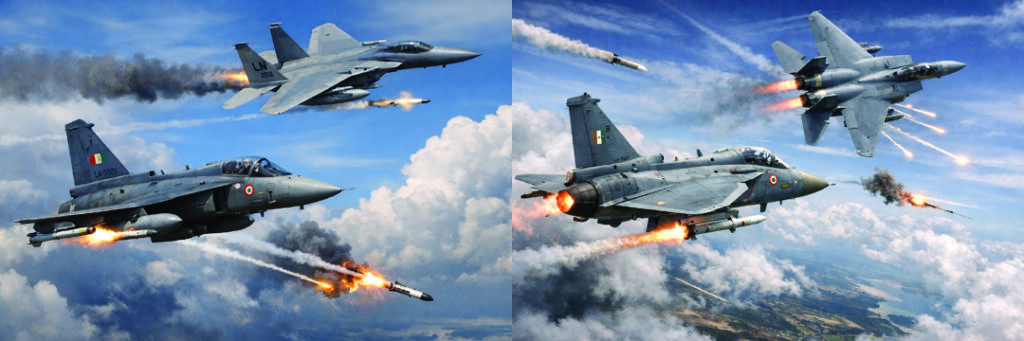
Indians make smaller, lighter and cheaper. That’s what the Indian nation is good at. We are good at getting employees with lesser salary, who will barely function but an Indian company’s majority shareholder will feel blessed if he (usually a he and not a she) can accumulate such low performance staff and the feeling that he is feeding so many families.
We are good at jugaad, which literally means making do with whatever you have. A hack, workaround, makeshift solution, or frugal innovation, that’s what we are good at; fix something using limited resources. It is a mindset of surviving despite owning little resources. Survival, that’s the moot point.
Innovation comes from plenty. A fighter pilot is not told to conserve fuel and practice less number of sorties. They are told to fly as many sorties as they can and get the dogfight into muscle memory. Therefore, if the tale of building our own aircraft begins with lesser, smaller, cuter, easier, cheaper then we have lost the race before we began.
With the current Indian aircraft engineering ecosystem, we can never dream of an F-15, which flies like a rocket without a wing. This happened in Negev, in 1983, when an Israeli F-15D survived a mid-air collision that tore off nearly its entire right wing, flying roughly 10 miles and landing safely at twice the normal speed. It succeeded due to the F-15’s massive “lifting body” design, raw engine thrust, and durable control surfaces.
However, the Tejas is proud of its economical design, which may be great but it refuses to take off as a fighter squadron without an Indian made engine. We can build the cheapest (again the cheapest) spacecraft and lauch 104 satellites at one go but cannot make an engine with superior knowledge of material science and mechanical engineering. Why is that?
The chief hurdle to export the Tejas and prove its fighting capability are primarily its engine and the ejection seat. Argentina wouldn’t buy the Tejas with a British ejection seat and Malaysia and other South Asian countries would not buy the Tejas owing to its American engine. The Tejas currently uses General Electric F404-GE-IN20 (USA) for Mk1/Mk1A; F414-INS6 planned for Mk2.
India has faced this problem for years. Why doesn’t the Ministry of Defence set up a new research institute for aircraft engines and invite the best engineers across the world to come and teach new students from civilian and military life?
Hindustan Aeronautics like any other public sector organisation is run more by clerks and less by Skunk Works minded engineers. Can we have another Skunk Works in India? Skunk Works was begun in 1943 by Lockheed chief engineer Clarence “Kelly” Johnson to rapidly develop the P-80 Shooting Star jet fighter under strict secrecy. The startup within the parent company had been created to bypass bureaucracy, it became famous for small, agile teams producing revolutionary aircraft like the U-2 and SR-71. Can we do that with HAL? Not likely.
Creating an indigenous engine for the Tejas fighter is hindered by extreme technological complexity, a lack of specialized materials (superalloys/single-crystal blades), limited high-end testing facilities, and a weak aerospace industrial ecosystem. Historical issues with the Kaveri project, foreign tech restrictions, and precision manufacturing gaps also remain key hurdles.
The Indian genius for the small, the light, and the cheap
Indians are exceptionally good at making things smaller, lighter, and cheaper. This instinct runs deep through the country’s economic, social, and industrial DNA. From consumer goods to infrastructure projects, from startups to public sector undertakings, the instinct is always the same: cut cost, reduce size, simplify ambition, and make do. This approach has undeniable strengths. It allows a resource-constrained nation to survive, to function, and often to leapfrog certain stages of development. But it also carries a hidden price—one that becomes painfully visible when the subject shifts from survival industries to strategic ones like aerospace, defence, and high-end manufacturing.
In corporate India, this mindset often manifests as pride in low wage bills and bloated headcounts. An Indian company’s majority shareholder frequently feels morally satisfied, even blessed, by employing large numbers of people at modest pay, regardless of productivity. The narrative becomes one of feeding families rather than building excellence. Efficiency, depth of skill, and technological mastery are quietly sidelined in favour of numbers and optics. This approach may work for labour-intensive industries, but it is catastrophic when applied to fields that demand ruthless competence and uncompromising performance.
A fighter aircraft is not a sewing machine or a scooter. It is a flying embodiment of national power, scientific depth, and industrial maturity. It cannot be designed with the same mindset that celebrates frugality above all else. Yet, that is precisely the trap India fell into with the Light Combat Aircraft Tejas.
Jugaad: Survival mindset versus innovation mindset
The word jugaad is often celebrated as uniquely Indian. It refers to making do with what one has—improvising, hacking, finding workarounds, stretching limited resources to solve immediate problems. In daily life and small-scale engineering, jugaad is admirable. It reflects resilience and adaptability. But when elevated to a national philosophy of innovation, it becomes deeply problematic.
True innovation does not emerge from scarcity alone; it emerges from abundance—of time, of resources, of failure tolerance, and of institutional patience. A fighter pilot is never told to conserve fuel by flying fewer sorties to save money. On the contrary, pilots are told to fly as much as possible until the aircraft becomes an extension of their body and dogfighting instincts settle into muscle memory. Mastery comes from excess practice, not rationed exposure.
Similarly, aerospace engineering excellence does not come from counting every rupee spent on metallurgy, testing, or failed prototypes. It comes from an environment where engineers are allowed—encouraged, even—to overdesign, overtest, and overshoot. When a national aircraft programme begins with adjectives like “lighter,” “smaller,” “cuter,” and “cheaper,” the race is lost before it starts. Those words signal an intention to compromise, not to dominate.
Why the F-15 could do the impossible
To understand the scale of ambition missing in Indian fighter development, one must look at an almost mythical episode from aviation history. In 1983, over the Negev Desert, an Israeli F-15D suffered a mid-air collision that sheared off nearly its entire right wing. By all known laws of aerodynamics, the aircraft should have disintegrated instantly. Instead, the pilot continued flying for nearly ten miles and landed safely at twice the normal landing speed.
This was not luck. It was design philosophy. The F-15 was built with enormous engine thrust, a massive lifting body, and redundant, brutally strong control surfaces. It had power to spare—far more than was strictly “efficient.” The aircraft could fly like a rocket without wings because it was designed with excess capability, not minimal sufficiency.
India can never dream of such an aircraft if its guiding principle remains economy over excellence. The Tejas, by contrast, wears its efficiency as a badge of honour. It is aerodynamically clever, digitally modern, and cost-conscious. But a fighter aircraft is not meant to be proud of how little it consumes. It is meant to inspire confidence in how much punishment it can absorb and still fight.
The engine: The missing heart of the Tejas
The most brutal irony of the Tejas programme is this: India can build one of the cheapest and most reliable space launch vehicles in the world, capable of placing over a hundred satellites into orbit in a single mission, yet it cannot build a fighter jet engine worthy of its ambitions. This contradiction exposes the limits of India’s industrial depth.
A fighter jet without a reliable indigenous engine is not a sovereign weapons system. It is an assembly project. The Tejas, for all its indigenous airframe and avionics, refuses to truly take off as a fighter squadron because its heart is foreign. The Mk1 and Mk1A variants rely on the American General Electric F404-GE-IN20 engine. The future Mk2 is planned around the more powerful F414-INS6, also American.
This dependence is not merely technical; it is strategic vulnerability made manifest.
Export dreams crushed by foreign components
The engine problem directly sabotages India’s ambitions to export the Tejas and prove its combat credibility. Defence exports are not like selling software or pharmaceuticals. They are deeply political transactions shaped by sanctions regimes, alliances, and veto power.
Argentina expressed interest in the Tejas but balked because of the British-origin ejection seat, given its unresolved hostility with the UK over the Falklands. Malaysia and several Southeast Asian nations hesitated because the aircraft is powered by an American engine, which exposes them to potential U.S. export controls and geopolitical pressure.
Thus, India finds itself in a paradoxical position. It offers a “Made in India” fighter jet that cannot be freely sold without the approval—explicit or implicit—of foreign governments. In war or diplomacy, dependence equals leverage, and leverage equals weakness.
Why not a national engine institute?
The obvious question, then, is why India has not responded with institutional boldness. Why has the Ministry of Defence not created a dedicated, autonomous national institute for aircraft engine development—one that invites the best engineers from across the world, regardless of nationality, to teach and mentor a new generation of Indian civilian and military engineers?
Countries that master jet engines treat them as crown jewels. They protect the technology, but they also concentrate talent obsessively. India, by contrast, has scattered responsibility across bureaucratic silos—DRDO labs, HAL divisions, academic institutes—without creating a single temple of excellence dedicated solely to propulsion.
Jet engines are not incremental projects. They require generational commitment, not five-year plans.
HAL and the curse of bureaucratic engineering
Hindustan Aeronautics Limited embodies the broader problem of India’s defence public sector. It is run more by clerks than by engineers, more by process than by passion. Decision-making is slow, risk-averse, and hierarchical. Innovation suffocates under files, committees, and audit fears.
Contrast this with Lockheed Martin’s Skunk Works. Founded in 1943 by Clarence “Kelly” Johnson, Skunk Works was deliberately designed to bypass bureaucracy. Small teams, strict secrecy, and absolute accountability defined its culture. The result was a string of revolutionary aircraft—the P-80, the U-2, the SR-71—that changed warfare.
India has no true equivalent. And expecting HAL, in its current structure, to become one is unrealistic. Skunk Works requires cultural revolution, not procedural reform.
The Kaveri trauma and its long shadow
The failure of the Kaveri engine programme still haunts Indian aerospace. Launched with optimism, it collapsed under the weight of technological complexity and institutional weakness. Instead of being treated as a learning process, it became a cautionary tale used to justify continued dependence on foreign engines.
The result is a national psyche that fears failure more than it desires mastery. Yet, every successful jet engine programme in history—from the American to the French to the Russian—was built on decades of spectacular failures.
The brutal complexity of fighter jet engines
Developing a modern fighter jet engine is among the most difficult engineering challenges known to humanity. The materials must withstand temperatures exceeding 1,800 degrees Celsius—hotter than molten lava—while spinning at tens of thousands of revolutions per minute. This requires superalloys, ceramic coatings, and single-crystal turbine blades that few nations can reliably produce.
Design precision is unforgiving. Microscopic flaws can destroy entire engines. Mastery of thermodynamics, fluid mechanics, and computational fluid dynamics is essential, but theoretical knowledge alone is insufficient. It must be matched with hands-on manufacturing excellence.
Infrastructure India still lacks
India’s testing infrastructure remains inadequate. High-altitude test beds, advanced wind tunnels, and endurance testing facilities are limited. Indian engineers often rely on foreign facilities, creating dependency even during development.
Equally problematic is the absence of a mature aerospace manufacturing ecosystem. Jet engines are not built by one company alone. They require hundreds of specialised suppliers capable of producing components to near-atomic tolerances. India’s vendor base, though improving, remains thin at the high end.
The cost of choosing cheapness over power
The story of the Tejas is not a story of incompetence. It is a story of misplaced priorities. India chose to celebrate economy where it should have celebrated excess. It chose survival thinking where it needed domination thinking.
For want of an engine, not just aircraft, but entire squadrons were lost—lost to delay, dependence, and diminished ambition. Until India accepts that true aerospace power demands extravagance of effort, tolerance of failure, and obsession with excellence, the Tejas will remain what it is today: a capable aircraft trapped inside an incomplete nation-state ambition.
The engine is not just a component. It is a philosophy. And until that philosophy changes, India will keep building wings that never fully learn to fly.