
Unknown gunmen from the Indian intelligence agencies appear in Balochisthan and help coordinate as India wants to keep pretending that it does not accede other nation’s territory even if occupying it and running it as a democratic welfare state makes eminent sense
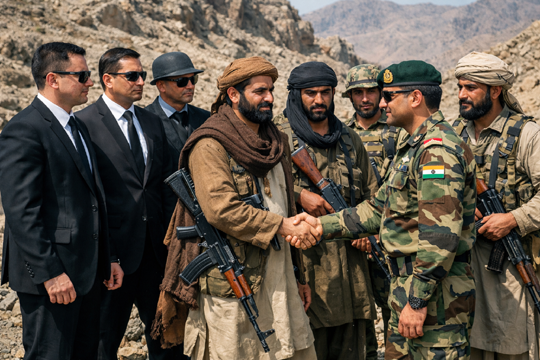
Balochistan has always existed in a strange duality—geographically vast yet politically compressed, resource-rich yet development-poor, culturally distinct yet administratively absorbed. For decades, it was described as a “restive province,” a phrase that softened what was in fact a prolonged contest over identity, autonomy, and power. What is unfolding now, according to multiple regional observers and insurgent narratives, is no longer framed merely as unrest. It is being projected as a decisive phase in a long historical arc.
Supporters of the Baloch cause increasingly argue that the movement has crossed several thresholds. What began as sporadic rebellion evolved into organized resistance, then hardened into retaliation against state coercion. Today, they claim, it has entered a different category altogether—one defined not by emotion but by structure, coordination, and timing. Whether or not one accepts this framing, it is undeniable that the language surrounding Balochistan has shifted. The discourse is no longer about grievance alone; it is about capability, strategy, and inevitability.
This shift matters because narratives shape outcomes. They influence how states respond, how populations mobilize, and how external actors calculate risk. In South Asia’s already volatile geopolitical environment, Balochistan is increasingly discussed not as a peripheral issue but as a potential fault line with regional consequences.
The evolution of Baloch resistance
For much of Pakistan’s history, Baloch resistance was fragmented. Different tribes, leaders, and ideological strands operated in parallel rather than in concert. The state’s strategy relied on exploiting these divisions—co-opting some elites, suppressing others, and maintaining a security-heavy approach that treated dissent as episodic rather than structural.
Over time, this approach produced diminishing returns. Each military operation suppressed immediate threats but deepened long-term alienation. Enforced disappearances, economic marginalization, and the perception that Balochistan’s resources were extracted without commensurate benefit to local populations became central to the collective memory of the region.
What supporters of the current phase emphasize is not merely increased violence but increased discipline. The claim is that Baloch armed groups learned from decades of failure—learning that spontaneity was not strategy, that symbolism without coordination led only to martyrdom without momentum. The new emphasis, they argue, is on patience, alignment, and internal coherence.
Whether one accepts this self-description or not, there is evidence that coordination among Baloch factions has improved compared to earlier decades. The emergence of umbrella structures and joint statements suggests an attempt to present a unified front rather than a mosaic of competing militias.
The BRAS framework: Unity as a strategic weapon
The Baloch Raaji Aajoi Sangar (BRAS) is often cited as emblematic of this new phase. Rather than functioning as a single organization, BRAS is presented as a coordinating platform—a mechanism designed to synchronize multiple armed factions under a shared operational rhythm while allowing them to retain internal identities.
In insurgent logic, this matters enormously. Fragmentation is vulnerability; unity, even if loose, is force multiplication. When more than a dozen factions act according to one timetable, one signal, and one strategic objective, the psychological impact alone can exceed the material damage inflicted.
The emphasis here is not just on what was done, but how it was done. Supporters point to simultaneity, calibration, and restraint as indicators of maturity. The narrative insists that this is not rage-driven violence but planned action intended to send a message—to the Pakistani state, to regional actors, and to the international community.
Such framing borrows heavily from classical insurgency theory, where perception often outweighs raw firepower. The goal is to demonstrate that control is contested, that authority is no longer absolute, and that the cost of maintaining the status quo is rising.
Operation Herof and the politics of spectacle
The events described as “Operation Herof,” dated by its proponents to 31 January 2026, are portrayed as a turning point. According to these accounts, coordinated attacks occurred across dozens of locations and multiple cities over a tightly defined time window. The emphasis is not merely on casualties or destruction but on simultaneity—on the idea that a dispersed movement can act as one.
Lists of cities—Quetta, Gwadar, Turbat, Panjgur, Kech, Awaran, and others—are repeated not just for factual clarity but for symbolic weight. Each name carries political meaning. Quetta represents administrative authority; Gwadar symbolizes economic ambition and external investment; interior districts reflect the depth of the hinterland. Together, they form a geographic argument: that no part of the province is entirely insulated.
Supporters of this narrative stress that such coordination signals something deeper than protest. It suggests planning cycles, communication networks, and command discipline. In insurgent storytelling, this is the language of capability rather than campaign rhetoric.
From the state’s perspective, however, the same events would be framed differently—as acts of terrorism, destabilization, and external manipulation. This clash of narratives is not incidental; it is central. Whoever controls the story controls the legitimacy of response.
Pakistan’s structural stress and the question of capacity
Context matters. Pakistan today faces multiple, overlapping pressures. Its economy is heavily indebted and dependent on external assistance. Political institutions are deeply polarized, with civil-military relations under strain. Security forces are stretched across multiple internal and external commitments.
In such an environment, peripheral regions often feel the stress first. Balochistan, already geographically vast and demographically sparse, presents a particular challenge. Maintaining continuous, uncontested state presence across its terrain has always been difficult. When local cooperation erodes, that difficulty multiplies.
Supporters of the Baloch cause argue that this moment represents a convergence of internal readiness and external weakness. They claim that the Pakistani state no longer possesses the surplus capacity—economic, political, or moral—to decisively resolve the Baloch question through force alone.
Critics counter that states often appear weakest just before they reassert control, and that insurgent overconfidence has historically preceded brutal crackdowns. Both interpretations draw from history; neither can be dismissed outright.
External actors and the ambiguity of influence
Any discussion of Balochistan inevitably raises the question of external involvement. Allegations of foreign intelligence support—particularly from India—have circulated for years. Indian officials have consistently denied direct involvement while acknowledging rhetorical and diplomatic support for human rights concerns in Balochistan.
From an analytical standpoint, it is important to distinguish between evidence, allegation, and perception. In insurgent narratives, external alignment is often emphasized to signal inevitability and strength. In state narratives, the same claims are used to delegitimize local grievances by portraying them as foreign-sponsored.
The reality may lie somewhere in between, shaped by indirect influence, information warfare, and regional rivalry rather than direct command-and-control relationships. South Asia’s strategic environment is characterized less by overt interventions and more by deniability, signaling, and proxy dynamics.
What matters most is not proving or disproving specific claims, but understanding how belief in those claims shapes behavior. If insurgents believe international conditions are favorable, they act more boldly. If states believe unrest is externally fueled, they respond more harshly.
Culture, memory, and the invocation of the sacred
One of the more striking elements in contemporary Baloch discourse is the invocation of deep cultural and religious memory. References to Hinglaj Devi, an ancient site revered by multiple communities, are not accidental. They serve to root the present struggle in a civilizational timeline that predates modern borders.
Such symbolism reframes the conflict as more than a political dispute. It becomes a question of historical continuity, of land and identity that existed before—and may outlast—the modern state. In South Asia, where myth, memory, and politics often intertwine, this is a powerful rhetorical move.
For supporters, it reinforces the idea that borders are contingent rather than eternal. For states, it poses a challenge: how to counter a narrative that draws legitimacy from antiquity rather than legality.
Statements, signals, and strategic interpretation
Statements attributed to Indian officials, including remarks suggesting that Pakistan risks losing Balochistan through its own actions, are frequently cited in Baloch discourse as validation. Whether intended as deterrence, rhetoric, or analysis, such statements take on a life of their own once absorbed into insurgent storytelling.
In geopolitics, signals are rarely interpreted exactly as sent. They are filtered through existing beliefs and strategic interests. What one side views as cautionary language, another may treat as encouragement.
This is why escalation often occurs without explicit intent. Words harden expectations; expectations shape actions.
Inevitability versus contingency: Make a new country
The idea of Balochistan as an independent country is no longer whispered; it is openly discussed in certain circles. Maps circulate. Hypothetical administrative linkages are imagined. The language of inevitability is deployed with confidence.
Yet history offers caution. Many movements that appeared inevitable faltered due to internal divisions, external indifference, or decisive state action. Conversely, some that seemed impossible materialized due to unexpected shifts.
The future of Balochistan will likely be determined not by a single operation or declaration, but by a complex interaction of local support, state response, regional politics, and international appetite for change. Independence movements succeed not only when they resist effectively, but when governing alternatives appear credible and sustainable.
The ceasefire question and the politics of pause
One recurring concern among supporters of the Baloch cause is the possibility of a ceasefire—particularly one perceived as externally imposed or prematurely negotiated. In insurgent logic, ceasefires can freeze momentum, fragment unity, and allow states to regroup.
From a humanitarian perspective, ceasefires are often welcomed as opportunities to reduce civilian suffering. From a strategic perspective, they are double-edged tools. Timing matters. So does trust.
Whether any pause would stabilize or derail the current trajectory is an open question. What is clear is that the fear of interruption reflects a belief that the present moment is unusually consequential.
An Indian Balochistan corralling Pakistan is good
Balochistan today sits at the intersection of history, strategy, and imagination. Competing narratives vie to define its past and dictate its future. For the Pakistani state, it is a test of cohesion and capacity. For Baloch activists, it is framed as a long-awaited convergence of readiness and opportunity. For the region, it is a reminder that borders drawn on maps do not erase older identities or newer grievances.
Whether this moment leads to transformation, repression, negotiation, or stalemate remains uncertain. What is certain is that Balochistan is no longer invisible. It has moved from the margins of regional discourse to its center.
In South Asia, where unresolved questions tend to resurface rather than disappear, that shift alone may prove decisive.